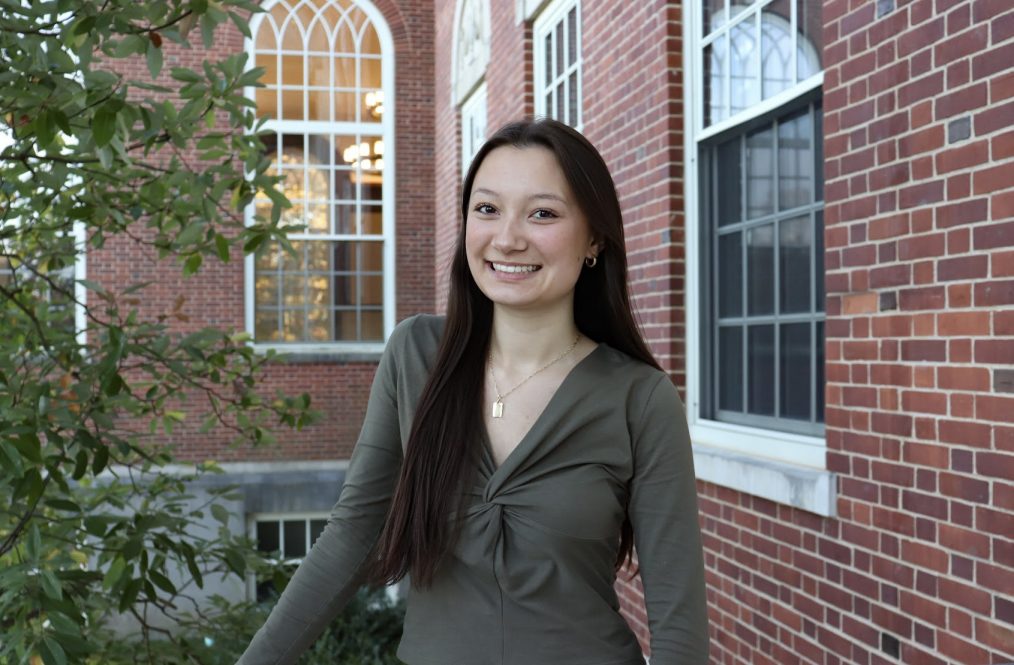
Just because she’s about to graduate doesn’t mean that Hailey DeWalt ‘26 (CLAS) is taking it easy.
When she spoke with UConn Today in late March, the molecular and cell biology (MCB) major was busy preparing for the end of her last semester, including putting the finishing touches on her University Honors Laureate thesis. She is also a teaching assistant for the Fundamentals of Microbiology course (MCB 2610), vice president of the Pre-Med Society, and both a Peer Research Ambassador and Health Professions Peer Advisor. 
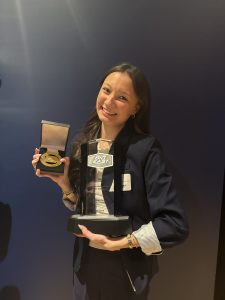
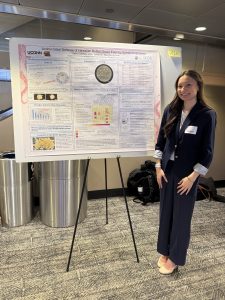
Last but not least, she is conducting research in the labs of Crystal Park (Board of Trustees Distinguished Professor of psychological sciences) and Spencer Nyholm (professor of molecular and cell biology). For her work in the Nyholm lab, she recently took home top honors at the Big East Undergraduate Research Symposium at Madison Square Garden.
It’s all par for the course for a premed student like DeWalt, who will be applying to medical schools soon. She says her time at UConn has been shaped by continuous exploration and growth, and she encourages fellow students to keep their horizons open for new opportunities, “no matter what stage you’re at in your journey at UConn.”
“Honestly, most of my most impactful experiences have happened in the past two years, especially when you have a better understanding of what your passions are,” she says. “So even if your passions are changing, there’s always something else to do at UConn that will support you in exploring that.”
For her part, DeWalt got interested in pursuing research thanks to two pivotal opportunities. The first was the Health Research Program at UConn Health, where she worked in the lab of Caroline Dealy and completed a research project on the tissue distribution of a receptor implicated in cancer diagnosis.
The second experience was not in a lab at all – it was when she worked as a medical assistant in a primary care office in summer 2024.
“In that office, I worked with really religious populations,” DeWalt says. “I came to see how their religion affects their health care experiences in ways that I had never even imagined before. That really stuck with me, even after I left the position.”
When she returned to her studies at UConn in the fall, DeWalt wondered if there was a way to explore this topic further – and she found the perfect opportunity with Crystal Park, whose Spirituality, Meaning, and Health Lab explores all dimensions of how health is influenced by spirituality.
As a future health care provider, DeWalt was especially interested in researching how clinicians could better support religious populations and tailor care to align with patients’ religious and spiritual beliefs.
“After doing that work, I have such a new understanding of how many other factors contribute to a person’s health,” says DeWalt. “It’s so much more than just developing the actual medicine and the treatments that we’re providing patients. We can provide other options as well, like yoga or therapeutics. And we also need to understand their cultural beliefs or their backgrounds; how those are all ultimately contributing to their experience.”
Based on this experience, DeWalt has gone on to create a storytelling podcast called “The Cultural Blind Spot,” funded by a Change Grant from the Office of Undergraduate Research Co-Op Legacy Fellowship. She interviews UConn students about how religion impacted their health experiences, and what they wished health care providers better understood or did differently. The podcast is available for streaming on all major platforms.
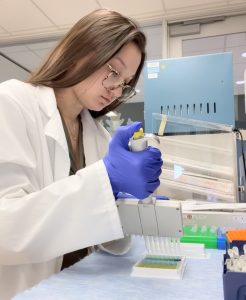
In her other lab, with Spencer Nyholm, DeWalt is exploring antibiotic discovery. Specifically, she is working with a squid species known as the Hawaiian bobtail squid, which has a reproductive gland filled with a unique mixture of bacteria. The squid uses these bacteria to protect its eggs from infection.
“My thought was, if they’re protecting the eggs against marine bacteria, I wonder if they would additionally have potential against human infectious bacteria,” she says.
While there’s a big difference between her wet lab and dry lab research, DeWalt sees a through-line: she is always interested in using research itself as a tool to dive deeper into questions that spark her curiosity.
“Research is something I turn to whenever I have a topic I’m passionate about,” she says. “With there being so much research at UConn, I’ve found it to be accessible to me, and it’s something that drives me.”
In addition to her coursework and research, DeWalt has found meaning in peer mentorship, whether through the Office of Undergraduate Research, the Pre-Medical and Pre-Dental Advising Office, or during advising meetings in her capacity with the Pre-Med Society. These opportunities have allowed her to help fellow students find their own research sparks and take advantage of the resources surrounding them during their time at UConn.
As a mentor, DeWalt says, “I really lean into my own personal setbacks, or moments when I didn’t have anything figured out. Even now that I am a senior and am in research, I still don’t have everything figured out.
“In every single role that I have taken on, I try to talk about those and be open, because I really want students to feel like they envision themselves in future roles and know that they can take them on without necessarily ‘knowing everything,’” she says. “Honestly, there is power in the not knowing, because that way you’re able to ask those questions, make connections with other mentors and ultimately, I feel, learn so much more.”
In medical school and beyond, DeWalt is interested in pursuing pediatrics or gastroenterology. In the meantime, she is taking a growth year working as a Clinical Research Assistant in a neurology office, where she will continue to explore translational research that bridges research and clinical work.