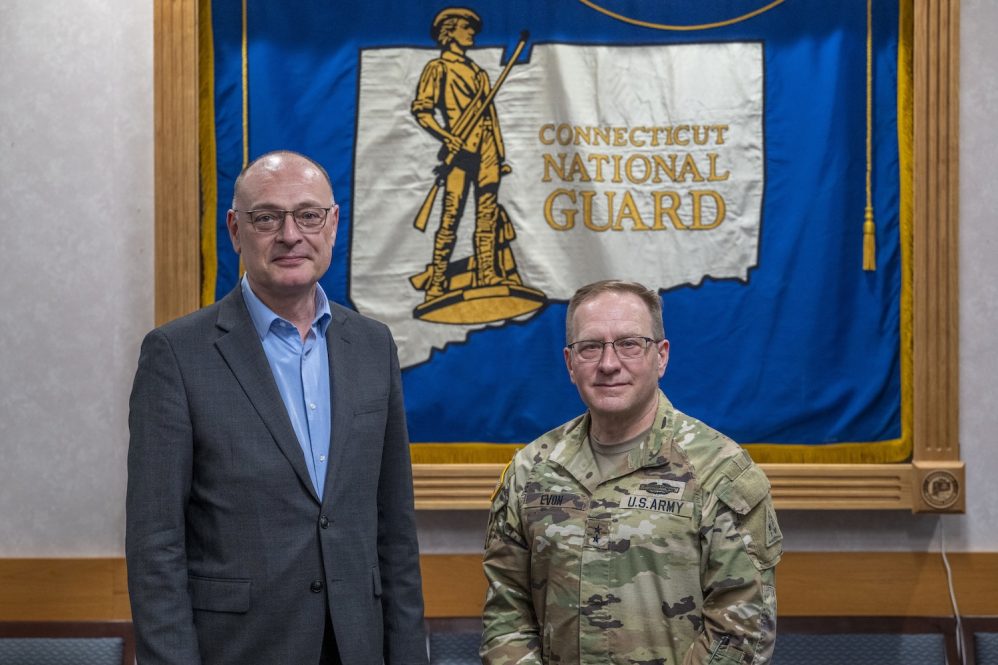
Though he might work out of his offices in Hartford, Maj. Gen. Francis J. Evon Jr. ’89 (BUS) likes to get out of the city.
“I like to shake hands,” he says. “I think I get my best intel on the organization, the pulse of the organization, from getting out and shaking hands with soldiers and airmen and their families.”
The organization he oversees is the Connecticut National Guard – he’s served as the adjutant general, responsible for the state’s Army and Air Guard operations, since 2018. But his leadership foundations, he says, started long before, the oldest son in a military family who sought education at UConn after enlisting as an anti-tank crewman in the Guard after high school.
As Evon rose through the leadership ranks during his 40 years of service, his early foundations in selfless service as both a cadet and student proved vital to his success.
UConn, largely through its Office of Veterans and Military Programs, has built a culture of support for both active and retired servicemen and women seeking to pursue academic opportunities at the University. Currently, seven UConn students are also active Connecticut National Guard members on deployment overseas, according to the office.
That’s one of the unique aspects of service in the Guard, says Evon.
“That experience they bring from their civilian career, they apply to the military, and vice versa,” he notes.
In a recent conversation with Interim Provost and Executive Vice President for Academic Affairs Pamir Alpay at the State Armory, Evon said his own time at UConn, particularly in the University’s ROTC program, helped to kindle the sense of purpose and build the leadership skills he’s carried with him through his own career.
Alpay: What attracted me most about your background is that you’ve been through the ROTC program and studied finance. I want to get your thoughts on, first of all, what stood out from that education that you received at UConn. And how did that help you through your career, which is really amazing, now leading our National Guard in the state of Connecticut.
Evon: It goes way back. I was the oldest of four, looking for a way to get to college. And thanks to the legislature back in the early ’80s, we had the tuition waiver. If you joined the National Guard, you got the tuition waiver, so that got me into UConn.
I didn’t want to burden my parents. Mom and Dad had three others to figure out what their destiny was going to be. I’m from Connecticut, born and raised in the valley. I had seven friends, I was number eight – they dragged me over to the recruiting station that was literally on the other side of the high school. I was eight of eight, and I think I’m the last one still in service, in boots. But it’s been a great ride.
The education experience, back in the mid-80s, was maybe a little different than now. I lived up in Towers, and campus was different, but it was a great experience. Freshman year was probably my first time away from home, and I think that experience set me up for the military success and basic training later on. Back then, when some of the soldiers went to basic training, that was probably the first time that they had been away from home. Between freshman and sophomore year, I went to basic training and advanced individual training [AIT], so I had at least a year of independence.
The curriculum back then was pretty much wide open, large classrooms, and I think that also helped refine a couple of things, because you quickly had to figure out how to stay engaged.
After the summer between freshman and sophomore year, I went away to military training, and then I came back, had a fresh-skin haircut, and saw an individual in the old uniforms – the BDUs [battle dress uniforms], we used to call them – and this individual had a tail, like one of those hair tails. Walking by, I’m trying to figure out which army are you in? Because I just came from Fort Benning, and that kind of hairstyle wasn’t allowed, was not acceptable.
But that cadet got me to the hangar, and I’d never thought I’d really be an officer. But I got to the hangar, talked to the PMS [professors of military science] at the time, and said, ‘Hey, why don’t you give this a shot?’ And that’s what started the ROTC, the leadership piece.
The idea of ‘selfless service’ got back to my dad in Vietnam. Through him, there was a little bit of military history in my family, military exposure. But I think the majority of it comes from the experience at UConn, and I credit that to ROTC. ROTC kept me on a path that I could have easily gone off of. I don’t want to say that I looked forward to those early morning PT [physical training] sessions, but I think it held me accountable. I needed the structure at that point. Structure and discipline are definitely part of the equation for me.
Alpay: Have you been to campus recently?
Evon: Probably eight months ago now, I think.
Alpay: So, you’ve seen a lot of the new buildings, new capabilities…
Evon: Absolutely. It’s amazing. It was much smaller back in the ’80s, but yeah, it’s a robust campus. And Stamford – I was at the ribbon cutting down in Stamford when they initiated the housing down there, and it’s great.
Alpay: For those who might not know, how would you describe your responsibilities as adjutant general?
Evon: I’m humbled and honored and have the privilege of leading 5,000 men and women in the Connecticut Army National Guard and the Air Guard. We also have the Governor’s Guard – two Horse Guards, and two Foot Guards.
But it’s an immense responsibility. We have a great team of dedicated individuals who raise their right hand to be part of something larger than themselves.
We currently have 650 members deployed overseas in just about any capacity, and we take that very seriously. We take their families and how we engage with them very seriously. We take the interaction with their employers very seriously as well, because we have the service member, the family, and their employer – none of this synchronizes within the enterprise unless all three are working together. If the family is not comfortable with what’s going on at home, then the soldier or airman deployed can’t focus on the mission at hand.
So, it’s great – I wouldn’t trade it for anything, honestly. We have a great team. They’re super innovative. Every single time they’re given a task and a purpose, what they come up with is just amazing. We started the Innovation Challenge a couple of years back – it’s a competition and a great way for them to offer input, and some things are just amazing, refinements on how to make the organization better, highlighting and helping to cut down some of the red tape that we may have in the organization, and just some simple ideas on how we recruit, how we interact with potential candidates, and showing them what this opportunity is to join the Connecticut National Guard.
Our guardsmen live in Connecticut, they serve here, they represent their community. We think we’re all better citizens because we interact like that, and we think that’s really what sets us apart from our active-duty components, because we have a state mission and a federal mission.
Alpay: Going back to your ROTC time, what is it like being not just a student but also a cadet at the same time?
Evon: I think a big part of it is that selfless service, that being part of something larger than yourself. In addition to your normal curriculum, you’re part of the ROTC program, a decades-old program that is producing leaders for the Army, the Army Reserve, and the Connecticut National Guard.
For me, it really kindled my leadership spirit, my sense of responsibility. I think if you were to talk to any of UConn’s coaches, for example, they’d say that a sense of belonging, a sense of purpose, would be key. And for me, I think Army ROTC gave me that right from Day 1.
Alpay: What would you advise UConn students, or potential students, who are considering a career in military service?
Evon: I think it’s a great opportunity. I don’t think we, as a nation, should consider mandated service. But you can truly give back to your country. You can truly lead. You can serve active duty and then come to the Guard. You can serve in the Guard and live in Connecticut and serve here. If someone is thinking about a gap year, the Guard could be a great opportunity. They can come and have a different experience. They can contribute to the workforce. They can travel.
And they can build some camaraderie. The National Guard didn’t telework during COVID. We were there, here, in this room, in many offices around our building, trying to figure out what was next, working with public health, working with emergency management, and the governor’s office.
I think it’s a great experience, an opportunity to grow leadership skills. I’m amazed at the service members that I meet. We have doctors in their civilian careers who want to be infantrymen on the weekend, because they want to get out and be in the woods. We have members that joined, whether they’re in the medical field or in the cyber field, that have gained this experience and are now adding value to the workforce.
And I think that’s a key component that makes us stronger when we mobilize, whether stateside or overseas. There are a lot of people like Alyssa Kelleher [director of UConn’s Office of Veterans and Military Programs], or we have a command sergeant major who’s the superintendent of the West Hartford school system, or we have our infantry command sergeant major who’s a state trooper deployed overseas right now. That experience they bring from their civilian career, they apply to the military, and vice versa.
I think Connecticut, as a whole – UConn is the flagship institution, and the Connecticut Guard is Connecticut’s home team – is growing into a very positive, innovative environment. We’ve got a lot of positive interaction going on with industry and innovation, the defense industrial base, and I think some days we don’t get enough credit.
There’s a lot of great things going on in Connecticut, and it’s super exciting.
Alpay: General Evon, thank you for your time. And thank you for your service to our nation and Connecticut. We are very proud of you and your achievements.
UConn offers a number of resources, leadership opportunities, and support programs for active duty and veteran services members pursuing educational opportunities at the University. For more information, visit the provost’s Office of Veterans and Military Programs at veterans.uconn.edu.