This month marks the 250th anniversary of the signing of the Declaration of Independence, and as Americans reflect on the Revolution, popular representations tend to center on prominent figures like Washington, Adams, Franklin, and Hamilton. Yet revolutions do not happen simply because of the actions of a handful of leaders. UConn Department of History Draper Professor Emeritus Robert Gross set out to learn about the everyday revolutionaries often left out of the narrative, and he focused on the people of the town where he lived, and where the war started: Concord, Massachusetts.
The result was Gross’s groundbreaking, Bancroft Prize winning book “The Minutemen and Their World,” which is also celebrating a milestone, as 2026 marks 50 years since it was first published. His inspiration to write the book was a drive to answer the question of why the war started in Concord, and to explore a curiosity piqued by a display at the Minute Man National Historical Park.
“There is a diorama that shows the layout of Minutemen, militia companies, and redcoats on the broad expanse of what would become the field of battle,” says Gross. “Everybody was frozen in time, fixed under glass, and I looked at that as a wonderful patriotic tableau, but everybody is already assigned to a role that hasn’t yet happened. I thought, ‘Well, why don’t I put them all in motion?’”
The book that resulted from this reanimation quickly became a mainstay in American history writing. Board of Trustees Distinguished Professor Emeritus Richard Brown says that after he read an early copy of the book, he immediately ranked it with the best.
“Now, after 50 years, I am a little bolder: ‘Minutemen and Their World’ is the very best close-up view of the experience of the Revolution—from its earliest glimmers to its aftermath,” says Brown.
For those who wary of diving into history books and encountering dry lists of names, dates, and battles, “Minutemen” is a welcome respite, because the facts are presented in a narrative of social history that reads more like a movie script.
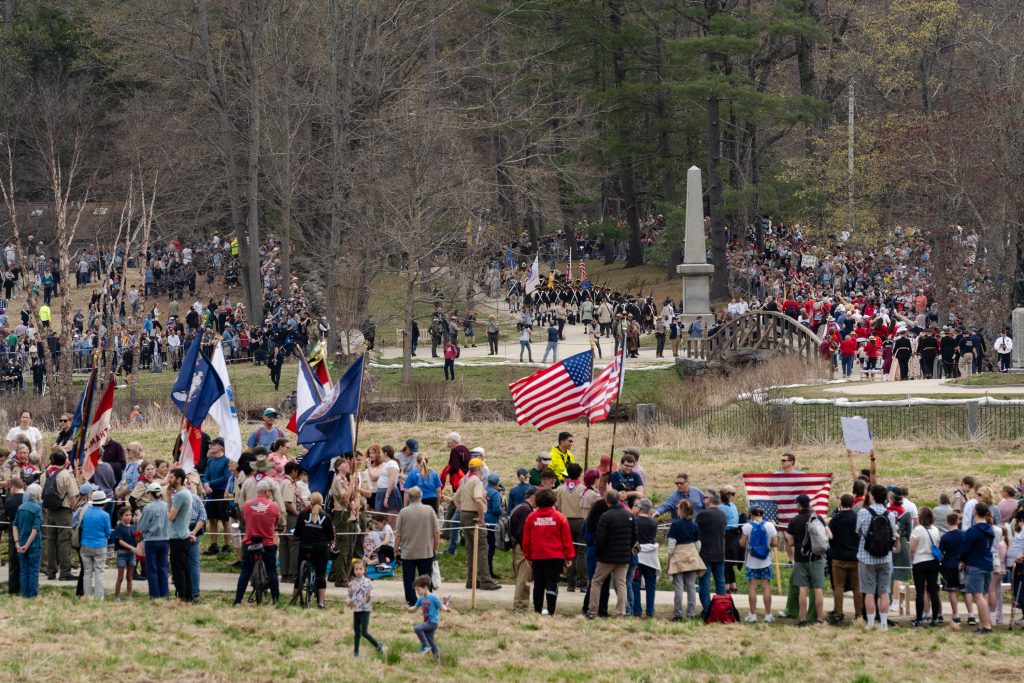
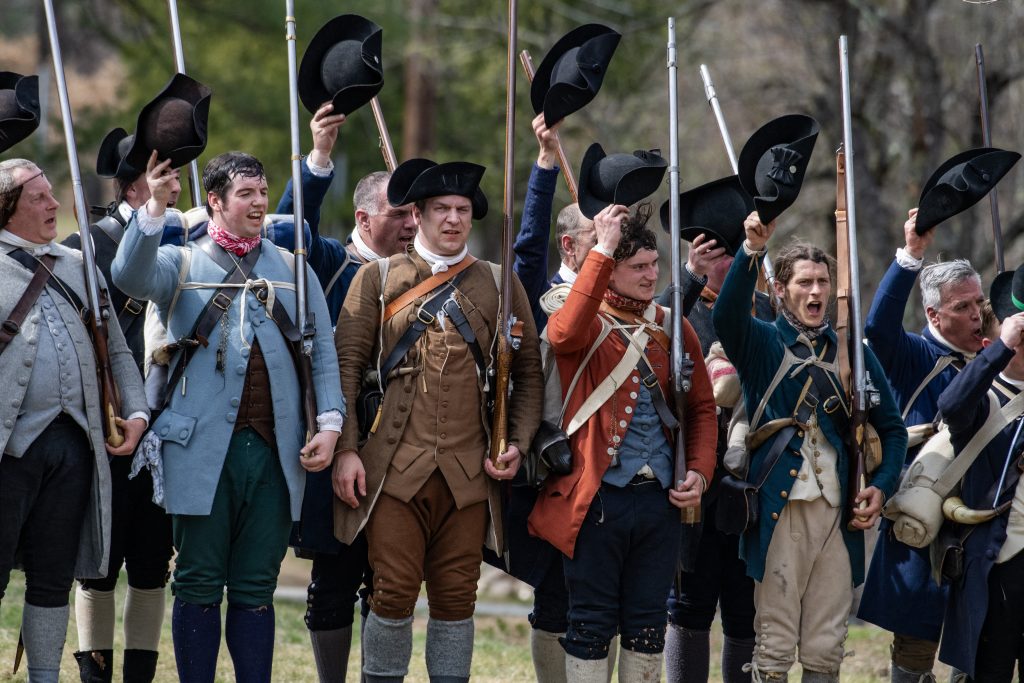
“It’s a funny thing, to write this for the general audience, but now it is kind of a fixture. It was widely used for college courses, and it gathered steam. I continue to receive Google Alerts about people using it. It has reached a wide variety of people, including Revolutionary War re-enactors, while still being read and used by my colleagues in history who are 30 to 40 years younger,” says Gross. “This June, ‘Minutemen’ [was] the featured book of the month in the State of Montana’s series for the 250th.”
With a humanistic approach, Gross says he sought to break through the frozen past and rediscover the stories of the everyday people that underpinned a grander story of the American Revolution.
“I try to write about people in the past from the perspective of the choices they have to make in life, within the constraints of their time. If I can write the narrative in such a way that you’re seeing them that way, you’ll really see them as fellow humans,” says Gross.
Researching the major figures in history is one thing, but finding traces in the past for average citizens requires a different skill set. Gross started combing through often overlooked historical documents like town meeting minutes, deeds, and tax records which he admits can be tedious and boring. In this case, though, it was fortunately exhilarating. After compiling the data, Gross applied computing and statistical analyses to support his hypotheses about the trends he observed.
“At times, I would be reading through document after document, often finding nothing, and other times thinking, how can I make sense of this? I would be looking at passage of land, and find mortgages and think ‘do I have to learn real estate law?’ Going through church records and reading about the covenant, I’d think to myself, what’s a nice Jewish boy like me doing rummaging among these church records? Yet, there were times when, voila, something exciting appeared that I had no idea would be there, and that happened often.”
The records revealed a town that became increasingly divided in the years leading up to the inflection point of “the shot heard ’round the world” at Concord’s Old North Bridge on April 19th, 1775, the day of the first battle of the Revolution. In the book, Gross leads the reader through the events that primed and pushed the colonists to choose where they stood while showing them as people simply trying to live their lives. Gross says that not everything had to do with British imperial policies, but local life was swept up in the mobilization against British authority.
“What was going on with them before British policy and opposition to it began to make its own force felt? It’s not like they’ve all been living thinking, ‘Oh, can’t wait for the American Revolution,’” says Gross.
“Concord and other market centers had leadership who often speculated in Western Massachusetts lands. Those people were getting patronage from the royal government and benefiting many of their neighbors, so ties of material interest could make you conflicted,” says Gross. “I think people thought, ‘Okay, let’s listen to the squire.’ But ultimately, the squires couldn’t contain the building conflict.”
From elementary school lessons to portrayals in popular media, the reasons for rebellion are often boiled down to “no taxation without representation.” However, once the full story of the everyday people is laid out, it becomes clear there was much more to the story. In the case of New England, Gross says he was dubious of the notion that the Revolutionary movement was purely political. Rather, the royal government’s overreach in limiting town meetings and reducing the people’s role in government represented a threat to the colonists’ way of life. A crucial element was the family farm, says Gross: there were too many sons and not enough land for all. Large families over several generations had sharply reduced available acreage, threatening the ability of fathers to support their children as sons and daughters came of age and thereby unsettling intergenerational relations.
“You might say that the people of Concord, Eastern Massachusetts, and Connecticut had problems of what we would now call affordability,” says Gross. “You raise your kids on a farm in Concord, but they can’t afford to live here when they grow up.”
The land pressures damaged family relationships and further unsettled the social order, Gross writes, noting the growing number of landless inhabitants. The ups and downs of Atlantic trade added to the insecurity, driving some merchants into debtors’ prison and creating a class of landless laborers wandering from place to place in search of work.
“Here’s a town that idealizes unanimity and disparages political parties and factions, but in fact, they’re tearing themselves apart,” says Gross. “What does this have to do with the coming of the Revolution? One thing that struck me is they kept emphasizing the need to preserve the inheritance from the founding fathers of New England, the inheritance of liberty that was both political and religious, and defend it and pass it on to their children. I thought, how interesting that they’re stressing the necessity of preserving a heritage that, entirely apart from British policy, was increasingly difficult to pass on to the rising generation.”
Through his research Gross says he came to realize that behind the scenes, those in leadership were doing whatever they could to avoid getting caught up in the swirl of emotion and passion. This, of course, was futile. A tipping point came in late 1774, when most of the town leaders who remained loyal were discredited, forcing some to flee and seek refuge behind British lines in occupied Boston.
“Historians and the general public often like to imagine the American Revolution was this incredibly learned discussion and debate over British law and policies and the like, but much of the discussion involved essentially Patriot crowds and mobs threatening people who didn’t go along. If you were in Boston and you didn’t approve the boycott for the boycott of British goods, you could be declared an enemy to the country.”
While the country geared up to celebrate the bi-centennial in the mid-1970s, Gross says he was determined to expand the narrative and tell the stories of women and Black people as actors in the Revolutionary drama. Gross traced the stories of Concord’s Black residents before, during, and after the war. Five of these enslaved men – Philip Barrett, Brister Cuming, Cato Ingraham, Caesar Minot, and Frank – were barred by law from militia service, so were ineligible for the Minutemen companies. Even so, with the outbreak of war, slavery waned as an institution in Massachusetts, and Black men affirmed their liberty through military service. In a telling instance, Gross notes that the enslaved Black man known as Brister Cuming – held in bondage by Concord’s leading man and reluctant rebel John Cuming – took on a new name in 1779, when he enlisted in the Continental army. He was now Brister Freeman, a proud citizen of the new republic.
A slave named John Jack was able to buy his freedom and pay taxes, but freedmen were not permitted to vote. Upon his death, John Jack’s epitaph was used to illustrate some of these hypocrisies.
“I took account of the different layers of the social order and brought them all together. Though Blacks were a small group in the population, two dozen or so men and women in bondage, they played a notable part in the narrative of events and in dramatizing the struggle for and limits of liberty in this era, in fact, playing a part in the largest narrative events.”