Community-engaged research collaborations can create meaningful partnerships that produce impactful work to advance health and wellbeing locally.
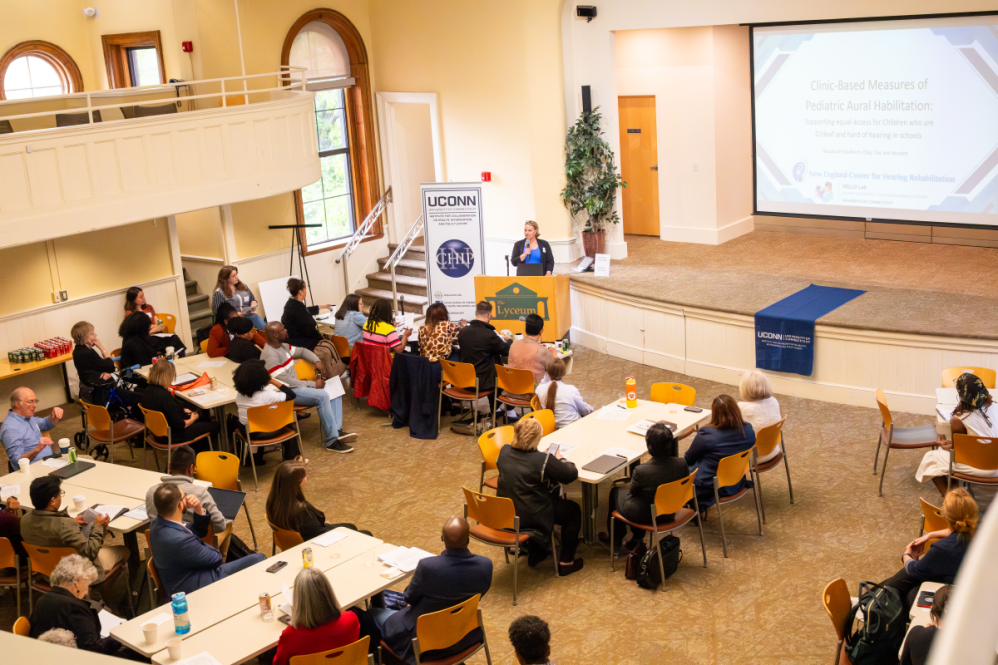
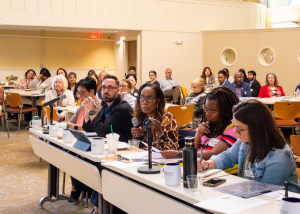
Recognizing the importance of these kinds of partnerships, the UConn Institute for Collaboration on Health, Intervention, and Policy’s (InCHIP) Community Engagement Core and UConn Health Disparities Institute (HDI) held a Community-Engaged Research Forum on May 15 at the Lyceum in Hartford’s Frog Hollow neighborhood.
The event brought together more than 50 academic researchers and representatives from community organizations for an afternoon of networking and rapid research pitches to stimulate new university-community research partnerships with a Connecticut focus. At least one project presented through the innovative rapid pitch format will be awarded $10,000 in seed funding.
“InCHIP’s leadership in convening researchers and community partners reflects a real commitment to building the collaborative infrastructure needed to advance health equity in our state. Community partnerships are one of the most powerful tools we have to translate evidence into action, and this forum showed how much stronger our work becomes when community wisdom guides the research agenda,” says Linda Sprague Martinez, Director of HDI and professor in the Department of Medicine and the Department of Public Health at the UConn School of Medicine.
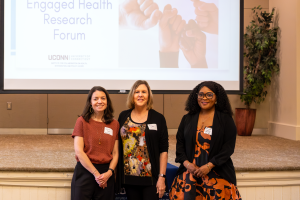
InCHIP’s Community Engagement Research Core, led by steering committee co-chairs Kim Gans, professor in the Department of Human Development and Family Sciences, and Kristen Cooksey Stowers, assistant professor in the Department of Allied Health Sciences, along with Caitlin Caspi, InCHIP Associate Director and professor of allied health sciences, opted for the rapid pitch format to reduce barriers to funding for university-community teams.
The idea was developed over the year by the Community Engagement Research Core’s Steering Committee, who were motivated by the immediate need to support more teams with the potential to impact local communities across the state.
“It was very gratifying to see so many academic-community teams come together to present from so many different UConn departments and community organizations, and all the important health topics they focused on in their proposed projects. We hope that this forum played a role in getting these teams together and that long-lasting partnerships will result,” says Gans.
To streamline the application process, teams were not required to create formal funding proposals, and projects underwent a dynamic review process.
Twelve research teams comprised of at least one UConn faculty researcher and at least one community partner pitched innovative ideas to a panel of five judges. Several projects were pitched by student researchers including Ph.D. students, medical students, and postdoctoral fellows. After hearing the pitches, judges could ask questions and offer feedback directly to applicants.
Judges included Christopher Ciarcia, associate director of the UConn Office of Outreach and Engagement; Linda Barry, professor in the Department of Surgery and Public Health at the UConn School of Medicine; Brittney Cavaliere, Chief Strategy Officer at Connecticut Foodshare; Candida Flores, former Chief Executive Director of Family Life Education, and Chavon Hamilton, founding Executive Director of Hartford Health Initiative.
Projects presented during the event sought to address needs and challenges identified in partnership with organizations like the Hartford Deportation Defense, Advocacy to Legacy, which serves the greater Hartford community, Connecticut Parkinson’s Disease Coalition, Catalyst CT based in Bridgeport, and New Haven Syringe Services Program and Yale’s Community Health Care Van.
Pitches ranged from addressing the needs of those with Parkinson’s Disease, reducing alcohol and tobacco use, understanding how the anti-immigrant environment is impacting young Latine immigrants, enhancing mental health among young Black men, identifying suicide risk among those participating in syringe service programs, and more.
“We were so excited to have this many university-community teams make pitches for the Community Engaged Health Research Forum. Not only did the event bring people together, but we got to hear a dozen great ideas for improving the health of Connecticut residents,” says Caspi.
The projects and research teams below have been awarded funds:
-
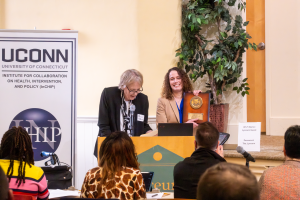
From left to right: Regina Stankaitis from the Connecticut Parkinson’s Disease Coalition, and Cristina Colon-Semenza, Assistant Professor of Kinesiology and Director of the UConn Movement for Life Lab (Danielle Faipler/UConn photo) Identifying the Needs of Individuals Living with Parkinson’s Disease in Connecticut Through the PRECEDE-PROCEED Model
- Research Team:
- Cristina Colon-Semenza, Assistant Professor, Department of Kinesiology
- Regina Stankaitis, Chair, Connecticut Parkinson’s Disease Coalition
- Holly Seymour, Program Director, American Parkinson Disease Association
- Carol Goldberg, Esq., Member, Connecticut Parkinson’s Disease Coalition
- Christine Gummerson, MD, Clinical Fellow, Yale School of Medicine
- Veronica Santini, MD, Associate Professor, Yale School of Medicine, and Director, Comprehensive Parkinson Disease Program, Yale School of Medicine
- Project Description:
- This project will develop and test a stakeholder-driven, evidence-based needs assessment to identify and prioritize the health and service needs of those living with Parkinson’s Disease in Connecticut. In partnership with the Connecticut Parkinson’s Disease Coalition, Colon-Semenza will design an assessment that evaluates social, epidemiological, educational and ecological, and administrative and policy factors. Parkinson’s Disease is a growing public health concern that impacts about 20,000 people in the state. Although there is strong evidence that interventions can improve quality of life, there is no data-driven system to understand unmet needs and guide equitable allocation of resources in Connecticut. The project is a collaboration between the Connecticut Parkinson’s Disease Coalition and the Movement for Life Lab.
- Research Team:
- Elevating the Voices of Youth in Immigrant Families Using YPAR
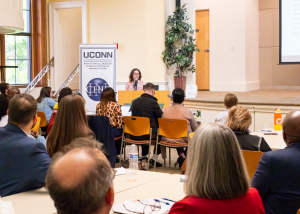
Mayte Restrepo, assistant professor in the Department of Public Health Sciences (Danielle Faipler/UConn Photo) - Research Team:
- Mayte Restrepo, Assistant Professor, Department of Public Health Sciences
- Camilo Ruiz, Assistant Professor, Department of Anthropology
- Leticia Cotto, Hartford Deportation Defense
- Saira Valencia, Hartford Deportation Defense
- Project Description:
- This project builds upon an ongoing collaboration between UConn and Hartford Deportation Defense to understand how Latine youth from immigrant families experience anti-immigrant hostility. Latine immigrant youth are navigating one of the most hostile anti-immigrant climates in recent history. This climate is marked by fear of deportation, family separation, discrimination, and political exclusion, which can create chronic stress and undermine safety, belonging, and community connection. All of which are essential to mental health and well-being for youth. The research team will develop a participatory action research project with 9 Latine youth between 13 and 17 years of age from immigrant families to provide insights into their experiences, cultivate research skills, and establish a community action project to address anti-immigrant hostility. Findings from the project will strengthen future proposals, be shared with the community, and be used to inform policy recommendations to reduce health disparities among Latine adolescents from immigrant families throughout Connecticut.
- Research Team:
-
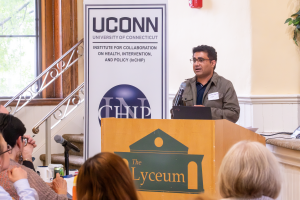
Kamal Gautam, lab manager for the Shrestha Lab and Ph.D. candidate in the Department of Allied Health Sciences SAFE-SSP Suicide Assessment and Facilitated Engagement in Syringe Service Programs
- Research Team:
- Roman Shrestha, Associate Professor, Department of Allied Health Sciences
- Kamal Gautam, Lab Manager, Shrestha Lab; Ph.D. Candidate, Department of Allied Health Sciences
- Frederick L. Altice, Director, Community Health Care Van; Professor, Yale School of Medicine
- Natalie Kil, Research Manager, New Haven Syringe Services Program
- Project Description:
-
-
- This project addresses a commonly overlooked aspect of suicide risk and opioid use. Suicide and opioid overdose are often interconnected, but few screening tools provide insights into how people who use opioids experience and express suicidality. Most existing tools only screen for suicidal thoughts and behavior. The population of interest often has high rates of homelessness, trauma exposure, and co-occurring conditions that may influence distress and its disclosure. This project will develop and test a tailored, community-informed screening tool that offers more nuanced insights into opioid use and suicide risk as well as response pathways to connect individuals to care.
-
-
- Research Team:
Overall, response to the event has been positive, with attendees appreciating the novel rapid-pitch format that enabled research teams to present a community-engaged project that addresses real-world challenges facing communities.
Additionally, participants appreciated the opportunity to compete for seed funding to capitalize groundbreaking pilot studies that lay the foundations for future external grant applications.
The event also took steps to strengthen bonds between researchers and community organizations to produce future research collaborations. Notably, the event represents the Community Engagement Core’s commitment to creating a pipeline of community-engaged researchers.
“We were thrilled to see so many graduate students and postdoctoral fellows attend the event and present on behalf of their labs. It was such a rich training and networking opportunity for our students to engage with community partners and hear the judges’ questions regarding rigorous health equity and community-engaged research design,” says Cooksey Stowers.
Community-engaged research refers to a collaborative approach in which academic researchers partner with community organizations as co-equal partners to produce evidence-based, culturally appropriate solutions to complex challenges.
InCHIP supports a variety of funding mechanisms for this work, including its Community-Engaged Research Health Research Seed Grant and its Rolling Seed Grants for Team Formation, Matched Funding, and Project Completion. These opportunities help fund novel pilot research that will lay the foundation for a future external grant application.
This approach to research can be mutually beneficial for academic researchers and community organizations. For researchers, community-engaged projects enable them to develop meaningful interventions that can be implemented within a community. For community partners, this approach can expand and strengthen the programs and services they provide. Community-engaged research can also enhance the impact of science on society and advance discovery and innovation.