Vikas Kumar is an Assistant Research Professor at the University of Connecticut School of Pharmacy and Pharmaceutical Sciences under the supervision of Raman Bahal, Professor of Pharmaceutics.
Kumar graduated from the Council of Scientific and Industrial Research-Indian Institute of Integrative Medicine (CSIR-IIIM) in Jammu, India, with a Ph.D. in Biological Sciences in 2020.
Kumar then pursued his Postdoctoral Fellowship at the Institute for Stem Cell Science and Regenerative Medicine in Bengaluru, India, from January 2020 to July 2020. In August 2020, Kumar began his studies at UConn in Bahal’s lab as a Postdoctoral Research Associate, a position he held until August 2025.
Kumar’s research focuses on delivering nucleic acids to specific kidney cells, which constitute over 60 percent of the kidney’s mass and are the primary injury site in many renal diseases.
Kumar’s research is currently in the preclinical stage, which assesses a treatment’s safety, toxicity, and effectiveness to determine whether it is ready for clinical trials.
Kumar’s research was recently selected for the Excellence in Research Award for the 2026 American Society of Gene & Cell Therapy (ASGCT) Annual Meeting.
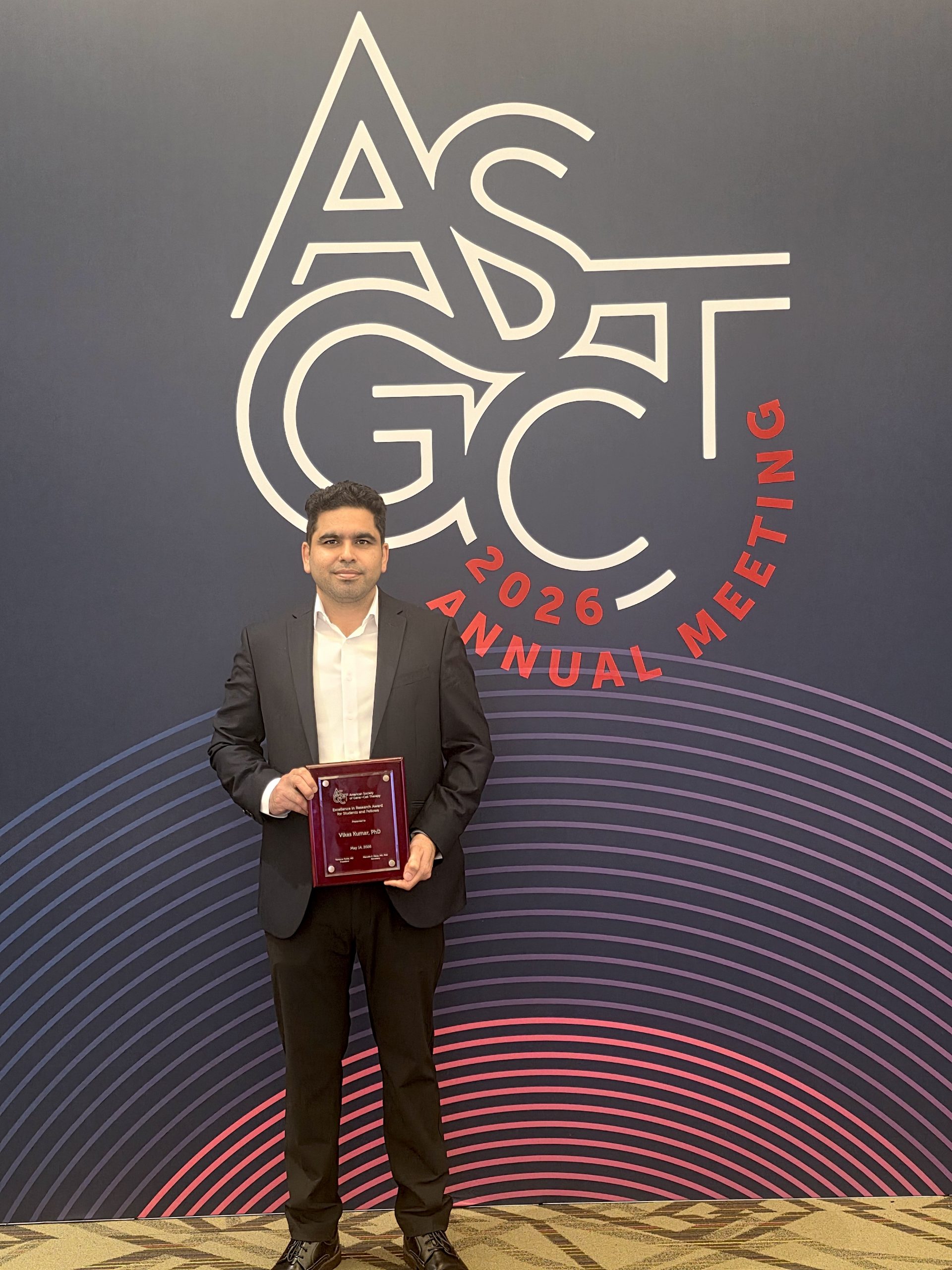
Kumar was surprised when he won the award.
“It was hard to believe at the time,” Kumar said. “It was a very humbling feeling, and it motivated me after receiving it.”
Bahal praised Kumar for his research.
“Kumar is an exceptional research scientist who works diligently and intelligently to address complex scientific challenges,” Bahal said. “I am very pleased that he received this distinguished recognition from ASGCT.”
The award meant a lot to Kumar as well.
“We worked consistently on this for the last three to four years, focusing on targeted delivery, particularly to the kidneys, and at that time we didn’t realize that the effort would be so meaningful in the end,” Kumar said. “I don’t know how to explain, but I feel happy overall.”
The award was very competitive.
“They mainly look into the depth of analysis and significance of the research done to decide the winners, and there are about 10 winners each year from researchers working in different domains of gene and cell therapy, depending on certain criteria,” Kumar said.
The challenging part of Kumar’s research was developing the things he needed to start.
“When we are developing a targeted drug delivery platform, we have to do extensive optimization studies,” Kumar said. “We have to figure things out, like whether our approach can deliver the drugs to the right cell type, and whether we can safely achieve the therapeutic effect without any toxicity in other parts of the body.”
Kumar was awarded the Excellence in Research Award at the ASGCT annual meeting from May 11-15 in Boston, Massachusetts.