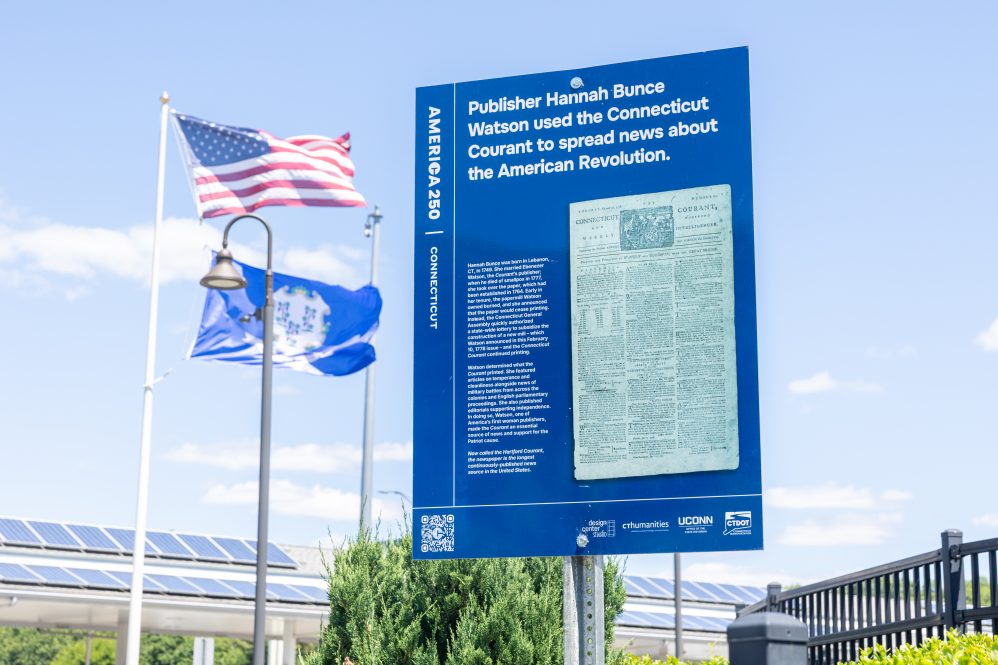
More than three dozen historical markers touting Connecticut connections to the American Revolution have been placed around the state in a cooperative project between UConn and the Department of Transportation to remind people of the struggle, sacrifice, courage, and contributions of those living here around the critical year 1776.
“Our Connecticut communities were at the center of this world-historical moment,” says Andy Horowitz, state historian and associate professor of history at UConn. “In our Connecticut modesty, many people assume that Connecticut was ancillary or on the sidelines – but in every way, Connecticut is at the center of this story.”
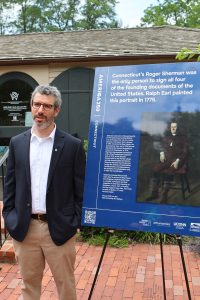
Surnames like Bushnell and Sherman are familiar for lots of contemporary reasons, but visitors to and residents of Connecticut might not realize that David Bushnell, who was born in today’s Westport, designed in 1776 the first submarine used in combat, and Roger Sherman, who lived in New Milford and later New Haven, was the only person to sign all four of the country’s founding documents.
Their stories and more are detailed on the markers as part of Connecticut’s celebration of the 250th anniversary of the signing of the Declaration of Independence. The 4-by-3-foot aluminum signs were unveiled Friday, June 26, during a ceremony in Wethersfield.
Horowitz says he’d already started thinking about a way to place historical markers around the state when DOT officials approached him about marking the semiquincentennial. Together, they conceived a plan to locate 38 signs at rest areas, service plazas, bus stations, and train stations, where the DOT estimates tens of thousands of people will see them each week.
Each sign features a picture of a historical item – like the hat Phineas Meigs wore when he died as the last known casualty of the Revolutionary War in Connecticut – and a short description of its significance, along with the museum location of the object.
“The idea was to tell some stories about Connecticut that may be familiar, and others that are worth knowing more about,” Horowitz says. “And whatever general knowledge people have about the American Revolution, I think the specifics remain arresting – like seeing the candleholder that a Salisbury miner carried as he hauled iron for a Continental Army cannon.”
Student Designers on the Job
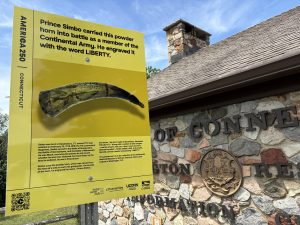
The sign erected at the westbound rest stop on Interstate 84 in Willington that depicts the powder horn carried into battle by Prince Simbo, a Black man from Glastonbury, is a favorite for Saemi Yoon, a digital media and design MFA student from UConn. The horn is engraved with the word “Liberty” and adorned with drawings of a bird, deer, and leaf.
“‘Liberty’ as he inscribes it on his powder horn must have reminded him, every time he filled his musket, of the stakes – not just life and death stakes, but also the ideological and political stakes of what he was fighting for. And then, he’s such a brilliant artist. In this one object, we have the military story and the political story, along with a fleeting glimpse, but a meaningful one, of an artist,” Horowitz says.
Yoon says the powder horn sign is a favorite because of proximity – she lives not far from Glastonbury where Simbo was born and the horn was made, and says, “That closeness made the story feel much more real and personal than something out of a history book.”
But as an immigrant from Korea, Yoon says the full series helped her learn more about the American Revolution and Connecticut’s contributions. For several months last semester, she and a group of four other students designed the series through UConn’s Design Center Studio using Yoon’s template as a basis.
“The main goal of this project was building the design system, and also I prioritized the information delivery over creating something merely pretty,” Yoon says. “I tried to focus on creating a clear visual hierarchy to deliver the content and the image of the historical artifacts much more clearly and easily to the audience.”
The Design Center Studio, she explains, is a place where classes work on real-life projects like this to experience, before they get into the workforce, what it’s like to collaborate with each other in a professional setting to satisfy a client-customer.
One detail that few people who see the signs will ever notice came from this collaboration between the students, Horowitz, center director Dina Benbrahim, and instructor Steve Bowden.
The green background on signs like the one depicting Timothy Lee’s canteen, or the yellow for Connecticut currency from 1776, the purple showing Nathan Hale’s diary, and the blue for a sketch of Newgate Prison in East Granby are extracted colors from the Connecticut state flag.
“All the choices, we tried to make intentional, whether it’s putting a specific sign in the region adjacent to where it happened, the colors that reflect the state flag, or the objects themselves that are drawn from Connecticut institutions,” Horowitz says. “Even though they may look like modest signs, a lot of thought went into trying to make them the best version of themselves.”
Yoon says the design team met with Horowitz periodically during the semester, taking the still images and narratives he supplied and fitting them into her design.
“I enrolled in this course to learn more about visual hierarchy, typography, color, and so on, because I thought learning more about those principles would be very helpful for my study area,” says Yoon, who generally focuses on interactive media design. “This whole course was a great experience for me to learn those design principles and to experience working on a project for a public purpose. Having the opportunity to contribute to this meaningful project has been an honor.”
The team’s efforts, Yoon says, have earned them a Gold Award in the 50th annual Connecticut Art Directors Club Awards Show in the Student Print category.
“We’re grateful to UConn professor and State Historian Andy Horowitz for helping CTDOT identify the most compelling stories to share and the best locations for each sign, and to the UConn design students whose creativity and vision truly brought those stories to life. Their contributions were essential to this project’s success,” DOT spokesperson Eva Zymaris says.
New Discoveries, Even Today
At Hartford Union Station, visitors can find a sign detailing Lemuel Haynes’s sermon “Liberty, Further Extended,” an important document by an indentured servant who was born in today’s West Hartford. Haynes completed the term of his indenture when he turned 21 in 1774, and joined the colonial militia.
After serving for two years, Horowitz explains, Haynes studied theology, and was the first ordained Black man to become a Congregational minister in the United States. He did that in Torrington.
In 1776, when he heard the Declaration of Independence, Haynes wrote “Liberty, Further Extended,” which states that if liberty is important to white people, then it must be equally as important to Black people.
“The American Revolution is so complicated because for all the talk of liberty and the American colonists’ enslavement to King George, some of those same colonists enslaved African Americans,” Horowitz explains. “This document shows that Lemuel Haynes, along with many others, immediately understood the implications of the Preamble.”
Haynes wrote his sermon in longhand and copied the Declaration of Independence’s Preamble next to his own words as a direct comparison, Horowitz says, adding a footnote that the sermon had been forgotten until the 1980s, when a historian found it in a library box labeled as miscellaneous.
Proof that 250 years into the country’s history, new discoveries can still be had.
“Even as Connecticut state historian, I am continually amazed by how rich Connecticut history is,” Horowitz says. “There is nothing that I care about as a person that hasn’t been struggled over in Connecticut. Focusing on the American Revolution is a relatively narrow window. The 1770s, out of all human history, is a tiny blip, and Connecticut is comparatively a very small place.
“Yet in doing the research for this project, I found people from America, Europe, and Africa fighting over the meaning of freedom, making use of the state’s environmental landscape, struggling over what citizenship is or ought to mean, carving their highest artistic aspirations into pieces of bone or sewing it into needlepoint,” he continues. “It just gave me a sense that the whole world is here, if we are willing to open our eyes to it.”
The historical markers from the Connecticut Department of Transportation, UConn associate professor and State Historian Andy Horowitz, and students from UConn’s Design Center Studio – MFA student Saemi Yoon, Lindsay Fiedler ’26 (SFA), Charlotte Wight ’26 (SFA), Lissa Kerstine ’27 (SFA), and Leeyah Roman ’27 (SFA) – can be found around the state throughout 2026. The project is part of America 250 CT, administered by CT Humanities.