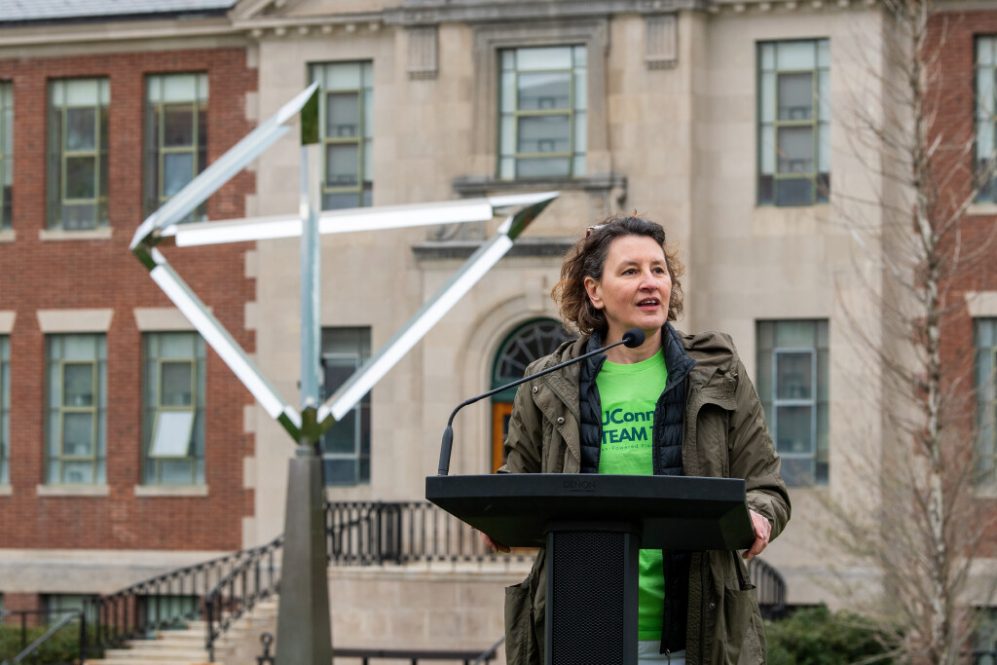
When Jasna Jankovic was deciding what to study as a teenager in Serbia, she considered a range of careers, from architecture and interior design to psychology and veterinary science. Engineering ultimately won out, thanks to a combination of aptitude, practicality, and encouragement from family.
More than three decades later, that decision has led Jankovic around the world and established her as an internationally recognized researcher, educator, and mentor in materials science, clean energy, and advanced microscopy.
Today, Jankovic serves as an associate professor in the University of Connecticut Department of Materials Science and Engineering, where her research combines cutting-edge imaging techniques, artificial intelligence, and sustainable energy technologies. Her path to academia, however, was anything but conventional.

Jankovic began her career in chemical engineering, earning her undergraduate degree before spending seven years working as a petroleum engineer in a refinery.
“While it was a good job, it wasn’t particularly exciting for me,” Jankovic says. “Looking back, I think I was already drawn to science, even if I didn’t realize it yet.”
A major turning point came in 2002 when she immigrated to Canada with her husband and children. While adjusting to a new country and raising a growing family, she pursued a master’s degree in chemical engineering at the University of British Columbia (UBC).
The transition was challenging.
“It was a very hard period,” Jankovic recalls. “New country, new culture, young children, coursework, exams, and financial pressures. Many of our international graduate students at UConn can probably relate.”
Near the end of her master’s program, she learned of an opportunity at the National Research Council of Canada’s Institute for Fuel Cell Innovation in Vancouver. The institute was launching a new clean-energy research initiative focused on fuel cells, a technology Jankovic knew little about at the time.
She applied immediately.
What she did not know then was that the group lead hiring for the position was Dr. Radenka Maric, now UConn’s president.
The position introduced Jankovic to materials science, fuel cells, and clean-energy research, fields that would define the rest of her career.
“I fell in love with clean energy and with science,” says Jankovic. “That ultimately changed my career path.”
Encouraged by mentors at the research institute, Jankovic pursued a Ph.D. at UBC under the guidance of chemical engineering professor David Wilkinson.
At the time, she was pregnant with her third child.
Despite the challenges of balancing family responsibilities with doctoral studies, the experience proved transformative. Her research focused on developing proton-conductive materials for intermediate-temperature fuel cells, requiring extensive materials processing, electrochemical testing, microscopy, and characterization.
“It was during my Ph.D. that I really started working with materials science and engineering,” Jankovic says. “Those experiences completely changed my career path for the better.”
The work provided both technical expertise and valuable mentorship while reinforcing the possibility of maintaining a healthy work-life balance alongside a demanding research career.
After completing her doctoral work, Jankovic joined the Automotive Fuel Cell Cooperation (AFCC) in 2011, a joint venture between Ford Motor Company and Daimler, a German company, focused on advancing fuel cell technologies.
She rose from postdoctoral researcher to senior research scientist, developing advanced microscopy methods to better understand fuel cell structures and performance.
The techniques she developed there continue to serve as the foundation of much of her current research.
“This is where the core of my current research started,” Jankovic says. “We developed unique methods that we still use today.”
When AFCC closed in 2017, Jankovic began exploring new opportunities. A faculty position at UConn offered the chance to build a research program of her own while training the next generation of engineers and scientists.
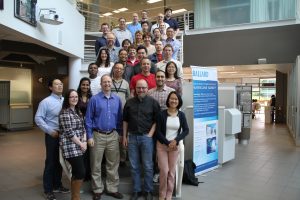
She arrived in Connecticut on Dec. 30, 2017.
The transition from industry to academia was significant.
“In industry, I focused primarily on science and a few projects,” says Jankovic. “In academia, I suddenly had to establish a lab, hire students, write proposals, teach, secure funding, manage projects, and build collaborations.”
Yet her industrial experience continues to shape her approach to both research and teaching. She emphasizes entrepreneurship, industry engagement, and practical problem-solving in her classrooms while helping students pursue internships and professional opportunities.
Since joining UConn, Jankovic has broadened the scope of her research while remaining focused on clean-energy technologies.
Her laboratory develops advanced microscopy and imaging approaches to characterize materials used in fuel cells, batteries, electrolyzers, sensors, and other energy systems. In recent years, her group has become an early adopter of artificial intelligence and automation technologies to improve data analysis and materials characterization.
“We started working with AI several years ago, before it became widely used,” Jankovic says. “We developed some really unique approaches that we are now publishing and licensing.”
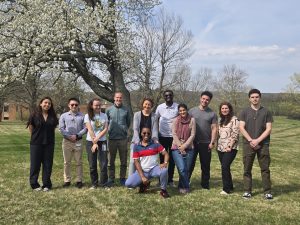
These innovations are helping researchers better understand the complex relationships between material structure and performance, accelerating the development of next-generation energy technologies.
Among the many milestones in her career, several awards stand out as particularly meaningful.
In 2021, Jankovic received a prestigious National Science Foundation CAREER Award, which supported her work in advanced microscopy and AI-driven materials characterization. The grant also funded the development of a novel operando microscopy system and supported numerous student researchers.
“The CAREER Award opened new doors for my research,” Jankovic says. “It enabled many opportunities for both my students and my lab.”
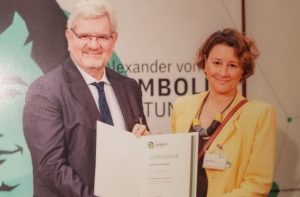
In 2024, she was honored with the Fraunhofer-Bessel Research Award from Germany’s Alexander von Humboldt Foundation, allowing her to spend six months conducting research at the Fraunhofer Institute for Solar Energy Systems. The collaboration led to the development of a novel approach to X-ray photoelectron spectroscopy for fuel-cell materials.
More recently, Jankovic received the 2025 Women of Innovation® Award in Academic Innovation and Leadership from the Connecticut Technology Council. The award recognized her interdisciplinary educational initiatives, including integrating entrepreneurship into engineering curricula, developing a STEAM-focused educational project, and incorporating virtual reality into materials science education.
One recognition remains especially meaningful.
“The Distinguished Engineering Educator Award from UConn is very dear to my heart,” says Jankovic. “I was humbled by the testimonials from students and colleagues and honored to be recognized for supporting students’ education and wellbeing.”
As both a researcher and educator, Jankovic hopes to encourage students to pursue solutions that address some of society’s most pressing challenges.
“I hope to inspire new generations to keep working on sustainability, clean energy, and novel materials that will help keep our planet safe and healthy,” Jankovic says. “I encourage students to help each other, build connections, and be supportive and collaborative.”
Looking ahead, Jankovic is excited by the rapid evolution of materials science, microscopy, and artificial intelligence. She believes responsible use of emerging technologies will unlock discoveries that were previously unimaginable.
For a researcher whose career has spanned continents, industries, and disciplines, the future remains as exciting as ever.
“Science is always evolving,” she says. “There is still so much left to discover.”