For the last 250 years, two sisters have lived side by side in what’s now known as the Fenton Tract of the UConn Forest.
It wasn’t forest when the sisters were born, though, likely around the same time the United States itself was born, with the signing of the Declaration of Independence in 1776.
Instead, the forest was farmland – a part of Connecticut’s agricultural landscape at the time.
And the two ancient sisters were then just young white oak trees, establishing themselves a few short yards away from each other before growing to sprawling height and offering shade to the livestock raised in their field.
Today, the two white oaks still stand in the forest, surrounded by the smaller trees and saplings – maples and aspens and birch – that have grown up around them in the last 60 years or so, as abandoned pasture slowly became forest again.
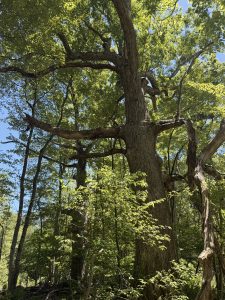
The two massive trees bear the scars of their long history. Decaying lower limbs. Thick bark. Knotted and gnarled trunks.
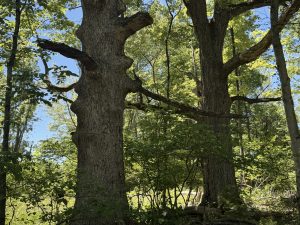
But high above the ground, branches full of their distinctive round-lobed leaves still stretch over the forest canopy, contributing to an ecosystem of birds, insects, and wildlife as they have for more than two centuries.
And as they will for centuries more, if Thomas Worthley, a UConn Extension professor of forest sustainability, has any say in it.
Because as ancient as they are, even as they and the country prepare to celebrate their coinciding 250th birthdays, the trees could potentially be just middle-aged, explains Worthley, who has spent his career working in both private and academic settings, and has been with UConn Extension in various capacities for the past 30 years.
“White oak is a unique species in that it’s one of the trees that has the longest lifespan in our part of the world,” Worthley says. “Given the opportunity, given a good site, given protection and proper weather and climate and fertility and so forth, a white oak tree can live to be 500 years old.”
White oak is a unique species in that it’s one of the trees that has the longest lifespan in our part of the world. Given the opportunity, given a good site, given protection and proper weather and climate and fertility and so forth, a white oak tree can live to be 500 years old. — Thomas Worthley, UConn Extension professor of forest sustainability
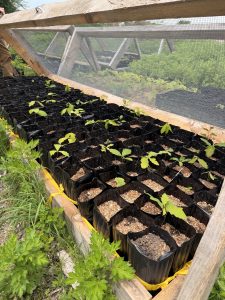
A short walk from where the ancient sisters reside on the Fenton Tract, a new generation of Quercus alba spread their first leaves in black plastic pots under wood-and-wire A-frames behind the Horsebarn Hill Science Complex.
The 100 or so tiny white oak seedlings are the result of acorns that Worthley collected last fall from a few old white oak trees, most notably the known descendant, or scion, of Connecticut’s legendary Charter Oak that lives at the Nathan Hale Schoolhouse in East Haddam.
These tiny, newly germinated seedlings, and their ancient counterparts in the UConn Forest, are all part of an effort Worthley is leading at UConn to highlight the important historic, economic, and ecological role of the white oak tree as Connecticut commemorates the 250th anniversary of the nation’s founding this year.
A Storied History
Before the two ancient trees in the UConn Forest were even acorns, an exceptionally large example of a white oak grew in Hartford until it fell in a storm in 1856.
State legislation signed in 1947 officially designated the white oak as Connecticut’s state tree, but the reason stems from events that allegedly happened with that storied oak tree in 1687.
“The most commonly retold story in Connecticut history is the story of the Charter Oak,” says Andy Horowitz, an associate professor of history at UConn and Connecticut’s state historian.
In 1680s, that already ancient oak stood strong as the king of England, James II, sent his agent, Edmund Andros, to Connecticut. Andros, Horowitz explains, was to be named governor of the new Dominion of New England, which would assert royal control and take away the independence that the Connecticut colonists had come to expect through decades of self-government granted to them by the colony’s unique charter.
“The Royal Charter of 1662 is an essential document in the history of Connecticut,” says Horowitz, “and it was important because it gave the Connecticut colonists an extraordinary degree of autonomy from the British crown. It gave them the right to elect their own governor, elect representatives, make their own courts – basically to govern themselves, which was uncommon in the American colonial experience.”
In 1687, Andros came to Connecticut, and his warrant was to take back the charter.
The legend goes, Horowitz says, that when Andros arrived in Hartford, there was a meeting that went from the afternoon into the night, as Connecticut’s colonial governor, Robert Treat, gave a long speech.
“In the course of the speech, as it got dark outside, so the story goes, all the candles in the building were extinguished,” Horowitz recounts. “Felicitous wind, good luck, subterfuge – we don’t know. But in the darkness, the charter that had secured Connecticut’s self-government was secreted out the window. And this man named Wadsworth took it and hid it in an oak tree down the road. This tree is what we’ve now come to call the Charter Oak.”
Putting the charter in the tree didn’t stop King James II from asserting that stronger control over Connecticut, Horowitz notes.
“But it certainly symbolized Connecticut’s resistance to that move,” he says. “The charter and the autonomy and independence and political rights that it allowed really cemented and defined Connecticut’s expectations for liberty and self-government.”
And the terms, rights, and freedoms spelled out in Connecticut’s charter were fundamental to what were ultimately included in the Declaration of Independence.
“That tradition of having written rights, a sort of constitutional fundamental law, certainly helped to inspire the U.S. Constitution of 1789,” Horowitz says, “and I think it’s one of Connecticut’s proudest contributions to the United States.”
After it fell in 1856, seedlings from the Charter Oak were planted around the state. The wood from the fallen tree was used to make a number of artifacts that still exist today, including the frame of a copy of the Royal Charter of 1662 housed in the Museum of Connecticut History in Hartford and the famous “Wishing Chair” – a highly ornate chair carved from the oak that resides on the dais in the third-floor Senate Chamber of the State Capitol building.
It’s this history that’s inspired Worthley to raise awareness of the importance of the white oak – and not just as a hiding place for foundational governing documents – this year.
“2026 is the 250th anniversary of the Declaration of Independence,” Worthley says, “and we felt it was appropriate to recognize the role that white oak played in that history.”
An Ecological Champion
White oak differs from other species of oak trees not just in how long the trees can live, but in the economic and ecological value it adds to the landscape.
“When the conductive tissue on the outside of the white oak tree eventually becomes heartwood, the tree forms a kind of tissue called tyloses that plug up all the pores in the wood and makes that wood kind of watertight,” explains Worthley, a characteristic that made white oak ideal for making things like whiskey barrels and kegs, buckets, and even ships.
Connecticut white oak is highly valuable even today for those purposes, Worthley says.
But even when a white oak ages beyond its ideal lumber years – like the ancient white oaks in the UConn Forest – the value they offer in the forest ecosystem is hard to quantify.
The deep fissures that sometimes develop in the trunk, the kind that can be so helpful when trying to hide a royal charter, also offer a nesting place for owls and woodland mammals.
The very surface of the tree serves as a host for many of the creepy crawlies so vital to a forest habitat.
“The old white oaks, especially those that have been around for a while, that have thick bark with lots of nooks and crannies, lots of branches, lots of leaves, will support thousands and thousands of caterpillars,” says Worthley. “Almost 500 species of caterpillars can be found on white oak trees in Connecticut, and in turn, that supports a wide diversity of birds and other animals.”
While annual acorn crops vary significantly based on spring weather conditions, and often decrease in quantity as a tree ages, white oak acorns – easily distinguished on the forest floor from other species of oak in that the nut separates from the cap as it drops from the tree – are a particularly prized food source for a number of forest inhabitants.
White oak acorns contain fewer bitter tannins than red oaks. The acorns also begin to germinate as soon as they drop off the tree, Worthley explains, so they quickly convert stored starches into sugars to support a potential new tree’s growth, giving them a sweeter taste.
“Lots and lots of animals like to eat white oak acorns,” says Worthley. “The deer, the turkeys, the squirrels, the chipmunks, and many, many birds will eat acorns. Having an abundant crop of acorns is good for the diversity of the wildlife, but also will help to ensure the future of the species itself, in having acorns that germinate and become established and grow.”
White oaks have been historically valued as shade-giving pasture trees because of their sprawling architecture in open areas.
But both young and old white oak trees face new and growing challenges in modern times, as weather and climate patterns change and as invasive plants and insects have entered the picture.
Here I am, a white-haired gentleman. I’ll never see that tree that’s being planted today that will grow for another 250 years, but I care very deeply that it happens. — Worthley
“If we want to perpetuate oak in general in our environment, and white oak in particular,” says Worthley, “then we need to take some management actions to help that oak overcome some of the barriers and some of the challenges that we have in the environment today that have to do with pests, that have to do with invasive insects, that have to do with climate change, and that have to do with all of these things that weren’t factors 100 or 200 years ago.”
A Learning Opportunity
The two ancient white oak trees on the Fenton Tract aren’t unusual in Connecticut – you can find very old trees here and there all around the state, says Worthley.
But what is unusual about the trees in the Fenton Tract is how many ancient white oaks can be found in a relatively small area – there’s nearly a dozen of them, intermixed with younger oaks and other trees, both native and non-native.
“It is unusual to find as many of these very old trees all in one place like we have there,” says Worthley, and so, as part of efforts to highlight the importance of the white oak this year, Worthley and a team of faculty and students are building a publicly accessible Ancient White Oak Heritage Trail on the Fenton Tract.
“It’s not a long trail, and it’s not a difficult walk, so what I’m hoping we can create with this trail is a place where people might go briefly for some peace and some quiet and some contemplation, who enjoy the benefit that they derive from going and just personally interacting with some old trees,” Worthley says.
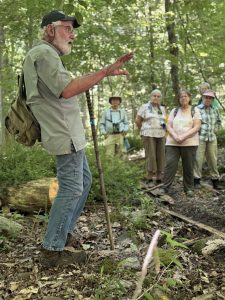
The trail is already accessible on Horsebarn Hill, though still under construction. Signage and benches, as well as a few footbridges – largely utilizing lumber milled from non-native and highly decay-resistant black locust trees harvested from the site – will be installed on the trail over the next several months.
Undergraduate students at UConn are contributing to the effort, offering educational opportunities for members of the UConn community as well as the general public who want to learn more about the forest management efforts underway on the tract.
A recent trail walk, the first of a series of walks Worthley plans to lead through the year, welcomed nearly two dozen community members to learn about not only the ancient trees but also the many forest and invasive management considerations underway on the tract.
“The trail is just a piece of a larger stand restoration effort that’s going on there, with wildlife habitat enhancement in mind,” Worthley says. “And so, we’re hoping to create a space where there’s some very impressive old trees that people can engage with, but also be able to have some interaction with bird life and animal life and so forth that will come as a result of the management activities we have going on there.”
Worthley and his team also want to know where other ancient white oaks are living in Connecticut. They’ve launched an online survey where anyone in Connecticut can identify and enter details about their favorite old white oak trees. The survey data will be used to collect the locations and create an online map pinpointing the location of these old white oak trees.
And then there’s the seedlings – the roughly 100 baby white oak trees currently growing in those pots on Horsebarn Hill.
Worthley is working in partnership with the nonprofit Connecticut Humanities and its America 250 Connecticut program to distribute the seedlings, including many direct descendants of the original Charter Oak, to community partners around the state later this year.
Worthley hopes the communities that plant one of these white oak seedlings will recognize the longevity and the connection to history that the trees represent.
“I hope they have a connection to the efforts that people made in the past to assert their self-government and their autonomy, their sense of liberty later on with the Declaration of Independence and the formation of the Constitution,” Worthley says, “and that they symbolically can carry on that legacy and perhaps even have an individual tree that will grow for another 250 years for somebody to talk about in the future.”
An Enduring Story
“It’s really important to think about the stories we tell about ourselves and what we mean to tell people with them,” says Horowitz, the state historian.
The story of the Charter Oak, he notes, is striking in how it has endured as one of the most oft-recited pieces of Connecticut history.
“When I see the oak show up on UConn’s campus, or when we celebrate the relics of that tree, or we try to replant the descendants of the Charter Oak,” Horowitz says, “I see these as ways of recommitting to that proud tradition of trying to safeguard our liberties the best we can in Connecticut.”
For Worthley, the celebration of our nation’s founding this year offers a prime opportunity to recognize the white oak, to retell the story of the happenings in Hartford in 1687, and to educate as many people as possible about the significance of these often-overlooked ancient trees that still stand tall in the Connecticut landscape.
“What I have hoped for this project is that, as many people as we possibly can, I would like to educate them to be able to recognize and identify a white oak tree,” Worthley says. “For people in the position to grow a white oak tree, I would like to be able to share the information they need to do just that, to bring that white oak seedling along to a sapling, and then along to a bigger tree, and nurture it in the process.”
Because today’s saplings will be tomorrow’s ancient sisters, growing yards apart in a forest, hopefully inspiring a new generation of foresters and conservationists and backyard aficionados, providing shade and shelter, as the country tiptoes on in its own long history through the next 250 years.
“Here I am,” says Worthley, “a white-haired gentleman. I’ll never see that tree that’s being planted today that will grow for another 250 years, but I care very deeply that it happens.”
Worthley’s white oak projects are generously supported by the nonprofit Hampshire Foundation. For more information, visit hampshirefoundation.org.
For more information about Extension Forestry efforts to support and promote white oak heritage, visit ctforestry.cahnr.uconn.edu/extension-forestry/whiteoak. Use the online survey here to add your favorite white oak tree in Connecticut to the interactive map Extension Forestry is building.