The white oak is Connecticut’s state tree, the mountain laurel is the state flower, the American robin is the state bird, but until recently there was no state rock. This omission was something that UConn Department of Earth Science Professor Robert Thorson wanted to change, and he teamed up with Mansfield Middle School educators and students, Neag School of Education researcher Todd Campbell, and Earth Science Education and Earth Science graduate researcher Violet Andrews to not only ensure Connecticut has a state rock, but that the lessons learned along the way serve as a unique and impactful learning tool that can be emulated anywhere.
Naming or designating things helps create a distinct sense of place. In the case of a state rock, Thorson says it also serves as a powerful tool not only to help connect students with where they live, but also forge new connections with global and Connecticut-specific concepts. For example, without rock, we would have nowhere to live, and no elements to make our bodies with.
In the early stages of adding Connecticut to the list of 35 states that already have a designated rock, Mansfield’s state representative suggested that working with students would be a key element for a successful proposal. This, says Thorson, added another crucial dimension to the learning process, because students would receive lessons in civics and learn how decisions make their way through the legislative process.

Thorson connected with Mansfield Middle School teacher Raechel Alteri, who integrated the idea into her geology lesson plan. Thorson visited all seventh-grade science classes where he gave a short presentation to introduce concepts along with a list of seven candidate rocks. With so many potential choices, he set three criteria for the students to help students decide which rock to vote for.
“We had three very clear criteria. First, is it beautiful or not? The second is utility and that’s important. A crystal of garnet, for example, may be beautiful, but it’s also useful for making sandpaper and abrasives and a million other things,” says Thorson. “The third criteria is distinctiveness, in other words, does it represent the state, regardless of whether it’s beautiful or useful, whether symbolically or otherwise.”
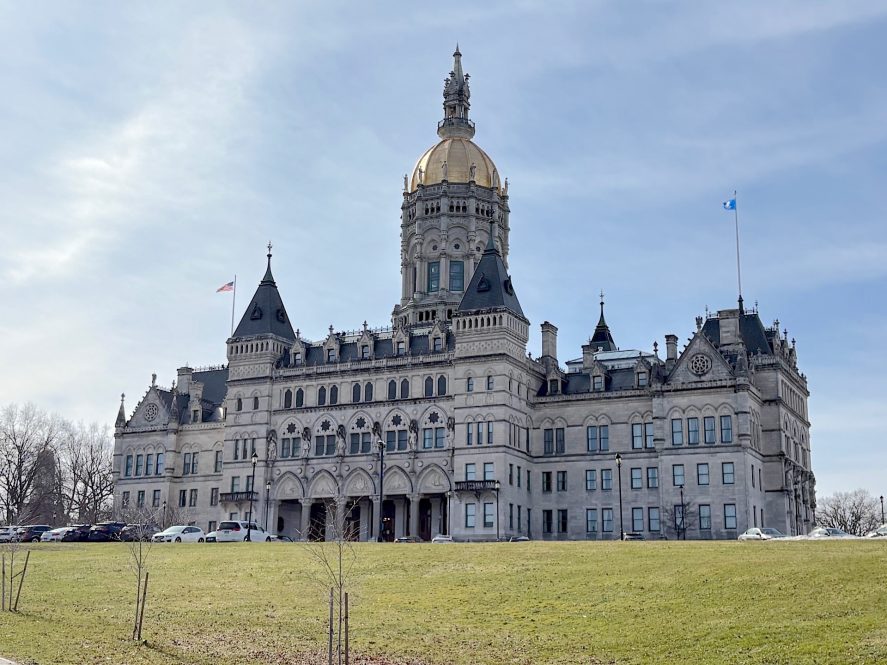
The students learned about the candidate rocks important to Connecticut. After deliberation, they voted for Housatonic Marble, from which the state capitol building is made. He says that was a key aspect for why the students overwhelmingly voted for this dazzling rock over the others. Along the way, students looked at rock classification, mapping, and geochronology, to learn more about how the state’s unique geology controls its terrain and the history guided by that terrain. The geology lessons also introduced the concept of evolution, which cuts across many topics, from human culture to distant planets, to the carbon cycle here on Earth, says Thorson. In this case, marble is a carbonate rock, a group comprising the most abundant reservoir of carbon on Earth, playing a key role in the planet’s carbon cycle.
“Carbon is element number six on the periodic table. When combined with oxygen and calcium, we get the mineral calcite, which plays an important role in art, architecture, industry, to agriculture. Our state rock impacts all of that. These are the things that kids can talk about in a seventh-grade science class,” says Thorson, “and they all link back to geology.”
This draws on a key element in this teaching approach called anchoring phenomenon, Thorson explains, or things that the students are already familiar with, for example that they live on a habitable planet with air they can breathe, thanks to Earth’s carbon cycle.
“In contrast, our nearest neighboring planets are both uninhabitable based on differences in the carbon cycle, which are in turn driven by the presence or absence of carbonate rock, such as limestone and marble. Marble as our state rock connects to our state climate,” says Thorson.
Following on from these lessons, representatives from the seventh-grade class officially testified about their detailed proposal to the Connecticut General Assembly with great success on March 13th, and the measure was made official when House Bill 5534 was signed by Gov. Ned Lamont on May 19, 2026.
Sharing Success
Now the goal is to share the lessons learned along the way to help more teachers help their students make the same connections. As head of Neag’s Department of Curriculum Instruction, Campbell suggests designing a curriculum that could be easily integrated into existing lessons over the course of a couple of days.
“We talked about creating a three- or four-day lesson where teachers wouldn’t have to pull something out of their curriculum or replace a unit. Instead, they could put this in as a locally relevant, timely lesson to learn about different concepts. I think it would probably raise questions about the geology that most students might not be as curious about if they were not brought up,” says Campbell.
Campbell explains that Connecticut has adopted the Next Generation Science Standards (NGSS), and he and his research team are working to make science more authentic by presenting topics students may be uncertain about, and where they can use their current knowledge to connect new ideas to their everyday understandings. The example connecting the state rock to the global carbon cycle is one case of how students may start to develop more sophisticated understandings of these topics.
When designing curriculum, Campbell says they start with a complex, puzzling phenomenon with multi-faceted explanations so that students are challenged to weave together many concepts to arrive at a stronger claim. Housatonic Marble serves as an effective anchor.
“Western sciences largely understand something by isolating it, studying it, and then you’ve separated it from all the connections and relationships, and you’ve set yourself up to exploit it and ignore the connections,” says Campbell.
Andrews will be working on designing the curriculum, and as a geoscience major, Campbell says she is well-prepared for the task. Andrews previously created a similar learning unit centered around the impact Hurricane Katrina had on carbon cycling in New Orleans.
“We cannot talk about science without considering the socio-environmental impacts. Tackling this through an asset-based framework shapes the way for students,” says Andrews.
The project highlights another important point, Campbell says, that many states bypass geology instruction all together. He feels that this could be an important moment where people reconnect with the geological features that shape our lives as much as we shape them, and our sense of connection to everything around us.
“If there’s any way for us to be an exemplar for other states to start highlighting their own intersections between geology and how they live in the culture that’s formed, that would definitely be a dream for me,” says Campbell. “It is a potential landslide moment where we could raise the attention about earth science in the state. I think teachers would appreciate it. There is a need for high-quality instructional materials.”
Though Connecticut has adopted the NGSS as a guide, Campbell explains, and each school determines performance expectations for each grade, and this is where there is some flexibility, and uncertainty, comes in, showing the need for resources like these, and the curriculum they are designing will have enough flexibility so educators anywhere can use it to help students explore their local environments.
“There are some open science lessons out there that that teachers can use, but districts are left to pull those together and decide if it’s coherent for the students to experience,” says Campbell. “There is always a tension in putting amazing curriculum out there nationally, but local place matters, so you want to be careful about how much you prescribe a curriculum that’s designed for the nation, because local learning should be part of that.”
Besides helping students learn how to think critically, arrive at group decisions, and present their case before state lawmakers, this story is also an example in how UConn, as a land grant university engages with and helps the community, and beyond.
“This shows how we are doing more than just research, we are contributing to the state’s future. We now have a state rock, whereas we didn’t have one before,” says Thorson. “It was extremely successful, in part because the teachers and administrative staff were so good, and the students all worked together. It is a case study that can be replicated in the 14 remaining states that don’t yet have a rock, and which can be replayed in all the rest.”