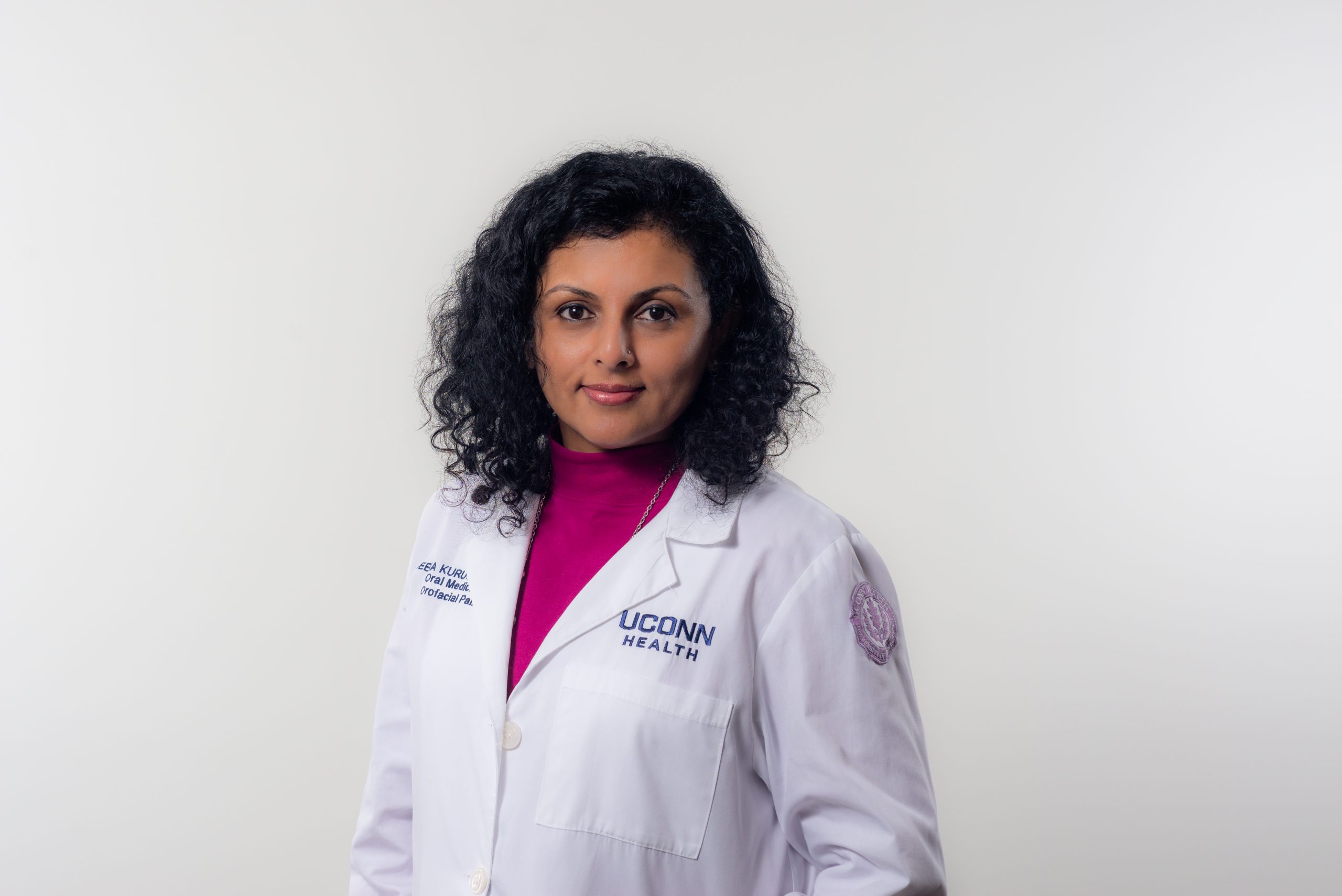
For more than 10 years, Kathryn Libal – a professor of social work and human rights at UConn – led what’s now known as the Gladstein Family Human Rights Institute, one of the top human rights academic and research programs in the country.
This past academic year, Libal stepped down as the institute’s director, but her scholarly pursuits haven’t stopped. She’s spent the past two decades conducting collaborative research on volunteerism and refugee resettlement in the United States, Canada, and the Middle East.

Her work supporting UConn students and human rights education in all its various forms – which Libal says is needed now perhaps more than ever, as human rights issues continually make headlines both in the U.S. and abroad – hasn’t stopped either.
If anything, the demand for critical thinkers and grassroots community advocates has only increased, she notes.
“Our Human Rights Institute has always been distinctive because we have heavily devoted our time and our love and resources to research, to education in the classroom, but also to amplifying different forms of human rights practice,” Libal says.
“We need more interdisciplinary, university-based institutes for the study of human rights across the country. We can't take for granted any longer the idea that democracy will deepen over time. This has been patently obvious to marginalized groups for a long time, but at this particular political global moment, it’s time for us to build these institutions – not weaken them.”
In a recent conversation with UConn Today, Libal talked about some of the most pressing human rights issues we’re currently facing, the importance of human rights education, and what students as well as average community members can do to help enact change.
It seems like there’s no shortage of human rights issues to talk about right now. In your opinion, what do you think are the most pressing human right issues we’re currently facing?
I’ll focus on domestic issues, as my work has centered more heavily in the U.S. in the last decade, but there are a number of issues that have both global and local implications.
I would say that migration, anti-immigrant sentiment, and the way in which negative views about immigration are used to gain political power are among the most important issues we’re dealing with, at least visibly.
There are a lot of other matters – access to healthcare, working on climate change, the erosion of democratic participation and faith in political institutions to name just a few – that require a lot of buy-in from society and government from the local to national levels.
In the last year, we’ve seen a fundamental crisis of the rule of law in the United States. In many ways, we don’t have a functioning democracy. Undermining environmental protections, targeting journalists, and the use of very negative polarizing social media to undermine people’s faith in governmental institutions are also deeply troubling trends that further erode human rights close to home.
Universities are cornerstones of democracy. One of the most pernicious ways in which human rights are called into question for universities include attacks on academic freedom and on science. These domains form the bedrock of realizing the right to health and well-being – they are preventative mechanisms to keep people alive, healthy, and well.
How are human rights practitioners, advocates, and scholars working to meet some of the challenges of this time?
Some of the most important human rights defenders right now are brave lawyers and judges. The rule of law is under the most serious assault in decades. In many instances, especially in immigration courts, there is no due process. Yet, in these arenas lawyers are pushing back in very profound ways, even at risk of being charged with crimes or having their lives threatened. Immigration and public interest lawyers are organizing with community groups and other human rights defenders to try to hold governments accountable at both state and federal levels. And, federal judges are making very brave decisions, sometimes costing their jobs.
Former workers for USAID, for the U.S. Department of Agriculture, and for the Centers for Disease Control and Prevention are trying to hold the line on reality and faith in science, understanding that science is something we all need. In this era, I would say they are also human rights defenders.
In terms of the academy, amongst human rights institutes, leaders and faculty meet regularly across the country to consider how to foster both human rights-observing climates within universities as well as how to work alongside community organizations and amplify their efforts.
And there are a lot of smaller associations and grassroots groups that are trying to raise awareness about serious assaults on democracy, but we’re at a time when many people seem overloaded by the scale of anti-democratic actions taking place within the federal government. These actions are affecting the foundation of critical social institutions – health, education, environment, legal, media.
I know based on research with colleagues that when the first Trump administration largely dismantled refugee resettlement ecosystem, it took years to even begin to "normalize" that system. Federal funding cuts to research in the sciences, humanities, and arts, for example, will reverberate throughout universities and the private sector for decades, if and when funding is restored.
What do you think is the role that human rights education can or should play right now, in the midst of these challenges?
Human rights education plays a more significant role probably than it has any time in the history of the Gladstein Family Human Rights Institute. In almost every class, students are gaining an appreciation of international human rights norms and how they are being challenged in the United States and globally.
Human rights education doesn’t mean you’re teaching that only one side is right. It means that you’re teaching core principles, and you’re getting students to think critically about what’s going on.
The U.S. has long portrayed itself as a model democracy. But now, unfortunately, other countries with illiberal governments are able to cite the United States and draw on its example in their own crackdowns on immigration and so forth. Even progressive states, like Canada, seem to be drawing from the U.S. anti-immigration playbook.
So, one of the critical roles of human rights education in the United States is to explain how the U.S. largely held itself outside of the system, portraying itself as the major beacon of democracy and human rights, even while having its own substantial human rights contradictions. Longstanding segregation in the U.S., Jim Crow, and failures to implement the Civil Rights Act and various laws to upend racial discrimination are firmly tied to human rights and always have been.
Some of the leading human rights defenders were W. E. B. Du Bois and the National Association for the Advancement of Colored People in the 1940s. We ask, why isn’t that history well-known? And these erasures of history are worsening given the current administration’s efforts to rewrite a triumphalist, revisionist history with potentially devastating consequences in future. The federal government aims to limit what ideas we can teach about or discuss openly in universities and other public institutions. This is a critical human rights challenge, and it creates a setting where higher education becomes one of the flashpoints of human rights work.
In sum, we’re celebrating the 250th anniversary of the founding of the U.S., and yet we reside in a deeply polarized society that is not able to share a national conversation about the core principles of democracy and human rights. That’s something that human rights programs could support within their universities and beyond.
What are some things that people who are feeling overwhelmed, who might not know where to turn or how to start, can do to help support human rights initiatives close to home?
Working close to home is precisely what is needed now – ideally fostering the capacity of young and older alike to become more engaged in civil society and attuned to local, state, and national politics. Bringing a human rights lens to the work also connects us in meaningful ways to international institutions and other models for ‘doing democracy.’ And such connectedness can foster a sense of purpose and well-being.
An example of something we’re doing now is launching a forced migration hub, which is a collaboration with the Human Rights Institute and the Asylum and Human Rights Clinic. In addition to hosting speakers and workshops and providing mentorship to students doing research on forced migration, we enable students, faculty, and staff to do practice-oriented work within communities.
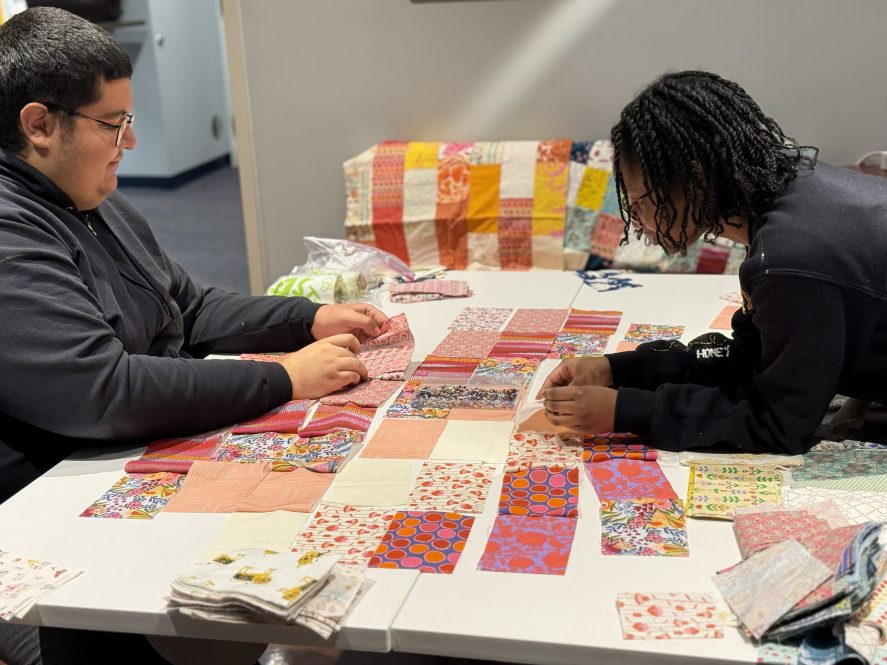
One example is the Welcome Quilt Collective, which I lead with Katie Roy in collaboration with the Well-Being Lab for Student Access & Belonging (WeLAB). Welcome Quilt is a project where students learn to sew and make blankets that we give to local organizations to distribute to children of newcomers or other marginalized communities. Students teach each other, finish work that may have been started in an earlier Welcome Quilt session, and connect with other groups in high schools or local communities. This past year, the 20 to 25 students have organized, raised funds, and set up their own workspace on the Storrs campus. Welcome Quilt events have also taken place at the School of Social Work and UConn Hartford.
Welcome Quilt is a different kind of community, driven by student interest and the belief that creating and working together on tangible fiber arts fosters connectedness and well-being. It is a space where students, faculty, and staff talk about what’s important in their lives, even as they’re creating something really beautiful to share with newcomer families as a sign of "welcome."
This is an example of what can be replicated in community. Talk to your neighbor, even if you might not agree with them, and find ways to build connections with people so that you can engage in civic action in defense of democracy close to home – this is human rights work.
A major driver of change requires fostering a clearer sense of connectedness and responsibility to each other, and then building the capacity to talk to those we have elected to represent all of us. This entails drawing in people who might not be thinking actively about how democracy is eroding, and then trying from the grassroots to start to repair some of the extraordinary harms that have been created in the last years.
For more information about human rights programs and educational opportunities offered through the Gladstein Family Human Rights Institute at UConn, visit humanrights.uconn.edu.