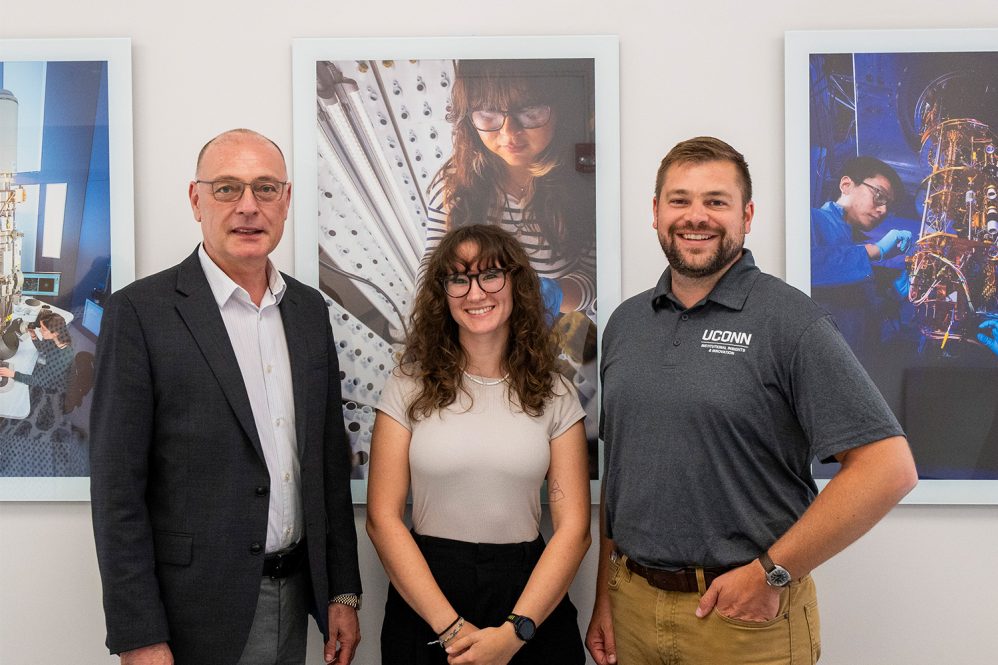
Ever heard of Lincus?
If you’re a UConn researcher – faculty, student, or staff – and you haven’t explored this unique research collaboration tool, you’re missing out.
Lincus leverages data on UConn faculty research to help build connections.
So if, for example, you’re interested in food safety following headlines about the nationwide cyclospora outbreak, a quick Lincus search on “food safety” could help you connect with more than 100 researchers enterprise-wide – from Storrs to Stamford, from UConn Law to UConn Health, from Extension to Educational Psychology – whose diverse expertise might help answer your questions or contribute to a new project.
Lincus was built and is managed by Institutional Insights and Innovation, or i3 – but more specifically, its developer is Maggie Danielewicz ’26 (ENG), who built the powerful system as a student before she graduated from UConn with a degree in computer science this past May.
But Lincus is just one of many tools that i3 has built for the University, and in support of funded projects, as part of its mission to provide practical, purpose-driven digital solutions to help the University run more efficiently, to support innovation, and to help improve the experience of working, researching, and learning at UConn.
“We consider ourselves strategists,” explains i3’s director, Joel Salisbury ’12 (BGS) ’15 MFA. “We help people make decisions about the technology that they employ. The way in which they present themselves requires designers, strategists – people who are writers as well as programmers. Our full-time staff reflects that, too. So, we have strategists and managers, designers, developers, pretty much all professional walks of life are represented in i3.”
Danielewicz is one of many valued students who’ve contributed to i3 since its launch, but she’s not only an alum. She’s now a full-time employee of i3, having joined its staff as a junior software developer in January, just before graduation.
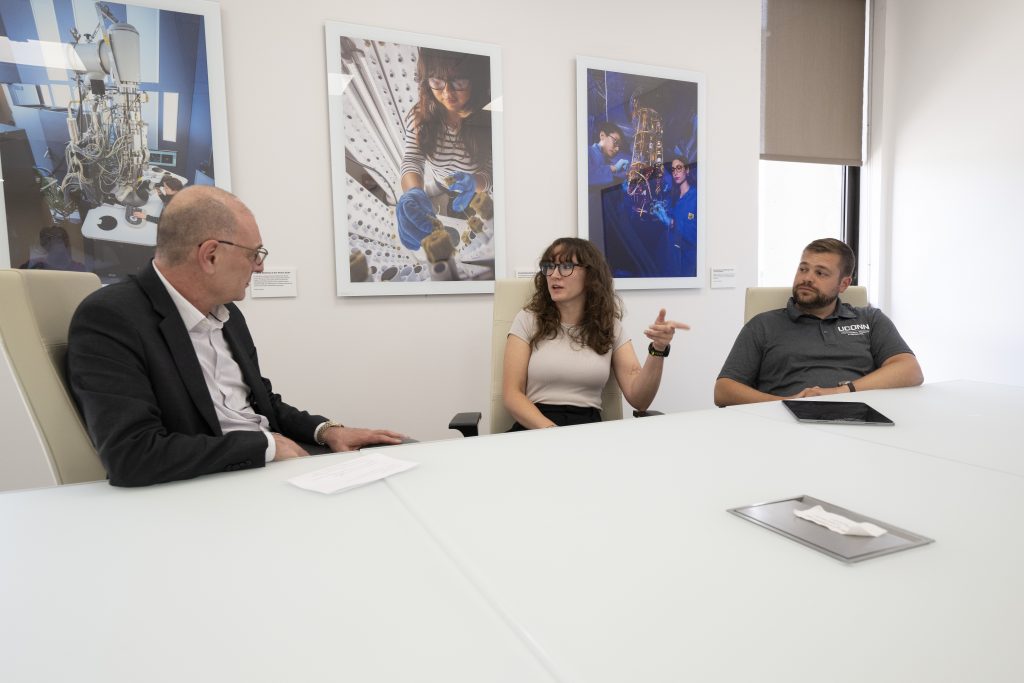
Danielewicz and Salisbury recently joined UConn Provost and Executive Vice President for Academic Affairs Pamir Alpay for a conversation about the unique role that i3, and the students and staff who work there, play each day in service to the UConn community.
*****
Pamir: A lot of people will wonder – what is i3 and what does it do? So, maybe we can start there.
Joel: i3 – Institutional Insights and Innovation – is the brainchild of vice provost Dan Schwartz. Essentially, it’s a digital enablement group within the provost’s office that serves research and academic operations through a team of developers, designers, and strategists who, on behalf of the University, explore and build out digital tools, websites, apps, and software.
We were born out of a couple of like-minded groups over the years, starting all the way back to Squared Labs and OVPR and the Digital Experience Group from DMD, and we’ve most recently merged with Greenhouse Studios.
Pamir: How big of a group are you?
Joel: We’re a team of 13 full-timers now, and I think we’ll have 10 students when the semester starts.
Pamir: Undergraduate students?
Joel: Yes, 10 undergrads and two graduate assistants.
Pamir: And what kind of projects does this group work on? And how many?
Joel: At our most recent count, we had 212 separate digital projects under our belt, with 50 or so of them under active development and 50 more that we’re responsible for in some way for maintenance. So, the volume is there, and some of those are kind of table stakes projects.
We were lucky enough to inherit the Nexus project. Jeff Winston ’95 (CLAS), the developer and creator of the original Nexus student success platform, brought what he knows about Nexus to us. It was in 2007, I believe, that the first version of Nexus was created. It’s nearly 20 years old, so there’s a tremendous amount of institutional history in that platform, and we’ve inherited it.
The Lincus platform is one that we built and maintain. Actually, Maggie built it while she was a student.
Pamir: I use it quite often.
Maggie: And now I’m responsible for it as a full-timer.
There’s also Grant Trails, which is one of our grant visualization tools. It shows where grant money is spent across the institution.
Joel: And there’s Sourcery, which is Mellon funded.
Maggie: Yes, this is a big, grant-funded application that’s actually being used right now by researchers around the world when they want to request archival documents, but they don’t want to physically have to fly or drive somewhere. It’s kind of like DoorDash, but for documents from institutional and libraries – that’s my most used allegory for it.
With Sourcery, it’s also been great to work with an actual, whole team, because with Lincus, I’ve kind of been the sole developer and manager of that. But with Sourcery, I’ve gotten to work with multiple developers, designers, strategists, and experience what a full team feels like.
Joel: Sourcery first got its grant through Greenhouse Studios in 2020. The PI is Tom Scheinfeldt in DMD.
Pamir: And you started actively working on it a couple years ago?
Maggie: I started working on it, actually, when I became full-time in January, as they’re funding part of my position. I’ve taken on a lot of tasks that [I3 staff engineer] Brian Kelleher ’17 (SFA) was working on mostly, which was nice because I kind of took on a lot of responsibilities from him on the Sourcery team. I’m actively working with the project manager, and I got experience with Jira and all of the platforms that we use. So, it’s been great to have that experience on top of working on my own project.
Pamir: So, the latest iteration of Sourcery – that’s your work?
Maggie: Oh, yes. I get to work with Natalie [Lacroix ’22 (SFA), i3 senior UI/UX designer] on the designs. She’s been doing great – she designs everything new. And our project manager, Joan [Frajaszy Troyano], is amazing. She’ll send me tickets or tell me, ‘Hey, this thing isn’t working.’ I’ll go in and fix it, try to fix it same-day, and then they’ll check it out and we’ll push it to the application that people now use around the world.
Joel: It’s another arm of what i3 does. Along with the internal apps and the tooling that we build on behalf of the University, we’re also a core facility. Researchers and PIs can hire us – we’re available for hire on grant-funded work as well.
Pamir: In terms of your favorite projects in the last three or four years, what are the things that you’ve absolutely loved working on? Or is it that all of the 220 are your favorites?
Joel: Some more than others, for sure! My answer is that, right now, I eat, sleep, and breathe Nexus. We’re tremendously lucky to have the support that we do and the adoption that Nexus has throughout the University.
Nexus is the University’s homegrown student success platform. It serves the advising context, faculty advisors, professional advisors, student support staff, staff in athletics, staff at regional campuses – essentially it snapshots our students and guides their success on the way to graduation.
And we’ve been granted the opportunity to reimagine it and expand it from the ground up, so that’s what I’ve been thinking a lot about lately: the expansion of the Nexus platform.
Pamir: What do you have in mind? What are the new things that are going to be in Nexus?
Joel: We’re looking forward to introducing the idea of insights – institutional-level insights, paths toward degree for students, helping identify problematic course combinations.
Maggie: It’s kind of been full-circle for me because I used Nexus as a student, when it came to advising. I used it when I was a peer advisor for the College of Engineering.
Pamir: Oh, you did that, too?
Maggie: Yes. Students would come in and schedule appointments, and I did a bit of mentoring with them. So, I used Nexus there, from an administrative point of view, and now it’s come to us to build it up.
Pamir: Your recently demoed a version for me, and I saw some exciting new features. One of them was the Forkcast, I believe?
Joel: Yes, the Forkcast – we think one of the biggest pieces of value in building Nexus the way that we are is that we’re inviting input from the entire UConn community. We’ve had some interviews with students who have come to us and said they really wish they had a place to land where they could gather information about their day, whether its their classes, their life on campus, clubs, engagements they’re involved with.
And one of the ideas that’s come through, named by Natalie, is the Forkcast, which gives insights into how busy a dining hall is, naming your favorite dishes and reading the menu and knowing what’s available to you on campus. Is this dining hall at capacity? Should I go there now, or should I look for one that’s not quite as busy?
So, it’s a good idea in itself, but it’s also one example of the way we are going about the build, by soliciting feedback from the entire UConn community.
Maggie: Not just the administrative stuff, but also student-facing.
Pamir: Joel, I’m sure you do a lot of outreach to get these undergraduates to work with the team. What are you looking for in someone joining i3?
Joel: I could go on forever about what drives i3 and just how much we benefit from the undergraduate student workforce. We couldn’t do it without them. Our 212 projects didn’t go through a handful of full-timers. We’re student-led, and the student energy and student output really drives what i3 is.
What we’re looking for in undergrad and grad students is a hunger to contribute to the UConn community. You’re hands-on from day one, really. You’re contributing to your community. You’re doing projects where you can see the direct impact at UConn. You’re building alongside us. These are real things, not hypothetical. They’re not prototypes. They get thousands and thousands of visits every single week.
So, you’re touching real things, and you’re getting paid well as a student, too. And I like that our students are paid pretty well, because we depend on them, and they produce at a high level.
What we’re looking for are people who are interested in the problems that the UConn community faces and are willing to approach it with us, bringing an energy that is focused on solving those problems.
Pamir: I’m going to switch it up a little bit. One of the things I love to do in this series is to highlight student success, student excellence. Maggie, how did you decide on UConn, and can you tell us a little about your UConn journey?
Maggie: When I decided on UConn, I was looking at it both socially and academically. We have so many clubs and activities at UConn. The Outing Club was a big part of my undergrad experience.
I was able to join the engineering learning community in my sophomore year, which connected me to the peer advising program, and that was just great, to be in that environment fostering academic excellence.
When it came to committing, I was between environmental science and computer science as majors. I knew UConn had really strong programs in both areas. I chose computer science and realized that I loved breaking these problems down and it was very satisfying to build something.
When I heard about i3, I decided to apply there.
Pamir: How did you hear about i3 and why was it something you wanted to engage with?
Maggie: I actually heard about it when it was still the Digital Experience, in my sophomore year. I was looking around for student jobs on campus, but I wanted something that would still tie into my career and what I was learning.
I found the Digital Experience Group, and I actually had a friend who had worked there before. I saw that students were actively building tools and software and websites for researchers and faculty, and for UConn in general. And seeing what they were doing inspired me to really jump ahead in my classes.
I learned web development tools on my own. I learned the languages and frameworks. Then, a few months later, I heard that they were transitioning into i3 and were hiring students.
Pamir: How was the interview?
Maggie: The interview was pretty good!

Joel: Did you interview with me?
Maggie: Yes, with you and BK [Brian Kelleher]. I was sitting in my dorm room.
Joel: We met Maggie, and we said, ‘She’s going to lead our dev team.’ We knew – yeah, she’s going to be the dev team leader. We didn’t even have that role in mind until after we talked to you.
Maggie: The interview went well, too, because I was able to talk about everything that I was learning in class. When the interview was happening, I was taking an intro to software class, and I was able to talk about the tools I was using in classes, like GitHub and Docker. And also everything that I learned on my own because of what the Digital Experience Group was doing that I wanted to be a part of. I liked the idea of working as a student – starting my professional career experience in the area of my interest while still being only a junior in college.
Pamir: And that also helped you in your academics?
Maggie: Yes. Honestly, the connection between school and i3 went scarily well. This past spring semester. I was learning about domain name systems in class the same week that I was configuring the DNS systems for Lincus.
Pamir: So, there was a lot of compatibility in terms of what you were doing.
Maggie: Yes. And with everything. With database design and my architecture classes, learning different languages and frameworks. When I first joined i3, I didn’t known any PHP or Laravel, and then I learned that I think in two weeks and started developing Lincus. That definitely was helpful when it came to classes.
Pamir: I’m so happy for you, and so happy for the team at i3. One last question to Joel. The the i3 team – your 23 students, staff, workers – not all of them are computer scientists. Can you give a broad profile of who’s involved in what with i3?
Joel: Yes, we recruit students from all disciplines. I think that the eagerness and the energy that I talked about is what matters most. Because it’s not just software projects that we’re doing.
We consider ourselves strategists. We help people make decisions about the technology that they employ. The way in which they present themselves requires designers, strategists – people who are writers as well as programmers. Our full-time staff reflects that, too. So, we have strategists and managers, designers, developers, pretty much all professional walks of life are represented in i3.
And that’s sort of the point. We recruit heavily from digital media and design. We recruit heavily from computer science. And we have a number of students who are in the humanities. We’ve had communication majors, English majors, political science, marketing, business. We have a Ph.D. candidate right now who is in the Department of Psychological Sciences.
Pamir: Let me tell you, my favorite platform is the dashboard you developed for all of OVPR. So, thank you for that, and thank you both for your time and for doing amazing work for the UConn community, for the tools that many of us use every day. Lots of appreciation for you both, and for your i3 team.
Students, faculty, and researchers interested in learning more about employment and collaboration opportunities with i3 can get started by visiting i3.uconn.edu.