Artificial intelligence is a technology that enables computers to learn from data and perform tasks like recognizing images, understanding language, and making predictions. But for one week this summer, UConn faculty, graduate and undergraduate students worked with a group of curious campers to bring AI to life.
Hosted by the School of Computing (Soc) in partnership with the Vergnano Institute for Impact (VII), the camp was created to help students build foundational knowledge in artificial intelligence while exploring how AI is transforming the field of engineering.
“AI is a disruptive technology that can either enhance or undermine student learning,” says camp program co-director Derek Aguiar. “Our camp introduces students to foundational AI concepts and teaches them how to use AI responsibly to support their education.”
Aguiar is an associate professor within the SoC, which is a unit of the UConn College of Engineering.
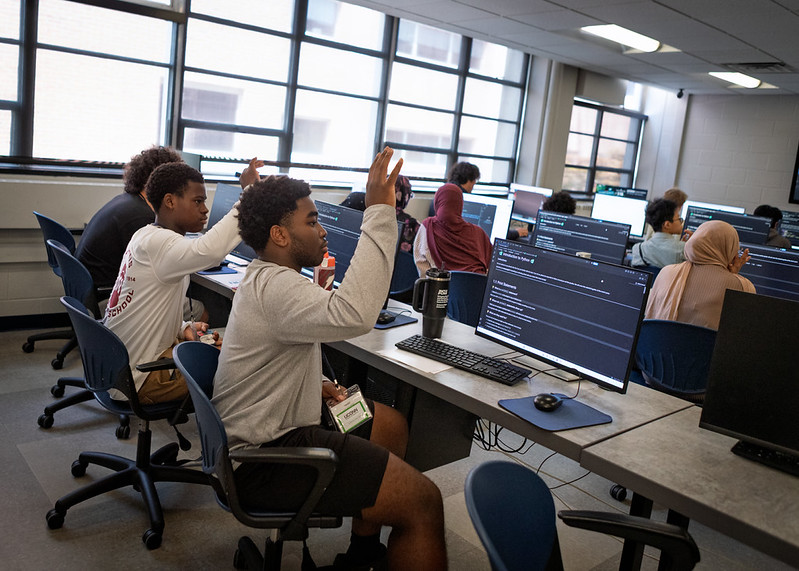
Campers from grades 8-12 gathered at UConn Storrs on July 27-31 for the immersive one-week program centered on the rapidly evolving field of AI. Through interactive games and hands-on activities, campers explored the algorithms, math, and programming that power AI systems.
Throughout the week, campers from 19 high schools across Connecticut, New York, and abroad, along with three homeschooled students, experimented with programming environments, trained AI models, and tested them through computer vision scavenger hunts and building their own video games. Alongside technical instruction, instructors challenged students to think critically about the responsible use of these emerging technologies.
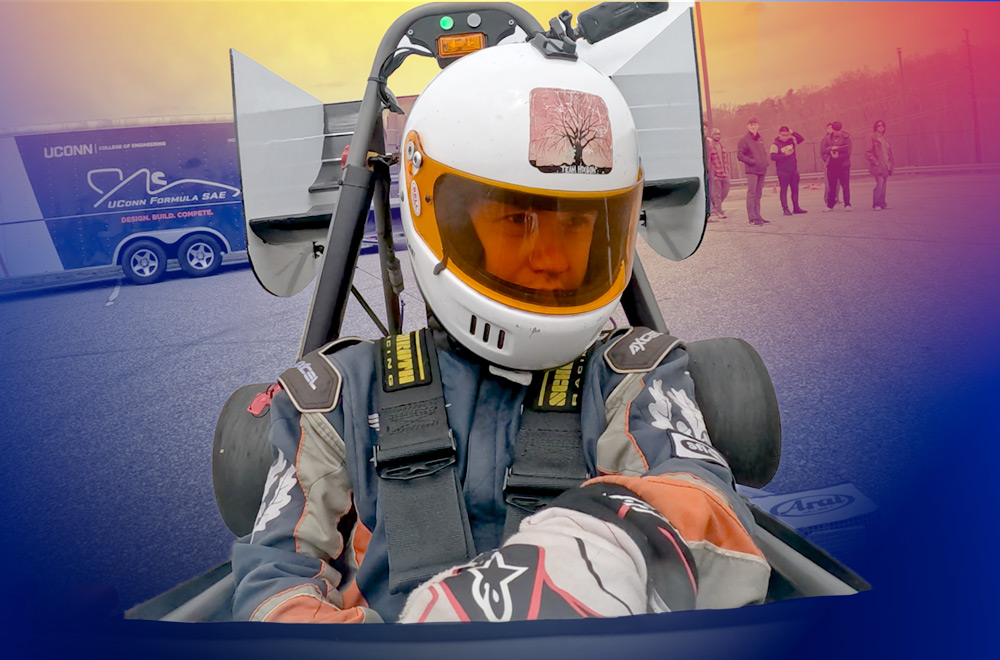
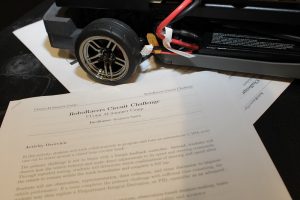
One of the week’s highlights took students beyond the classroom and into a UConn research laboratory. During their visit to the cyber-physics lab test track, campers met Keshawn Smith, an electrical engineering Ph.D. student who is developing technologies that enable vehicles to perceive their surroundings and navigate roadways safely. Campers connected the concepts they had learned throughout the week with the hands-on challenge of programming race cars to drive themselves.
“I wanted to lead this session because it gave students an authentic engineering experience where they could learn through experimentation rather than simply following instructions,” says Smith. “Watching teams test, observe, and refine their autonomous vehicles showed them that engineering is an iterative process driven by curiosity, teamwork, and problem-solving.”
Campers ended the week with a stronger understanding of how AI works, firsthand exposure to university research, and a clearer vision of the many pathways available in computing and engineering. Most importantly, the camp rounded out their learning with a session helping students build their understanding of the ethical thinking needed to evaluate AI technologies and their impact on people and society.
“There is a larger conversation in AI and social media about how today’s teens are constantly regulating potential harm,” says SoC Ph.D. student Sarah Bennett. “It is more important than ever to give teens the tools and language they need to have conversations and manage ethical dilemmas on their own.”
The camp is led by SoC faculty members professors Jinbo Bi and Aguiar, with activities coordinated by VII’s logistics team and workshops facilitated by professors Tingting Yu, Sheida Nabavi, and Yufeng Wu. Graduate student instructors serve as activity leaders throughout the week, supported by undergraduate counselors to create a fun computing experience in an environment that emphasizes collaboration, inquiry, and experimentation.
Beyond teaching technical skills, the program reflects the school’s broader commitment to preparing the next generation of innovators. The AI Summer Camp helps students develop computational thinking, problem-solving abilities, and the ethical frameworks to design technologies that serve society.
For more information about AI Summer Camp or to provide financial support for campers to attend next year, please visit the VII site. More photos are available online.