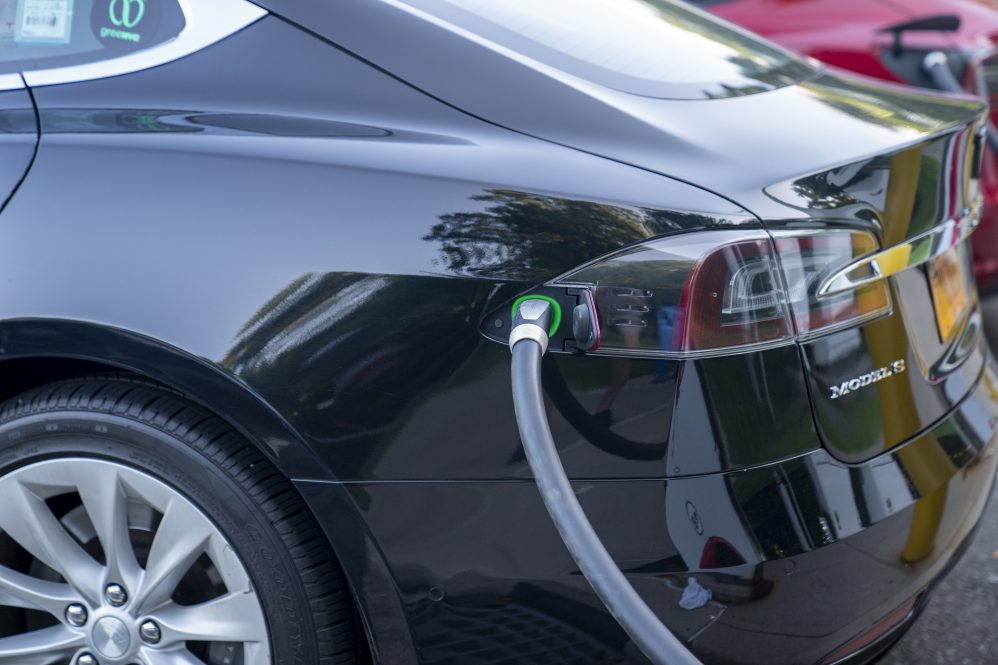
A recent United Nations report announced that we will likely surpass the 1.5°C limit for global warming by 2030. Despite this news, we need to continue trying to eliminate fossil fuel emissions. Since the largest component of household carbon footprints in Western countries is from private transportation, electrifying our vehicle fleet is a significant step we can take to reduce our fossil fuel dependence, but we need to ensure that we make this change as equitable as possible.
Electric vehicle (EV) charging infrastructure is not yet widespread enough and not everyone has access due to spatial and social disparities. Using Connecticut as a case study, UConn College of Engineering researchers – including Ph.D. student Omar Bustami, postdoctoral researcher Francesco Rouhana, associate professor Timothy Vadas, and professor Amvrossios Bagtzoglou – have developed a planning framework to help determine where there is great need for EV charging infrastructure, and where this infrastructure will help increase resilience and deliver energy justice. Their research is published in the Journal of Cleaner Production.
“EV infrastructure planning is much more complicated than just asking where do we have chargers. It goes beyond that,” says Rouhana. “A community may have limited charging access but also may also be dealing with flooding issues, high levels of pollution, they may not have transportation alternatives, or they may have other socio-economic vulnerabilities. Those issues interact and they must be viewed together, otherwise we risk missing the big picture”
This big picture approach aligns with calls from the UN Intergovernmental Panel on Climate Change (IPCC) for tailored, comprehensive policies to ensure the deployment of low-emission technologies works to overcome distributional, energy, and social injustices. Additionally, demand-side mitigation strategies like building EV charging capacity is a powerful way to encourage sustainable choices, as long as the efforts are intentional and well-planned, otherwise they risk re-enforcing existing disparities.
Rouhana says there are many existing tools available for identifying aspects such as vulnerability, environmental justice concerns, flood risk, or infrastructure gaps, but those analyses often consider the elements in isolation. The researchers considered these dimensions as four categories including EV infrastructure and transportation burden, flood risk, environmental burden, and socioeconomic vulnerability, to create the Electric Vehicle Viability Score (EVVS). Indicators for each category were assessed to yield an EVVS for each of Connecticut’s towns to show which communities experience the greatest intersecting burden, and which factors contribute to the burden.
Connecticut served as an excellent case study for the development and testing of the framework. Rouhana says unique qualities, including the state’s size, dense urban centers, affluent suburbs, rural communities, coastal areas, and variations in environmental and socioeconomic conditions across 169 different towns, meant many important insights were revealed, including distinct patterns of burden from location to location.
“We know that Connecticut is actively pursuing transportation electrification, but we have at the same time some inequity problems, for example, access to incentives is uneven. Usually, we see urban centers have stronger charging infrastructure while some rural and lower income communities remain underserved,” says Rouhana.
To illustrate how transportation electrification can reduce a community’s climate risk, consider that besides reducing emissions, EVs can act like mobile energy storage systems that add resilience to the grid, including by providing electricity during power outages. Rouhana says this is a vital quality to consider for building resilient communities, for example EVs can power emergency shelters or medical facilities where electricity is needed 24/7. This capacity is becoming increasingly important as climate change-driven extreme weather events become more frequent.
In terms of different geographic concerns, coastal communities face flooding and sea-level rise and while more affluent communities may have financial safety nets, that is not the case in low-income or marginalized communities, says Rouhana.
“We know that certain regions are underserved,” says Rouhana. “In our research, we saw a clear distinction between Windham and Litchfield versus Fairfield, where Fairfield had lower urgencies because of stronger existing infrastructure and socioeconomic advantages. Where infrastructure is needed most is not always where infrastructure is easiest to build, and equitable planning must consider both.”
Rouhana says the goal of this framework was not to just create a map or score, but to be the beginning of the planning process. With areas of need and possibility identified, this shows where funding should be prioritized to ensure EV infrastructure projects can provide the greatest benefits for underserved communities while reducing climate risk.
The researchers are planning to integrate a temporal dimension into the framework, says Rouhana, because communities, infrastructure, and climate will continue to change over time and considering these changes is important to track evolving needs in adoption of the technology, and behavior. The researchers are also working to make the framework scalable, down to neighborhood-scale, up so that other states can adapt the framework for their needs.
Rouhana says another important aspect they are developing is a way to integrate community feedback and involvement into the framework. Communities understand their needs best and they can give feedback through an iterative, collaborative process, that enhances the benefits of infrastructure development.
“It is important to ask whether the model reflects the real local needs, because unfortunately, most projects are implemented without the knowledge of the local community or the neighborhood,” says Rouhana. “We are trying to move from vulnerability to viability, from identifying who is burdened to helping decision makers understand where investment can begin to address those burdens. EV infrastructure is not just a charging location problem; it’s a community and resilience planning problem.”