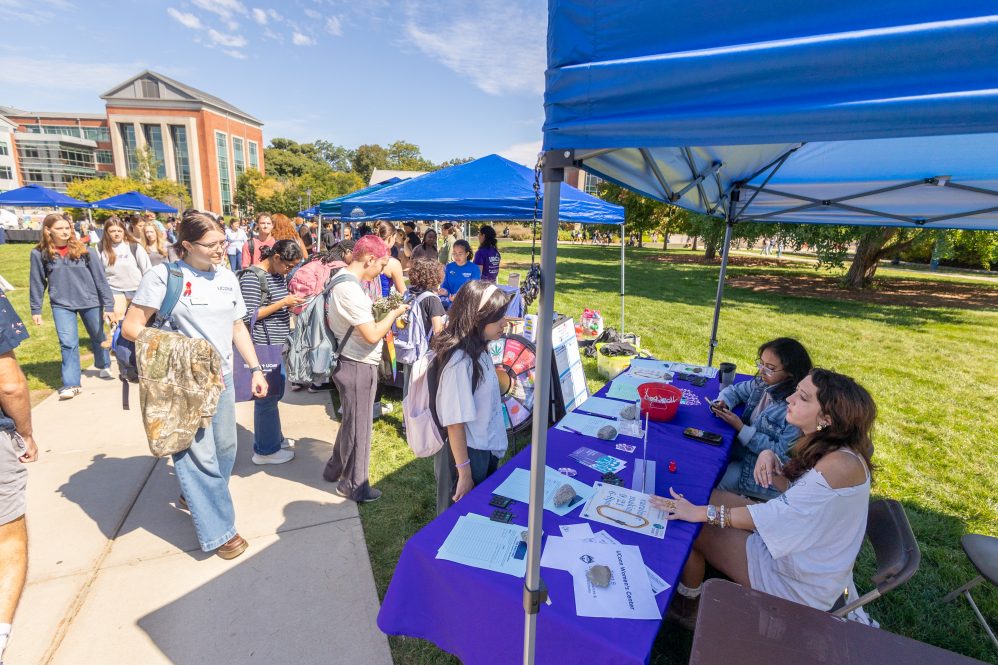
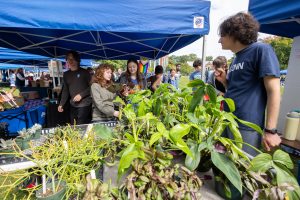
The University of Connecticut’s Student Health and Wellness (SHaW) office held their annual fall semester fair this month on the Student Union lawn at UConn Storrs, marking 40 years of the signature event.
SHaW partnered with multiple on and off campus clubs and organizations to launch the Sept. 16 fair, all dedicated to supporting the health and well-being of UConn students in all areas. Vendors ranged from UConn Dining Services to non-profits, mental health groups, physical and sexual health tables, school clubs, and many more.
Cassy Setzler ’12 (CLAS), a program manager at SHaW, was a coordinator for the fair. To make the event happen, Setzler said the fair was not coordinated overnight, with it taking several months to plan each year.
“In a couple of months, we’re going to start planning for next year,” Setzler said. “A lot goes into it behind the scenes, including lots of advertising, keeping in touch with vendors, getting donations for our raffles, even catering for our staff.”
Todd Gibbs, an Assistant Director of Health Promotion at SHaW, also said it is a long process, with lots of help from not only venders, but volunteers as well.
“This is an event that relies a lot on volunteers,” Gibbs said. “We have a crew of nearly 50 student volunteers that are reporting in for shifts in what is a very busy time in their lives. They’re taking time out of their schedules for this event too. The whole community is making this happen.”
When it comes to the wide range of vendors at the event, Setzler said it was an intentional split between UConn campus resources and community resources from neighboring towns.
“We do that intentionally because we have off-campus students and on-campus students that engage in all different ways,” Setzler said. We’re really intentional to make sure that we have a variety of resources for all students.”
Setzler also said this is a great opportunity for incoming students, especially first-year students, to become informed of the resources SHaW and other organizations provide.
“The first six weeks of a student’s time in college at UConn is a really important time to get acclimated with resources in a new place,” Setzler said. “You can’t succeed academically if you’re not succeeding in other areas of your life, including your health and well-being. Having a presence and supporting them [students] outside of their academics is just as important as the academic resources.”
SHaW also knowingly schedules the fair a couple of weeks after the start of the semester because of all the information students, especially those same first-year students, get hit with right away, Gibbs said.
“I think it’s a beautiful representation of all of the care we put into the student community,” Gibbs said. “Students get to meet people here, and it lets them know there’s actually people here who want to help out. This is one of the many ways we try and get the word out about all the support that is available.”
One of the on-campus resources that not only promotes the well-being of students, but people across the state, is the UConn American Red Cross Club. Katharine Enright ’28 (CLAS) is the secretary of the club and represented them at the fair.
“A lot of people donate blood through our blood drives on campus,” Enright said. “A lot of the blood donated goes to hospitals in Connecticut, including Connecticut Children’s Medical. It’s a great way to give back to the community and promote other people’s wellness.”
The William Benton Museum of Art was another on-campus resource provider attending the fair. Matthew Marshall, the curator of education at The Benton, said the mission of the SHaW fair is something he and the museum as a whole strongly believe in.
“The museum is pivotal in helping students because we are a place for all students and the campus community to come and unplug, rest and recharge,” Marshall said. “You are able to come in and take time to yourself to relax and not be overwhelmed by academics and the world.”
Marshall also said the Benton does community events for students weekly. These events are a way for students to build a support system on campus for themselves, Marshall said.
Among the off-campus groups and organizations at the fair was the Willimantic Food Co-op, a member-owned grocery store. Melissa Robichaud and Chris Jordan represented the co-op at the fair.
“We provide a lot of natural wellness supplements as well as gluten free, dairy free, and other special diet options in our store,” Robichaud said. “We work with over 40 different local farms and local businesses.”
A major problem for college students and young people is the rise of online gambling addiction. Better Choice Gambling Treatment Program is a community resource that provides outpatient counseling and recovery.
Barbara Kalpin, a peer counselor for Better Choice, said the majority of people contacting the program over the last couple of years are college students. The legalization of online gambling, as well as the rise of prediction markets, is the likely reason, Kalpin said.
“Every time you turn the TV on, you see an ad for online gambling,” Kalpin said. “College kids are jumping onto this head over heels. Everyone that has come up to our table knows somebody with an online gambling issue.”
The fair is only one of several events SHaW hosts for students throughout the academic year, Setzler said, citing the Student Sexual Health and Wellness Fair in the Spring semester as an example. A listing of programs and events can be found at the SHaw website.