There isn’t just one thing that Jenevera Abena Addai Mensah ’29 (ACES) is passionate about.
There’s many.
She loves color and art – choosing to wear bright reds, orange, and yellow – and bold patterns, a celebration of her African culture, she says.
“I feel like color makes everything more fun,” says Mensah, who was born and raised in Ghana, but lived in California and attended high school in Texas before coming to UConn last year. “I just love color.”
She’s passionate about her community, and about giving back to those in need in Ghana, women in particular.
“There’s something called the ‘no bed syndrome,’ where the hospitals in Ghana don’t have beds,” Mensah explains. “To the point that when women go into the hospital to give birth, they don’t have the resources to be able to deliver their child.”
And she’s passionate about building something of her own.
“My family is full of interesting entrepreneurs,” she says, “so everywhere I always went, they said I had a business mind.”
In the past, her “side hustles” have been things like a jewelry-making business, where she made beaded anklets and bracelets – she still has a stock of beads stashed away. During COVID, she started making lip gloss.
“That didn’t work out,” she laughs.
At one point, she says she thought she wanted to braid hair, but found it took too much time away from school.
“My education comes first,” she says. “That’s one thing my parents instilled in me. I don’t play about school.”
Now a sophomore at UConn, Mensah has her sights set a bit higher than bracelets and lip gloss. She’s been working for the past year to build a new venture, with expecting mothers in Ghana in mind.
And she’s done so with the help of the Werth Innovators Program at the Werth Institute for Entrepreneurship and Innovation, which has been helping first-year women, in particular, find their entrepreneurial footing for the past six years.
Impacting Women
First launched in 2020 by UConn’s Werth Institute for Entrepreneurship and Innovation, the First-Year Women Werth Innovators program was designed to engage diverse and multidisciplinary cohorts of first-year undergraduate women to provide them with mentorship, networking, and resources to develop their entrepreneurial skills.
In the U.S. alone, women own more than 40% of all small businesses, generating $2.8 billion in revenue and employing 12.6 million workers. Yet women still struggle in securing access to capital to support business ventures.
The program was designed to help push back against those struggles by supporting young women at the outset of their entrepreneurial journeys.
“The Werth Innovators Program helps students see themselves as leaders whose ideas deserve to be heard,” says Katie Britt, the Werth Institute’s director of leadership development who coordinates the program.
“Through a community centered on women’s leadership, students explore the challenges women face in entrepreneurship and technology, learn from one another, and build the confidence to turn ideas into action,” says Britt. “They develop an entrepreneurial mindset, gain skills to pursue their ambitions, and build connections that support them at UConn and beyond graduation.”
Once accepted into a cohort, participants in the program begin meeting in January to work on things like ideation and mindset as they prepare for a summer internship project, where many launch their own ventures.
In May, cohort members spend an extra week on campus at UConn Storrs together after spring move-out, giving them time to better get to know each other.
During their paid remote summer internship as a part of the program, the Werth Innovators meet virtually to develop their ideas through structured programming and alumni mentorship. Although they embark upon their entrepreneurial journeys individually, they collaborate, share ideas, and support each other relentlessly while developing résumé-building skills.
When Mensah – who has not yet decided on a major and plans to attend law school to pursue corporate law in the future – decided to apply and was later accepted into the program, she wasn’t sure what she was going to do, but she initially considered starting a nonprofit to help women in Ghana, either through direct fundraising and advocacy, or by selling a product.
“In the beginning, it was a lot of ideas,” she says. “At some point, I wanted to have a wine company, with the wine being made by women farmers in Ghana. Because my whole thing was that it has to be something that would impact women.”
Mensah also considered baby clothing or items, or a makeup line, or a stationery brand.
Clothing wasn’t even in the picture, she says. Until March 6.
“For Ghana Independence Day, which is March 6, I was wearing my palazzo pants, which have an African print. And Katie was like, ‘I really love your pants. Those are so cool, and look so comfortable.’ They really are. And I was like, okay, you like my pants? Let me see what I can do about that.”
Pants turned into skirts. Which turned into tops. Which turned into a brand.
Rise to the Challenge
With support from the Werth Innovators program, Mensah is launching NeeVera this fall.
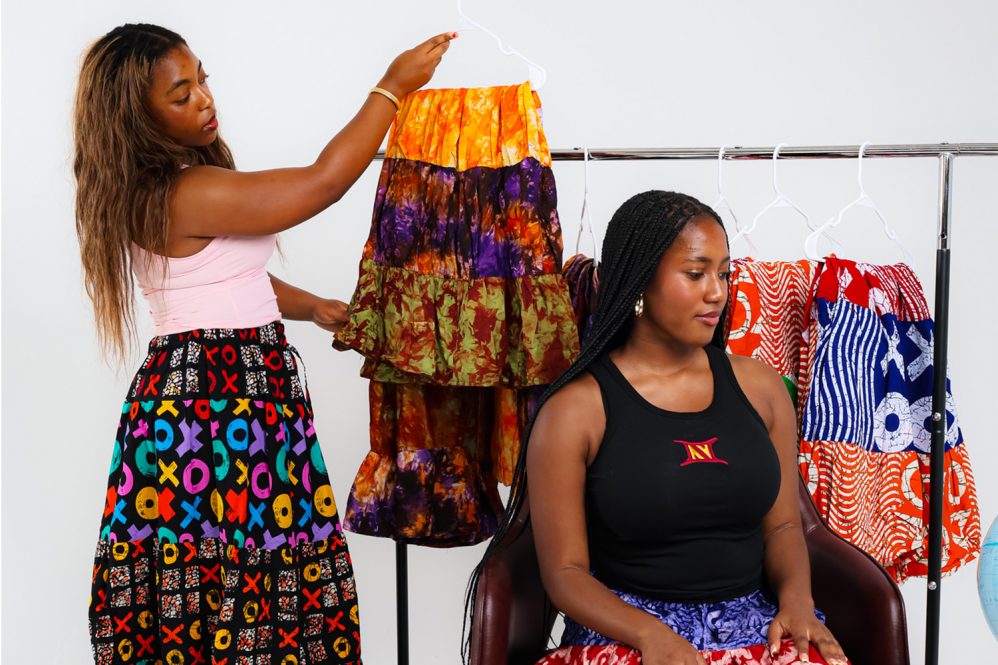
Her first capsule collection features size-inclusive designs crafted from colorful fabrics she found in Ghana, with each fabric selection only being used to make a small number of items.
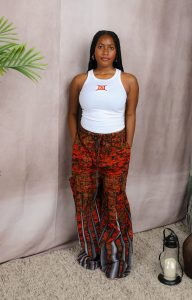
“I’m going to have skirts, pants, dresses, and then the brand signature logo with tank tops that are embroidered, all made in Ghana,” Mensah explains.
“I want something that embraces Africa, embraces our culture, embraces our color, and so I picked a whole bunch of fabrics, different fabrics,” she says. “And I told her, maximum you can make me of the same thing is three or four. I don’t want the same fabric into more than that. And everything is size inclusive. The skirts fit an extra small, then stretch enough to fit an extra large, because of how flared and flowy the outfits are.”
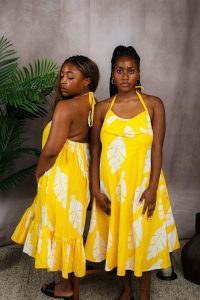
Each piece is made by a craftswoman in Ghana. Her promotional photos were taken in Minnesota when she returned from the summer – one of her sisters modeled for her.
She hopes to launch her collection in October. She plans to use the proceeds from any sales to help support expectant mothers in Ghana.
“I don’t believe that my brand is a solution,” she says. “I’m more like an aide where I cannot solve the problem. What I can do is try to support different maternity wards so that when a woman comes to give birth, she’s okay and not stressed out about where she’s giving birth and how she’s going to give birth. So that she can have a sound, peaceful birth to be able to birth a healthy baby.”
Throughout the summer – while connecting with her mentors and cohort remotely from Ghana, managing connectivity challenges, sourcing materials and learning about supply chains, and building her business plan – she kept that goal in mind.
“When Jenevera first told me about the ‘no bed syndrome’ in her home country of Ghana, her empathy for the women affected was clear,” says Britt. “As her idea evolved, her commitment to improving their lives never wavered. She embodies the spirit of a UConn student who listens to others, puts people first, and builds a venture with purpose.”
And Mensah also used inspiration from her peers in the Werth Innovators program, whom she bonded with during their extra week on campus together in May, to keep going, even when it was difficult at times.
“When you see people who are motivated to wake up every day and do something, you look at yourself and you check yourself,” she says. “I’m going to rise to the challenge, and be like my friends, and be like the people that I’m working with, so that we can all lean on each other, which is a big thing for me.
“During the summer, when you feel like you don’t want to wake up or you don’t feel like opening your laptop because it’s the summer, honey, do it – you should definitely do it, because this is a once-in-a-lifetime opportunity. I’m so proud to tell people I have a business. It feels good, it feels amazing.”
To follow Mensah’s progress on her venture, visit houseofneevera.com or follow her on Instagram @houseofneevera.
The Werth Institute is accepting applications for the next cohort of the Werth Innovator’s Program, Women’s Leadership Cohort, until October 25. For more information, or to apply, visit werth.institute.uconn.edu/WI.