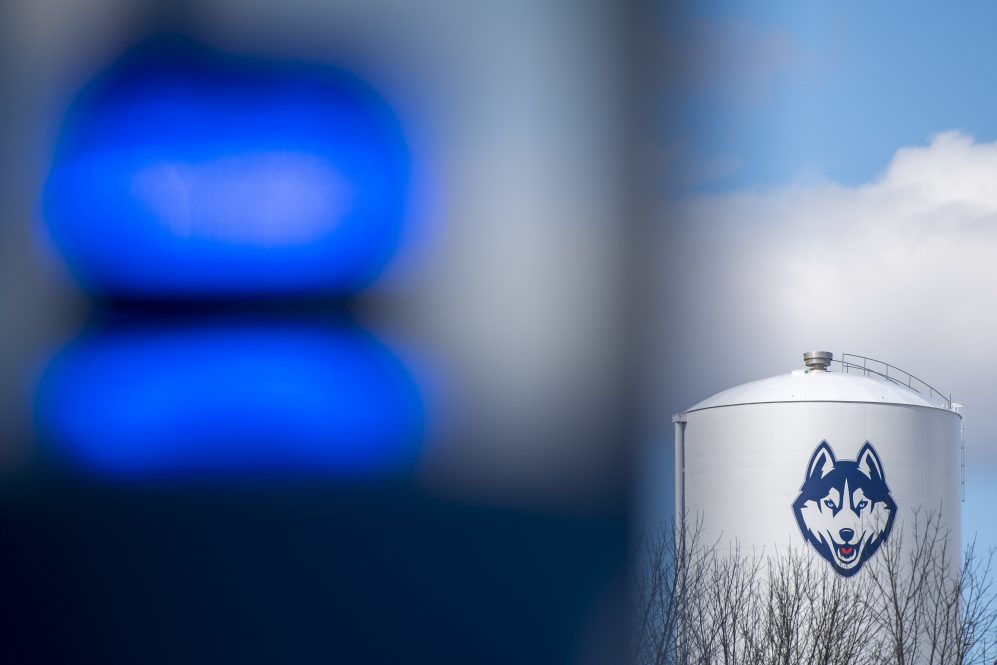
The safety of students, employees, and guests on our campuses is our highest priority at UConn, and a driving force behind decisions about how to best deploy resources and technology to achieve that goal.
The blue light emergency phone kiosks on our campuses were installed in the mid-1990s with those safety and security considerations in mind, using what was the most current technology at that time.
Their purpose was to allow someone to push a button that would connect them to University Safety to report an emergency if they were outdoors or otherwise did not have access to a landline phone.
In the approximately 30 years that have passed, the nature of telecommunications, and communication generally, has changed dramatically. When the blue light phone kiosks were implemented, cell phone technology was primitive by modern standards and cell phone ownership and connectivity was limited, including within the university community.
Today, three decades later, there is near universal ownership and use of cell phones here at UConn and across the nation. When seeking help or reporting an emergency, members of the community would typically use their cell phones to dial 911 and contact University Safety.
In addition, the University ‘s LiveSafe application allows for reporting through text, video, or calls directly to our emergency communication center. The State 911 system also allows for “text to 911,” routed through our Emergency Communications Center. QR codes are posted on all bus shelters and the University Safety website for students to download the LiveSafe app.
With the widespread adoption of cell phones in recent decades, the low volume of calls on the 1990s-era blue light phone kiosk system shows the community does not use or need it for its original purposes, and that it has become obsolete.
The phones have been activated 166 times over the past five years, almost exclusively as the buttons have been pressed for testing or out of curiosity.
Of the 166 calls, only two required a public safety response: one to report a concern about potentially being followed, which was investigated and determined to be unfounded; and one to report a vehicle collision near the Depot Campus and Route 44.
Supporting the largely dormant program and the costs associated with it is no longer practical or a good use of resources.
Maintenance expenses are at least $70,000 annually, and an estimated $6 million would be needed to update the phone system to ensure it meets modern operational, reliability, accessibility, and technological standards.
In light of this, the university will, with some exceptions, begin to gradually phase out the blue phone program on our campuses.
It is important to note that not all blue light phone kiosks will be removed, however.
While the number of blue light phones will be reduced at UConn, some will be left in their current location and maintained to continue to provide access. This includes phones located in areas where cell service is determined to be less robust than elsewhere on campus. The connectivity around each site is currently being assessed.
UConn is one of many institutions that have removed or started phasing out these phones, including UC Davis, New Mexico State University, University of Colorado at Boulder, University of Nebraska, Brigham Young University-Idaho, University of Wisconsin at Oshkosh, University of Tampa, Ohio University, Bowling Green State University, and others.
UConn prioritizes safety above all else, working to ensure its emergency communication systems are reliable, accessible, sustainable, and appropriate for the technology and needs of today’s campus community.