Imagine a scientist. Do they wear a lab coat, their name embroidered on the lapel? Do they squint through a pair of thick spectacles? Do they have white skin, or is it another color?
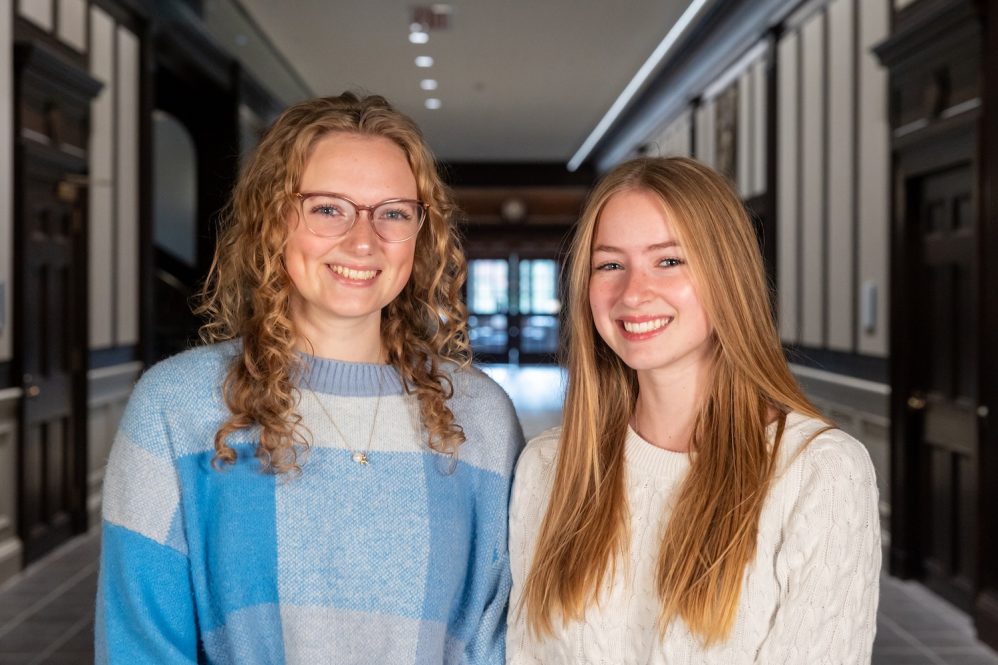
Sisters Lucy Homer ’27 (ENG, CLAS) and Kathryn Homer ’29 (ED, BUS) expect that when they ask the 8-year-olds in a third-grade classroom at Natchaug Elementary School in Willimantic to draw, not just imagine, a scientist, many of the pictures will look like Albert Einstein – not the young students themselves.
“Research shows that inspiring confidence in kids is incredibly important to making sure they don’t weed themselves out in third and fourth grade,” Lucy says. “One way to do this is to tell them over and over again they can be – and are – scientists and give them opportunities to practice confidence.”
That’s just what the sisters hope to do this academic year with their project, UConn-Willimantic Young Scientist Program, during which they’ll give once-a-month science lessons to two Natchaug classrooms. Their project is thanks to an IDEA Grant from UConn’s Office of Undergraduate Research.
“The STEM requirements at the elementary school level are very low,” says Kathryn, an accounting and elementary education double major who’s in her first year in the Neag School of Education. “They basically only learn about habitats and wildlife, and it’s so much more.
“We’re going to introduce them to all these different STEM-oriented careers that they could do. You don’t just have to be a chemist. There are so many options that kids don’t know about because they’re not exposed to them,” she continues. “We’re trying to do that and show them that no matter what, they could do it, regardless of what they look like or what they identify as.”
From Anatomy to Zoology
The concept for the Young Scientist Program came from the high school club Chem4Kids that each sister was president of when they had their respective turn as an upperclassman. The club brings science projects to various elementary schools to boost young students’ exposure to science.
Kathryn says she and Lucy lamented last year that UConn doesn’t have a similar club, so they conceived the idea of bringing some of the same experiments into an elementary classroom. They also thought it would be an opportunity to conduct their own scientific experiment to determine whether the experience would have any significant effect on the young students, namely by next spring do they see themselves as scientists.
The draw-the-scientist test, a technique borrowed from other much-larger research studies, is a way to get a baseline understanding of how the students broadly relate to STEM, Kathryn says. They’ll follow up with another survey later in the year.
But before then, there will be fun lessons in chemistry and biology, electrical engineering and genetics, astronomy and botany, Kathryn says, along with her favorite, environmental science.
“We’re trying to span all of science to show that if you’re scared of chemistry – you shouldn’t be scared of chem because chem is awesome – but if you don’t want to do chem, you can still be a scientist but through something different,” she says. “It doesn’t stop at something you think is difficult or scary. You can do something else that you like in a STEM-related field.”
Their first stint in the classrooms came at the end of September when Lucy and Kathryn stood before the young students and mixed two colorless reactants into a single container and magically turned the solution dark purple in seconds.
“I couldn’t believe my eyes when I saw it in my AP chem class,” Lucy says, thinking back to high school when she first saw the so-called iodine clock experiment. “It’s so fun. You could do it for hours and never get bored.”
You Can Be a Scientist
While they’ll have only about hour once a month with the students, the sisters have recruited the help of other UConn volunteers who also self-describe as STEM-oriented, if only to exemplify that scientists can have black or blonde hair, green or brown eyes, fair or dark skin, and be male or female.
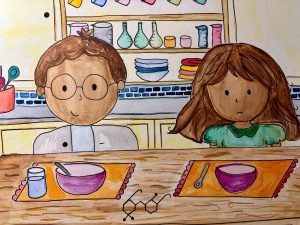
“Young students can look at these volunteers and say, ‘Oh, I look like you, and I could be a scientist too,’” Lucy says. “It can have a life-changing effect on the student.”
Kathryn agrees: “Research shows that as students get into middle school their interest in STEM decreases because of the past exposure they’ve had. It seems far too difficult, or if they’re a girl, they feel like they can’t do it, or if they’re a different race, they don’t feel that it’s accessible to them.”
Science, she continues, isn’t limited to a type of person or even to dissecting frogs. Not everyone who’s STEM-oriented has to go pre-med. Take her, for instance.
“I really enjoy STEM, but I enjoy education more. I’m very mathematical, and I really love chemistry. If I wasn’t going into education, then 100% I would be going into STEM,” Kathryn says. “A huge part of being a teacher is being passionate about what you’re teaching. Being excited about it is 50% of the lesson because it shows that the kids can also be excited about it.”
It’s a welcomed contagion Kathryn wants to spread in an elementary classroom one day.
Meet the Roes – Mack and Mike
As for Lucy, a biomedical engineering and molecular and cell biology double major, she says her first exposure to science was limited. Growing up in a small town and going to a small K-8 school, left her without many experiences beyond the basic elementary curriculum.
When the family moved to West Hartford, she says that all changed. That first year in fourth grade, she had to conceive her own science experiment and present it to the class. Then in sixth grade, she did a year-long study of synesthesia, and in seventh grade she spent the year looking at aphasia.
“That was life-changing when you have the opportunity to do a year-long project as an 11-year-old,” she says. “It made me feel really confident as a researcher.”
So, when she draws a scientist today, it might very well look like her. And because she knows the power in that, Mack Roe and Mike Roe – yes, think “macro” and “micro” – were created to be as ambiguous as possible.
Macky and Uncle Mike are characters in the children’s book tentatively titled, “Uncle Mike’s Glasses,” that Lucy is authoring thanks to a second IDEA grant for her solo project, Improving Scientific Literacy and Bolstering the Field of Microbiology Through Children’s Literature.
It’s a project she dreamed up while abroad in Edinburgh, Scotland, last fall when she took classes like art history and in her free time dropped into free art lessons where she picked up some painting skills and printmaking techniques.
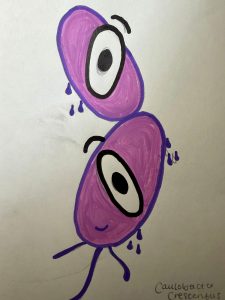
“At UConn in my molecular and cell biology classes, I was learning for the first time about microbes – bacteria, archaea, and fungi – and they’re so cool,” she says. “It’s crazy that we don’t really ever talk about them.”
Since then, she always thought it would be neat to turn images of them into cartoons. Thus was born characters like Lacto B., Lactobacillus, who lives in yogurt; Vibby, Vibrio fischeri, who lives in the water and glows; and C.C., Caulobacter crescentus, who’s stickier than glue.
“The big idea is Macky wakes up, looks out in the yard, and her bike is gone. She panics and runs to her uncle, Mike. She tells him her bike is gone, and Uncle Mike tells her to calm down and gives her these glasses. ‘Use these glasses. When you wear them, you can see and hear my microbe friends.’ From there, she goes on an adventure throughout her town, meeting with all these microbes who tell her where to look for her bike,” Lucy explains.
‘You get to be multidisciplined here’
Lucy says she drew all the characters with big eyes and with bright colors, not unlike the shades of blue, green, and red she’s seen in scientific images laid out in reference books. Only, she knows those bright colors are due to added dyes or the image-taking process. Microbes, on their own, aren’t particularly vivid.
The young children who read the book won’t necessarily know that, but she hopes her work gives them a better understanding of science than the children’s books she read to the kids she used to babysit, which always seemed to center on dinosaurs, insects, or underwater creatures.
“I remember I never loved the books that had pictures of dinosaurs and just stated the dinosaur name under it, and that’s it. There’s no story,” she says. “I think that’s really boring, unless you’re a super fan of dinosaurs. This is why kids don’t want to read a book about science because it’s just an image and an informational blurb. It’s like reading a textbook.”
The story of Macky’s search for her bicycle is anything but textbook.
“I haven’t taken a writing course since I was a junior in high school, and it was really important to me that the story rhymed, which was so much harder than I thought it was going to be,” Lucy says, adding that a rewrite at the end of summer changed the rhythmic pattern and made it so much stronger.
Once the text is done and illustrations final, she plans to print about 10 copies and use Kathryn’s connections to get a few into some local schools. The story itself then will go to a couple publishers for their consideration.
“In high school, everybody fits in their box. I was the science kid, but you could be an art kid or a music kid. Then I came to UConn, and I met all these students and professors who got to dance between areas. One of my good friends is a computer science major and a jazz major, and that’s normal, awesome, and encouraged,” Lucy says. “UConn helped me realize I can be a STEM student, but that doesn’t mean I’m not allowed to be creative and have fun hobbies. You get to be multidisciplined here. It’s encouraged through things like the IDEA Grant. I really love that about UConn.”