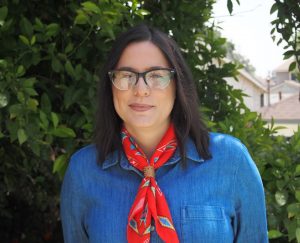
Kali Simmons has put lots of things on her resume in the last decade, but she never thought “wrestling in a river while dressed as a Puritan” would be her latest addition.
The assistant professor in UConn’s departments of English and Social and Critical Inquiry admits that getting in front of a classroom to teach is a bit of a performance – voluntarily stepping into a body of water as two cameras record every move of a pretend fight is something entirely different, a bit absurd really.
“It was cold,” Simmons says of the film shoot over the summer, “and it was hard to stay in one place. There were so many things you had to pay attention to: Make sure you don’t fall on a rock, make sure you don’t push someone onto a rock, make sure you’re still in frame.”
The exercise was part of Simmons’ jack-of-many-trades contributions to the upcoming feature-length film, “HANNAH,” which details the story of Hannah Duston, who in 1697 was taken by a group of Native Americans in a frontier raid on Haverhill, Massachusetts.
Duston’s newborn child died in the attack, and after weeks in captivity, Duston led the scalping of 10 Indigenous people, including six children, as she escaped. Her story – even the part about her husband’s fight for the scalp bounty from the Massachusetts government – became part of American folklore.
“It’s been presented as a story about the righteous revenge of a mother, with Hannah as the aspirational mother figure,” Simmons explains. “The question the film is asking is, ‘For whose children?’ Children become expendable in these kinds of discussions, and she killed six children. What we need to consider is she really the best mom to honor.”
Simmons, who studies captivity narratives and Indigenous horror and who created UConn’s course on the latter, initially served as a consultant on the film. That is, initially.
Like in many traditional documentaries, she was one of several academics to comment on Duston’s story and the multiple memorials honoring her, including statues in Boscawen, New Hampshire, and Haverhill. Today, those statues are up for debate – in one, Duston is clenching a handful of scalps.
A collaboration between Massachusetts filmmaker Siobhan Landry and Native scholar Angie Morill, “HANNAH” takes a twist in the second half.
Landry gets possessed and convinces those around her to do a series of odd things, Simmons explains, giggling at the thought of going into the woods to put on a Puritan pageant and dressing up in costumes for a night of wild partying.
“We eventually realize she’s possessed, and she tries to come after us. That’s when I fight her in a river, and in the scene, I’m dressed as Cotton Mather, a 17th century Puritan who collected captivity narratives,” Simmons says.
Foolery aside, Indigenous populations are no strangers to violence.
“Everyone knows someone who’s been killed or has gone missing, so while we might think that the threat of a Hannah Duston is something from the Colonial past, it’s not,” Simmons says. “There are silly things like fighting Siobhan in the river, but what the film asks viewers to consider is who gets to become grievable, who has historically been able to extend compassion across fields of difference, and who gets recorded. That’s what this film is doing.”
‘We make horror movies too?’
Simmons says she knew she was going to study horror from the time she got into grad school, having grown up listening to people recount their sightings of Bigfoot, ghosts, and aliens on the Art Bell radio program, “Coast to Coast AM.”
An affinity for the ghoulish punk rock band the Misfits, which offered Simmons a catalog of songs about horror movies, gave her entry to the genre, she says. As an undergrad, she started to watch and read horror through a feminist lens.
But in grad school, Simmons met Morill, herself enrolled in the Klamath Tribes and a prominent Indigenous scholar, and she was one of the first to suggest to Simmons that Native people also make movies, even horror films.
“The movie ‘Rhymes for Young Ghouls’ from Jeff Barnaby, a Mi’Kmaq director, had just come out and was one of the first big Native horror movies,” Simmons says. “I was dumbfounded. We make horror movies too? That was the pivot from horror broadly to Native horror more specifically.”
From Oregon, Simmons is Lakota enrolled in the Oglala Sioux Tribe through her mother. She says she grew up away from Native communities, but following her mother’s death reconnected to her heritage and shifted her professional pursuits.
This academic year with a fellowship from the UConn Humanities Institute, Simmons is working on her latest book, “Savage Screen,” that aims to study how Indigenous people have been represented in U.S. horror through things like ghosts – think of the haunted burial grounds in “Poltergeist” or “Pet Sematary” – and possession films, where someone is taken over by an evil spirit which prompts them to embark on a killing rampage.
“A lot of Native characters in animal attack movies, especially in the 1970s and 1980s, bleed through Red Power discourse that came about post-Wounded Knee, post-Marlon Brando having Sacheen Littlefeather speak at the Oscars,” Simmons says. “There was a breakthrough moment of Indigenous environmental activism that gets smooshed together with stories of land that has been wronged, taking revenge on the people who have wronged it.”
She continues, “There’s a good quote from comedian Joey Clift, who’s Cowlitz, who said something like, ‘Native people are so magical, they’re supernatural.’ So, anything we touch becomes a cursed space. There’s this idea that a place is going to take vengeance on the people who are living there now because the Native people in the past have been wronged, or as soon as Native people access some leverage to create revenge, that’s all they’re going to do.”
Scary Things Differ Person to Person
In her UConn class on Indigenous horror, Simmons says she starts by asking students to read something like “A Narrative of the Captivity and Restoration of Mrs. Mary Rowlandson” before moving into watching movies like “The Manitou” and “Ravenous” to look at how Indigenous people have been imagined in horror.
The second half of the semester studies Native-authored horror.
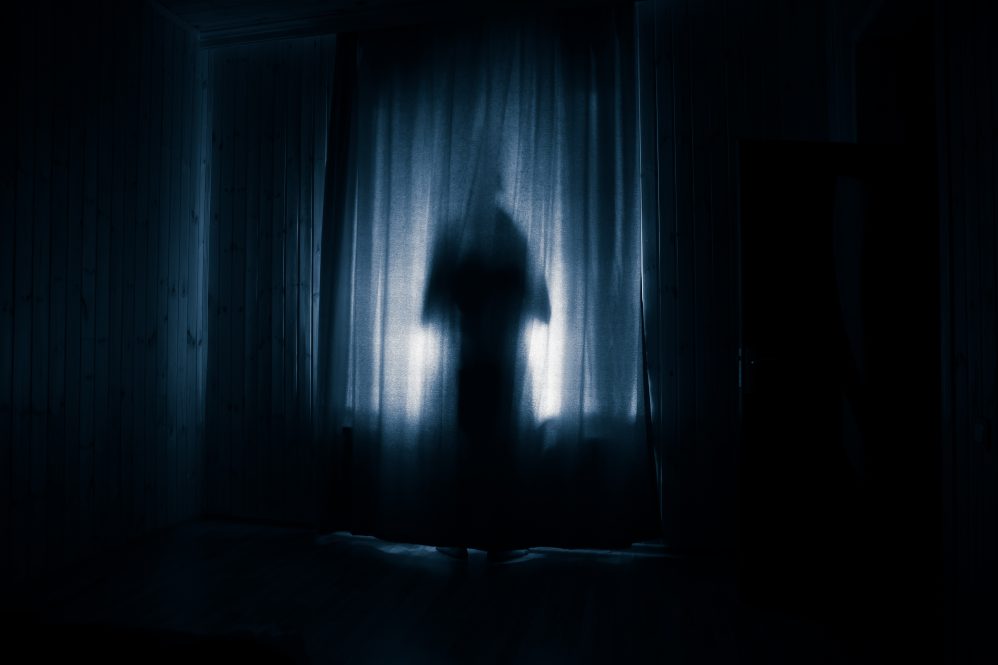
“Central to the class is thinking about how fear as an emotion is not an innate thing,” she says. “We tend to think everyone’s afraid of spiders and everyone’s afraid of ghosts, for instance. But when you start looking at Indigenous-authored texts, there are different understandings of what is monstrous. The baggage we bring to a text or a situation shapes our understanding of it.”
Central to the class is thinking about how fear as an emotion is not an innate thing. We tend to think everyone’s afraid of spiders and everyone’s afraid of ghosts, for instance. But when you start looking at Indigenous-authored texts, there are different understandings of what is monstrous. The baggage we bring to a text or a situation shapes our understanding of it. — Kali Simmons, assistant professor in UConn’s departments of English and Social and Critical Inquiry
By the end of the class, students are watching films like “Edge of the Knife,” Simmons’ favorite movie about a boating accident in the Haida community that causes a person’s death and the guilt that haunts and eventually changes the person who encouraged the deceased into the boat.
It’s a film that speaks to Native people differently than other audiences, she says, because it invokes struggles with substance abuse and sexual trauma in a way that’s specific to Native Americans, along with the idea of being adopted out of or otherwise leaving a community and later reintegrating into it.
“Students might not be able to see those things and also might not understand that the horrific thing that happens in the movie is not this transformation into another being, but a transformation into another being that severs your relationship with your community,” Simmons says. “By the end of class, it’s interesting to see them be able to pick up on that and to understand that fear of being isolated from your community is a very different fear than a big, scary monster that chases you with an ax.
“Often, the West has conceptualized horror and science fiction as ‘what-if’ genres. What if someone decimated your community? What if a terrible disease kills everyone? Native writers are often not writing from a speculative tradition. These things have happened to us, and how do we persist, produce change, and build capacity for us to continue in the face of this,” she adds.
These days, between Halloween in October and Native American Heritage Month in November, Simmons and her expertise are in demand.
She suggests as both approach that people keep in mind that dressing as a Native American for trick-or-treating or other merriment is not OK. Watching Native horror movies, though, is something she encourages.
Also, she recommends those like her who plan to enjoy seasonal activities like graveyard tours or ghost walks to reflect on their participation in systems of exploitation.
“Be mindful about where your fears come from. When my students say, ‘Well, that’s just human nature.’ I ask where our understanding of ‘the human’ comes from. Where does our understanding of nature come from? Understand that these things are culturally, individually, familially taught to us. There are lots of other ways of thinking about horror and scary stuff,” she says.