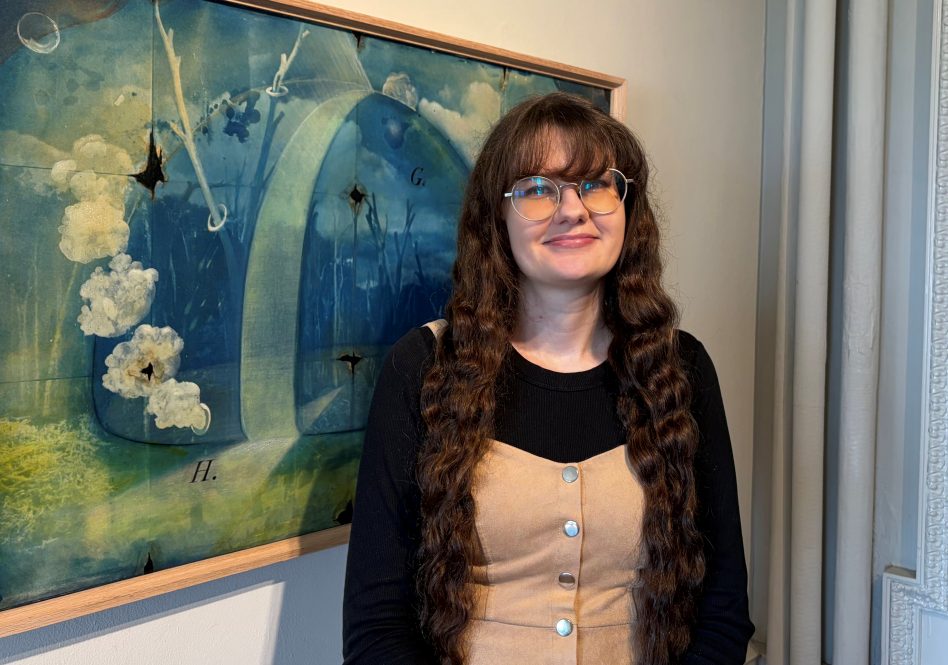
As a young girl, Dakota Halliburton would sit at the holiday table sandwiched between relatives – cousins, aunts and uncles, grandparents – hanging onto every word they shared about work and school, projects and people.
Some in the family orally conveyed their thoughts, while others signed them in American Sign Language as the blended group of hearing and deaf kin came together like any family for any celebration.
Halliburton was born deaf, the daughter of two deaf parents, and sister to four hearing siblings, and says she picked up lip reading from the relatives who didn’t know how to sign and became a good speller from those who could sign only the alphabet.
“There was a very mixed level of communication going on,” Halliburton ’27 MFA says through an ASL interpreter about her family gatherings. “I sat there, chin on the table as a little child, and watched everyone speaking and interacting. I just loved those times, and thought I could relate what happened around that table – the concept of deaf and hearing people coming together – through art.”
A photographer who also works in mixed media, Halliburton is making her curatorial debut Nov. 5 with the opening of her show, “Let’s Have a Conversation at the Dining Table,” at the Alexey von Schlippe Gallery of Art at UConn Avery Point. The show brings together nine artists – four hearing and five deaf – from around the world to showcase their work.
“I want visitors to realize the connections they never thought about before that exist between the hearing and Deaf communities,” Halliburton says. “There are differences, of course, but at the same time we all get up in the morning, make coffee, and go to work, deaf or hearing, it doesn’t matter. We move through life having similar experiences just using different languages.”
Rooted in Tradition
Halliburton came to UConn for graduate school after growing up in Texas and moving to New York in 2020 for her undergraduate work at Rochester Institute of Technology. She came to Connecticut after being wooed by UConn’s Department of Art and Art History and the prospect of putting together her own gallery show.
Pursuing a career in art was a natural move, she says, describing a childhood filled with crayons and paper, a toddler-sized art desk, and imagination. She’d draw for a while, then burst into the outdoors to pantomime a sword fight with her older sister.
Her Dad’s mom was a heavy influence on Halliburton, she says, the elder an artist who specialized in drawing the horses she saw on ranches around the Lone Star State.
“My grandmother was Deaf as well, same as me, the only deaf child in her family. She was excited to pass that tradition of being the Deaf artist in the family down to me. I would always watch her and was fascinated by her work. It’s in my blood,” Halliburton says.
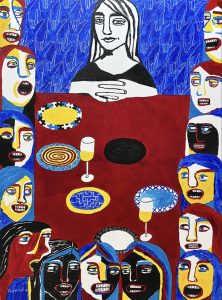
While Halliburton says she discovered photography in high school, the experiences she had growing up have defined her art today, which oftentimes overlays things like embroidery, lithography, or printed text on top of photographic images to describe the sounds she imagines she’d hear in the photo.
It’s a technique borrowed from a game she’d play with her sister, she says, when that sister would try to explain what the things around them sounded like – a bird chirping, a car muffler chugging, a tree rustling.
“Being Deaf does influence my work. It’s something that I feel like I can share with the world,” Halliburton says. “I enjoy being Deaf. It’s part of my identity. I don’t use my voice, but there are deaf people who do. Deafness is not a monolith. There are different communication styles. I prefer to sign and not use my voice.”
She continues, “A big part of our culture is accessibility. Our schools, the way that we grow up together, the way that we teach each other to advocate for ourselves, learning from Deaf teachers, exposure to Deaf professionals, all those things teach us that we’re not limited, that our culture is on par with any other. When I sit down with hearing people, and I’m there with my interpreter, I tell the person to look at me, not my interpreter. I’m the person you’re talking to.”
‘A nutritious meal’
At UConn, Halliburton says she’s run out of art history courses to take – the last several years have been chockablock with them. Now, she’s been focused on the “Dining Table” exhibition that’s the culmination of a couple years of work with gallery director Jeanne Ciravolo.
Not only is Halliburton the first Deaf person to have a graduate assistantship at the AVS Gallery, but she’s the first Deaf person in the MFA Studio Art program at UConn, she says.
“UConn has allowed me to grow as an artist, and I’ve helped UConn grow too,” Halliburton says. “Being the first Deaf student in the program, they asked me if would help make the program more accessible to other Deaf students. Of course, I was very willing to help improve and make things better for those who come after me. I’ve become a better person because of it, and the program has become better because of it as well.”
Halliburton’s eyes widen when asked what she’s learned from working with Ciravolo and building the exhibition. So much, she says, from learning to talk to other artists and conveying the show’s concept to narrowing her own objectives and tempering her expectations.
She found most of the artists on social media, people she’s admired and followed for some time, she says. When artists from as far away as India and Australia agreed to participate, she was overjoyed. When someone as noted as Chella Man agreed to include his video “The Beauty of Being Deaf,” she couldn’t stop smiling.
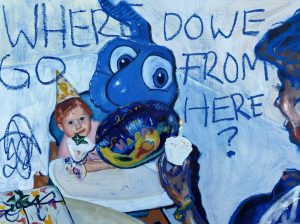
About 30 pieces will be on display in “Dining Table,” which will run through Dec. 6.
In preparation, Halliburton says she’s been learning bits of British Sign Language and Australian Sign Language. She explains there are over 360 signing languages worldwide, not just ASL – and the written word in English is her second language, she reminds.
Even as the international artists are unlikely to attend the show’s opening reception in early November, Halliburton describes them as friends, people with whom she’s developed a bond despite distance. That’s one reason for learning other sign languages.
“When I was developing this project, I considered sharing my own work,” she says. “But I backed off that and realized, sure, this show is about me but it’s more about my words and my perspective. Jeanne has given me so much permission to curate the show the way I envision it and has given me the skills to do so. They’re lessons I will be able to take into the future.”
That future might just be a Ph.D. program in Europe, she says, admitting that while she’s enjoyed her time on the East Coast, she’s a Southern girl at heart, and someone who doesn’t stay in one place too long.
For now, though, Halliburton says of her exhibition, “I want this to be a groundbreaking experience. I want to feed people’s curiosity. That’s the meal I’m talking about, gathering around the dinner table. When we share experiences, it’s a nutritious meal. My job is to support and enable that.”