It’s one thing to pour your heart and soul into a complicated project for an important class.
But almost 40 UConn business students, all juniors and seniors, recently spent two months brainstorming, analyzing, and preparing presentations about companies they considered potential candidates for leveraged buyouts. And they did it all during their free time and on top of their other commitments.
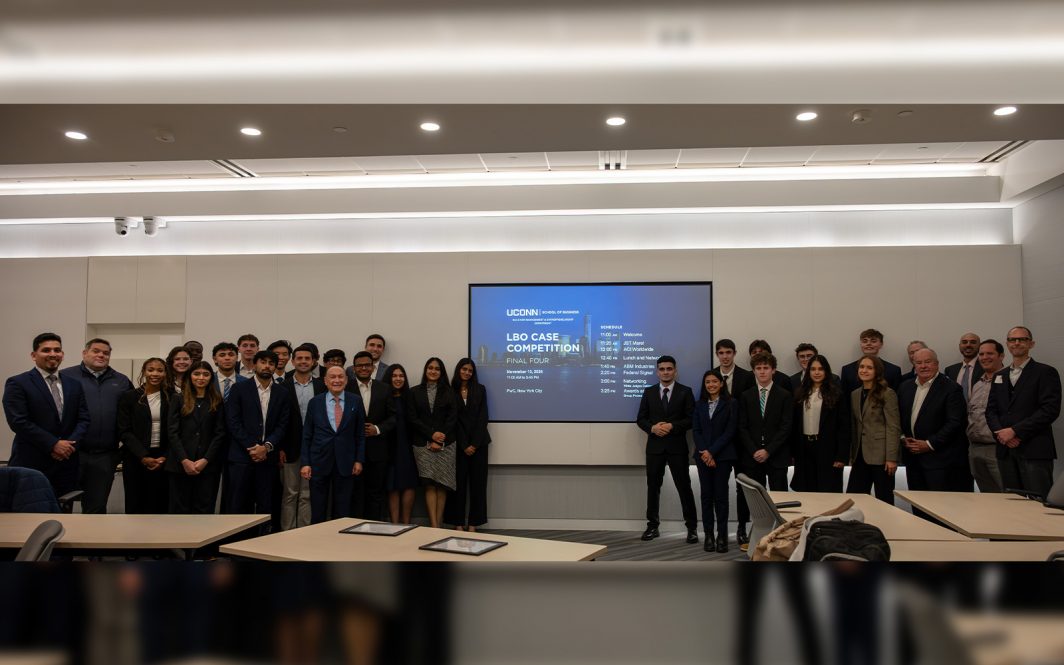
The LBO Case Competition concluded on Nov. 13, with the Top 4 teams awarded a total of $10,000 in prize money. The presentations and ceremony took place at the PwC offices in Manhattan.
Some 80 students expressed interest in the competition, but participation was capped at 40. Each of the 10 teams was paired with alumni mentors and industry professionals as they perfected their presentations. The project was almost as demanding as a 3-credit course.
Creating Something Tangible for Job Applications, Future Jobs
Professor Sami Ghaddar teaches business strategy and spearheads the case competition, now in its third year. He said it was important to expand participation beyond finance students.
“I wanted to draw participation from across the School of Business. It is important for students to know about leveraged buyouts, how to build detailed financial models, conduct due diligence, and evaluate risks,’’ he said. “I wanted them to create something tangible to use in job applications and industry and maybe even consider adding a double major.’’
By the time they faced the judges, the four finalist teams had developed sophisticated presentations.
“Was I impressed? 100 percent,’’ Ghaddar said. “Overall we were quite impressed with the levels of analysis, complexity, and how they dealt with the judges’ questions. They all did something fascinating. And many of the juniors want to do it again next year!’’
“It made me proud to see them draw on what they’d learned in class and then expand on that using their own judgment,’’ he said. “I think that speaks to the quality of the education our students receive at the School of Business.’’
One of the Biggest Takeaways: The Value of Feedback
The first-place winners, who received a $4,000 award, were: Cody Kiesman, Kabir Ramnani, Vihaan Shah, and Elijah Williams. The second-place finishers, Dev Gorasiya, Julia Miller, Riya Sabadra, and Ryan Tzou, shared a $3,000 prize.
Third place and $2,000 was awarded to Braden Fruin, Elshan Guliyev, Arya Pandya, and Jacob Potok. And the fourth-place finishers, Walther Arapa Herrera, Akosua Hansen, and Anneliese Ovalle, received $1,000.
Hansen, a junior majoring in finance, said the project was intense.
“I most enjoyed getting to approach a company the way an investor would, using research to build forecasts with limited information. It gave me a real appreciation for the judgement behind every assumption in a valuation,’’ she said.
“The prep was as difficult as we anticipated. Picking a company is really just the beginning. Every number in the model has to be research-backed and the model and presentation have to tell one consistent story,’’ she said.
Mentor Spencer Vlandis questioned the team’s assumptions and drove home the need for analysis to be consistent, making the final presentation stronger, she said.
“My biggest take away is the value of feedback. Every round of review reveal gaps that we simply wouldn’t have spotted on our own and the real lesson was in learning to embrace those questions and use them to improve,’’ Hansen said, adding that the experience will be an asset in her job search.
Senior Vidhi Hemal Parekh not only learned about how to evaluate a company’s appeal for a potential leveraged buyout, but she learned how to deliver a strong presentation.
“My biggest workplace takeaway was the importance of collaboration, adaptability and being receptive to feedback,’’ she said. “Throughout the competition, we constantly refined our analysis and questioned our assumptions. I learned that it is not just about finding the right numbers but also understanding the reasoning behind them and being able to confidently communicate and defend your decisions.’’
An analytics and information management major, Parekh said the competition pushed her outside her comfort zone, and allowed her to expand her financial knowledge beyond coursework. Although it was a tremendous undertaking, the mentors’ guidance and advice made it a great learning opportunity and one that will be valuable in her career, she said.
Students Really Stepped Up
Judge Mark Shenkman, the founder, president and co-chief investment officer at Shenkman Capital, said he was impressed by all the teams.
“I thought they all did a fantastic job. They were all very articulate and their presentations were very good. The caliber and the quality was so good it was difficult to choose the top team,’’ he said.
In his professional opinion, having demonstrated both their ability and ‘real world knowledge’ will be incredibly valuable for the students as they enter the working world.
“They have all demonstrated a tremendous passion for finance. They are an impressive group of students who devoted a great deal of time and effort to this competition,’’ he said.
Fellow judge Edward Lange, co-founder of Intellego Capital Partners, agreed.
“Our unanimous view was that the work product, level of analysis, and professionalism on display was of the highest quality,’’ he said. “Professor Ghaddar led the way in crafting a thorough program for the teams to follow, and the alumni mentors were great coaches. The students really stepped up and demonstrated what experiential learning is all about.’’
Alumni Say They Are Happy to Give Back to Students
Ten alumni volunteered to coach the teams.
Mentor Nick Carroll, a principal at Churchill Asset Management, said he enjoyed working with the students. “They impressed me with their curiosity, desire to learn and competitive drive to win the competition,’’ he said. “This experience provides students with a great learning experience, as well as a great networking experience both across the business school and the great UConn alumni base.’’
Vlandis, an associate at Audax Private Debt, said students rose to the challenge, and demonstrated a commitment to producing sound investment recommendations. He credited Ghaddar for his professional approach, emphasis on clear communication and high standards.
“Over the past few years, Sami has also done an excellent job connecting the program with alumni from a wide range of banking and investment backgrounds,’’ he said. “Having taken part myself, I can say that the experience and network the program offers benefits mentors as much as students. I believe this is part of why alumni mentor retention is so strong. I’m looking forward to more years of this competition.’’
Competition Part of Ever-Growing Experiential Learning Portfolio
The program is supported by the Boucher Departmental Grant Program in the Boucher Department of Management & Entrepreneurship. It is funded by alumna Toni Boucher and her late husband Bud. The program prioritizes transformative education experiences, like the LBO case competition, said department head Travis Grosser.
“Because of its tight ties with industry mentors and judges, whom we can’t thank enough for their service, the LBO case competition falls into our ever-growing and ever-improving portfolio of experiential learning,’’ said Interim Dean Bob Day, who attended the event.
“Our experiential learning programs simulate real work conditions and, as in this case, give students the direct feedback from real experts who work in the industries they are interested in,’’ he said. “In the end, this gives them the confidence they need to start out and maintain their early careers at the highest level possible. In the AI age, the development of confidence, communication, creativity, accountability, and critical analysis is going to be what sets our students apart. The LBO competition is a great example of a program doing all of these things for our students.’’