Mimicking a ketogenic diet lengthens lifespan but reduces fertility in fruit flies, researchers at the University of Connecticut and Mount Holyoke College report in the November 2025 volume of Developmental Biology. The study hints that there could be ways to get the benefits of a ketogenic diet without the difficulties of maintaining it – but there are downsides.
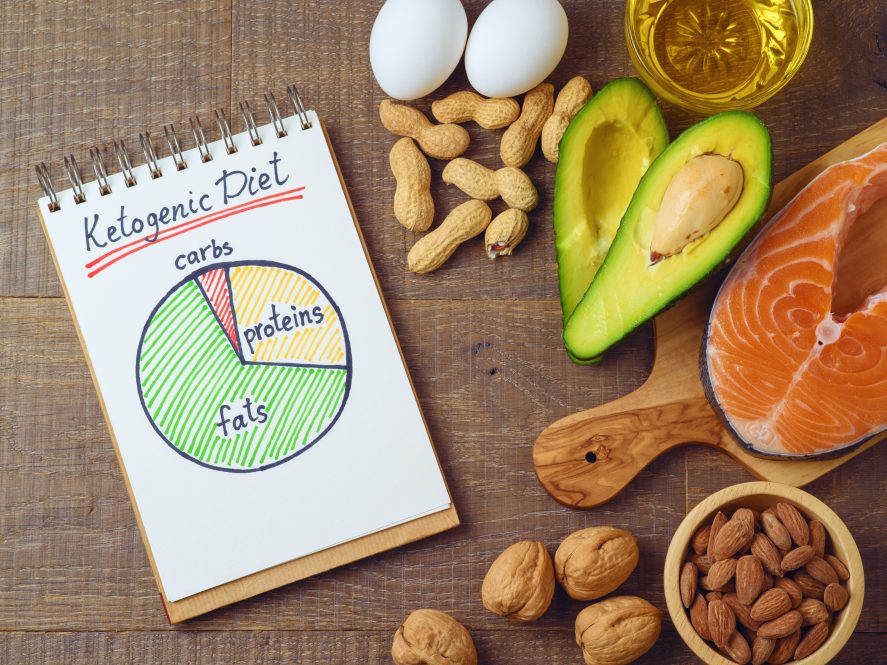
Ketogenic diets (commonly called keto diets) are high in fats and low in carbohydrates. They force the body to use fat for fuel. People with diabetes and children with epilepsy can use such a diet to keep their disease in check over the short term, but the lack of fruits, vegetables, grains, or sweets makes it difficult to maintain over the long term. Ketogenic diets are also commonly used by people seeking to lose weight.
Scientists have found that ketogenic dietary treatments can extend lifespan in mice. But the diet has to be maintained over long periods of time in the animal’s life, equivalent to years for humans. It hasn’t been clear why it extends lifespan. There are hints that the ketogenic diet, and the resulting ketone bodies made by the liver and released into the blood, significantly changes the body’s biochemistry and metabolism. Eating ketone bodies also seems to slow down the growth of fruit fly colonies.
That last observation was made by Derek Lee ’18 (CLAS) ’20 MS, who recently earned a Ph.D. at Boston College. Soon afterwards, an undergraduate at Mount Holyoke named Fangyi Zhai found that fruit flies on a diet supplemented with ketone bodies had higher levels of the active form of a protein involved in recycling old cell components into new ones.
Lee and Zhai’s supervising professors, UConn behavioral neurobiologist Geoffrey Tanner and Mount Holyoke College developmental biologist and biochemist Craig Woodard, were former colleagues. Discussing their students’ findings one day, they decided to run a study together that looked at three things: whether a diet supplemented with ketone bodies really did reduce flies’ fecundity and development; how it reduced it; and what was going on with the flies’ metabolism that would lead to extra amounts of that cell-recycling protein.
In their experiments, the team of researchers raised a colony of fruit flies on the standard high-carbohydrate diet, but with the addition of ketone bodies. Cells in the body can use ketone bodies as an energy source. Normally the liver makes ketone bodies from fats when carbohydrates are scarce, but the researchers fed the ketone bodies directly to fruit flies, mixed with the flies’ regular diet. The flies were allowed to eat as much of the diet as they wanted.
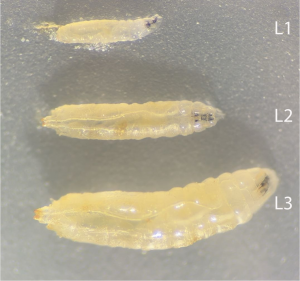
The results showed that female fruit flies on the ketone body supplemented diet laid about 14% fewer eggs than fruit flies fed the standard diet. And fly larvae fed the ketone body supplemented diet developed more slowly than normal, and fewer of them managed to fully develop into adults. The larvaes’ fat bodies (the fat body is a fly organ akin to the liver and fat tissue in humans) contained more of the active form of the cell-recycling protein, suggesting their metabolisms were different than larvae fed a normal carbohydrate diet.
“It’s remarkable that we haven’t had to do any crazy manipulation—no intermittent fasting, no caloric restriction, no starvation, no low carb diet, none of that,” and the flies still have delay in development and extension of lifespan, says UConn’s Tanner. It suggests that the ketone bodies might be signaling to the body’s metabolism rather than just feeding it. And that could mean that people who need ketogenic diets to maintain their health might be able to get similarly good health results from a less restrictive regimen, by eating ketone bodies as part of a more normal diet.
The effect on fertility was also significant, and women trying to conceive may want to avoid a ketogenic diet. The researchers intend to run the experiment again and do a fuller analysis of proteins and metabolism to get a more complete picture of the changes the ketone body-supplemented diet causes.