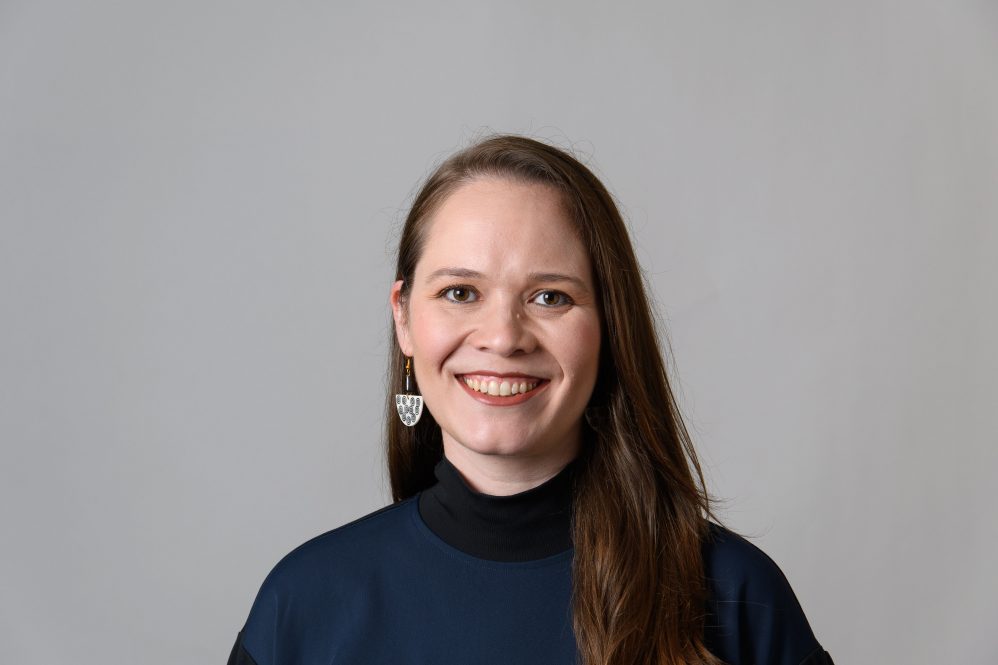
Starting as a first-generation transfer student at San Diego State University, Anna-Michelle McSorley didn’t even have public health on her radar as a potential career.
As a psychology major, she gradually became aware of and interested in the field through community engaged research opportunities in health and health care.
Working at the University of California, Los Angeles (UCLA) David Geffen School of Medicine, McSorley managed clinical trials involving low-income patients with end-stage renal disease waiting for kidney transplants which, for some, can be a decades-long process.
“It’s extremely valuable to be able to provide care once folks are sick and in need of an organ,” McSorley says. “But there’s so much work that can be done ahead of that, and that’s what called me and pulled me into asking that question.”
Given this pull towards disease prevention, McSorley pursued her studies at the UCLA Fielding School of Public Health, earning her master of public health and Ph.D. there. She worked in the then-newly established Center for the Study of Racism, Social Justice, and Public Health. Subsequently, McSorley spent her postdoctoral years at the New York University School of Global Public Health in the Center for Anti-Racism, Social Justice, and Public Health.
McSorley credits federally funded pathway programs as essential to her early development as a health researcher. She was supported by the Ronald E. McNair Scholar Program funded by the Department of Education, as well as the Initiative for Maximizing Student Success and Diversity funded by the National Institute of General Medical Sciences. These programs financially supported McSorley’s research training during the foundational years of her academic career, allowing her to craft a career in research and academia.
McSorley is now an assistant professor of allied health sciences (CAHNR) at UConn Waterbury.
McSorley, who is Puerto Rican, has focused her public health research on Latino communities.
“There was a personal call to do something to address the needs of my community,” McSorley says. “I had an intimate understanding of the many social-level injustices that were being experienced in that community. But I never had the language to understand what that was.”
McSorley is an author in the first-ever issue of the American Journal of Public Health dedicated to Latino health, which came out in 2024. McSorley contributed to three articles within the issue.
McSorley authored a paper in this issue that focused on how federal U.S. policies related to emergency aid through FEMA (Federal Emergency Management Agency), Medicaid, and political representation exacerbate health care inequities in Puerto Rico, a U.S. territory.
This policy-focused scholarship led to her appointment as the Policy and Advocacy Chair for the Latino Caucus for Public Health, and her designation as a Governing Council Representative for the governing body of the American Public Health Association, the largest national professional organization in the field.
There was a personal call to do something to address the needs of my community. — Anna-Michelle McSorley
Many of the existing health challenges McSorley has identified in her research are poised to be exacerbated by funding cuts to health care on the federal level.
“In this political moment, the states actually now find themselves having to face many of the same decisions Puerto Rico has had to face for years about how to manage their programs locally and what services they will and will not be able to provide to the population,” McSorley says. “In that sense, it’s a pretty good example to look to see what the implications are of making such cuts and the harm it causes to larger population health.”
McSorley presented on her work at a packed panel at the 2024 meeting for the American Association for Public Health (APHA).
“That was a pretty significant moment in my career as a junior scholar to realize I have published some pretty significant pieces in an area that has been under explored, elevating the population that I have a very close tie to in my scholarship and my lived experiences, and that people actually want to show up,” McSorley says. “There’s need, people want to be there. The energy in the room was amazing.”
Another node of McSorley’s work is focused on pushing for the disaggregation of population health data. Most data collection in the U.S. lumps all Latinos into a single ethnic category. However, this group contains dozens of unique populations with their own health needs.
“I have long pushed for the disaggregation of those data systems [maintained by the CDC] so that we can see what’s happening specifically in the Latino community and even more specifically in all the distinct, diverse communities that are represented in the Latino community,” McSorley says.
McSorley published a paper earlier this year comparing health outcomes for U.S. territories to each other and the States. She identified significant disparities when it comes to general health, especially in Puerto Rico. This was a unique opportunity as the territories are rarely counted in U.S. health data, which McSorley discussed in another publication.
Part of McSorley’s research practice is making sure that the communities she studies as well as policymakers have access to her findings.
McSorley has been to the state Capitol in Hartford multiple times since starting her position at UConn Waterbury in 2024. There, she has presented at public policy summits focused on Latino and Puerto Rican health in collaboration with El Instituto and the Puerto Rican Studies Initiative for Civic Engagement and Public Policy at UConn.
“There’s a lot of UConn collaboration to make it possible for investigators to make their way to the Capitol,” McSorley says.
McSorley engages her students in these activities, inviting them to join her at the Capitol to learn from the summits. She also mentors student researchers.
“The more that I can enroll students in that training trajectory so that they too can learn how to produce the evidence that will ultimately have positive impacts for the communities they seek to serve, those are moments of joy,” McSorley says.
McSorley’s next project is focused on civic engagement. She is interested in understanding the connection between civic engagement, which includes activities like political participation, volunteering in the community, or playing on local sports teams, and health.
“We know that the more connected you feel to your community, the more social connections and ties that you have, the more likely that you are to be healthy and feel good,” McSorley.
McSorley and her team are conducting a review of existing literature on this topic. They will then begin designing interventions.
Since moving to Waterbury last year, McSorley has spent time getting to know her new community.
“Right now, I am building intentional relationships and learning how to be a member of the community in a way that’s non-transactional,” McSorley says. “I’m just landing here. I’m the new kid on the block. I need to meet my neighbors.”