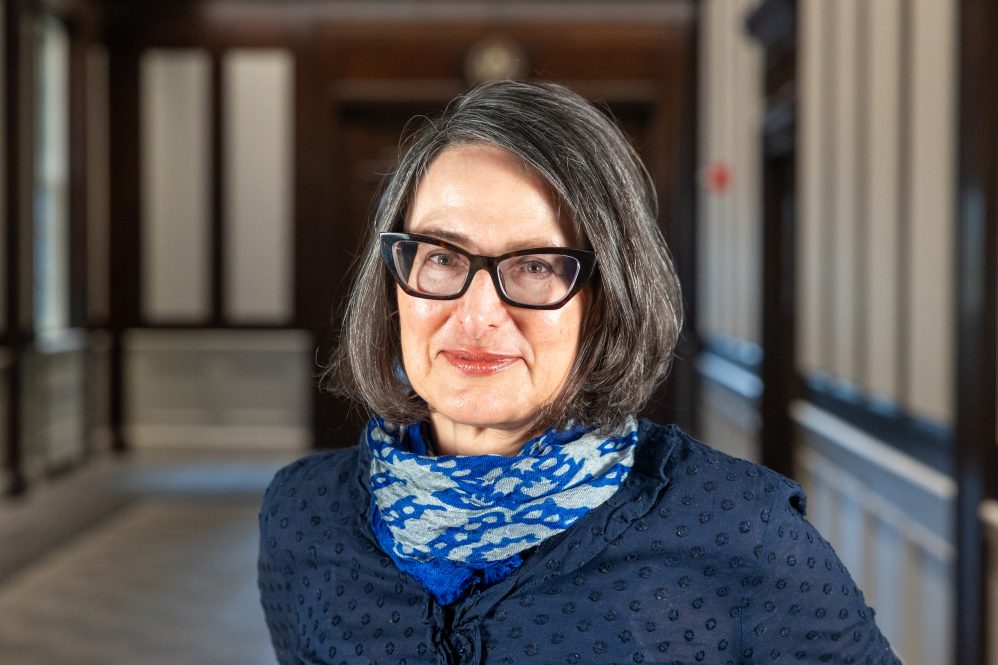
Early on, V. Penelope Pelizzon imagined herself as Lady Macbeth, bathed in stage lights as she delivered that iconic soliloquy in Act 1 – “Come you spirits/That tend on mortal thoughts” – but life for her conjured a different path.
“It turns out I wasn’t a very good actress, and when I flunked out of a performing arts conservatory at 19, my life came to a crushing halt,” Pelizzon says. “But I took from that a love of dramatic voice, which has been an influence on my poetry – thinking about how a voice sounds on the page, the way a character can shift in writing, and how a dramatic monologue can give you a whole portrait of a character.”
Today, the UConn English professor and award-winning poet delivers orations only into the recording end of her phone, reading aloud for her ear the many iterations of each poem she’s written to test where breaks belong, tongues trip, and syllables sync.
Her writing process, while less theatrical than stage work, perhaps still could be described as dramatic. A 100-page finished book might start with a 2,000-page manuscript, she says, the trimmed fat in crumpled pages on the floor.
“It’s not the most efficient way to work. It’s a terrible way to work, but that’s how I work,” she says.
However she got here and employing whatever process she needs, Pelizzon has found success, including most recently as a Guggenheim Fellow, one of 223 individuals worldwide selected from an applicant pool of 5,000 and named to the 101st class by the John Simon Guggenheim Memorial Foundation.
She is the only fellow from UConn in 2026-27.
Accessing the Human Experience
“We’re in this moment culturally where it feels like the arts and humanities are at worst under attack and at best being neglected,” Pelizzon says. “Having a foundation like the Guggenheim supporting arts and humanities projects reminds us that these are the heart of our culture. These are the things that help us understand who we are.”
Yet that understanding is partial, she says.
Only half of human experience has been written about, Pelizzon argues, suggesting the percentage might even be less, since the Western literary canon comprises mostly authors who were white and of the same gender. Anyone outside that group invariably brings a different perspective that, consequently, for a long time, was ignored.
“These are some of my favorite poets. They’re brilliant,” she says of the canon. “But part of my goal as a writer is to give voice to the experiences that haven’t been articulated and that I have access to.
“I’m interested in what has not yet been said about being female, what has not yet been said about living in a time of rapid climate change, what has not yet been said about a culture that in some ways feels like it’s shrinking, almost annihilating itself. Poetry can reach into and articulate those experiences in a way that other media has not been able to do,” she continues.
So, while for many people, she acknowledges, poetry is not important no matter who comprises the canon, it ought to be. Deep readers of poetry find companionship in verse as reflections of themselves and their experiences stare back from the stanzas.
“There are things the language of poetry can do and there are emotional human experiences poetry can express like nothing else can,” she says. “If you don’t have access to poetry, there are whole areas of human experience for which you likely have no language.”
Common Expression with So Much Meaning
Pelizzon’s Guggenheim year, during which she’ll step away from teaching, will be spent working on her fifth book, a fourth collection of poetry. With a working title of “The Wow,” its central poem considers the various meanings of “wow,” beginning with the Arabic letter “waw,” or و.
The letter, she explains, looks a little like the more familiar number 9, kind of reclining on its back. Nonetheless, “waw” is symbolic to many, especially those in the Middle East, because it can look like a seed, fetus, corpse, or person in prayer, depending one’s perspective.
Her sister and brother-in-law have a sign emblazoned with it hung over the door to their home in Turkey.
“You enter and exit under this sign that has all of these implications or suggestions,” Pelizzon says. “The poem plays around with this and with the idea that ‘Wow!’ came into the English language from a Scottish poet who used it in translating a classical text. I love that it’s this exclamation that can mean many different things: excitement, grief, despair, even irony.”
The poems in “The Wow” build on themes and techniques from her 2024 book, “A Gaze Hound that Hunteth by the Eye.” The title poem though is one that’s been in the works for years.
Pelizzon’s work most often starts with what she describes as “cognitive dissonance,” hearing a word or phrase that’s intriguing because it’s slightly off or has multiple meanings. Sometimes, she says, she’ll note an image – like the sign in her sister’s house – that spikes her curiosity and doesn’t abate.
Prioritizing Research, Prioritizing the Humanities
“We always say the poem is smarter than the poet,” she says of how a poem takes shape. “There are many things that I want to write about, but when I get to the page, maybe something else will happen. I listen to where the language goes.
“I love diction,” she continues. “I’m an extravagant stylist, so I’m interested in a lot of Baroque structures, Baroque syntax, and within economy, I also love to do interesting architectural stuff with language. I often work in forms that are counted in some way, maybe the syllables per line are counted. The line is your superpower as a poet, as opposed to the sentence. How do you break the lines? What different textures and tensions can you set up where a line break occurs? I generally don’t know when I start what form something will take.”
What she does know is that her work takes time, lots of it. Much of her year as a Guggenheim Fellow will be spent deep in historical research – several long poems in “The Wow” will be about contemporary Turkey, Pelizzon says, which means learning about the Ottomans and events from the 15th century to unravel the effect on the present.
Doing that level of research during the academic year is difficult. Pelizzon describes herself as a hands-on teacher who works with her students to develop their writing. Feedback and suggestions, restructuring and rewrites encompass the day.
“UConn is a place where people who value the humanities and arts are working,” she says. “The Guggenheim can help you realize what you have, and hopefully it helps the state of Connecticut prioritize the arts and humanities at a state level. We have people at UConn who are doing work that is valuable to the nation and world. Our people are doing good work here.”