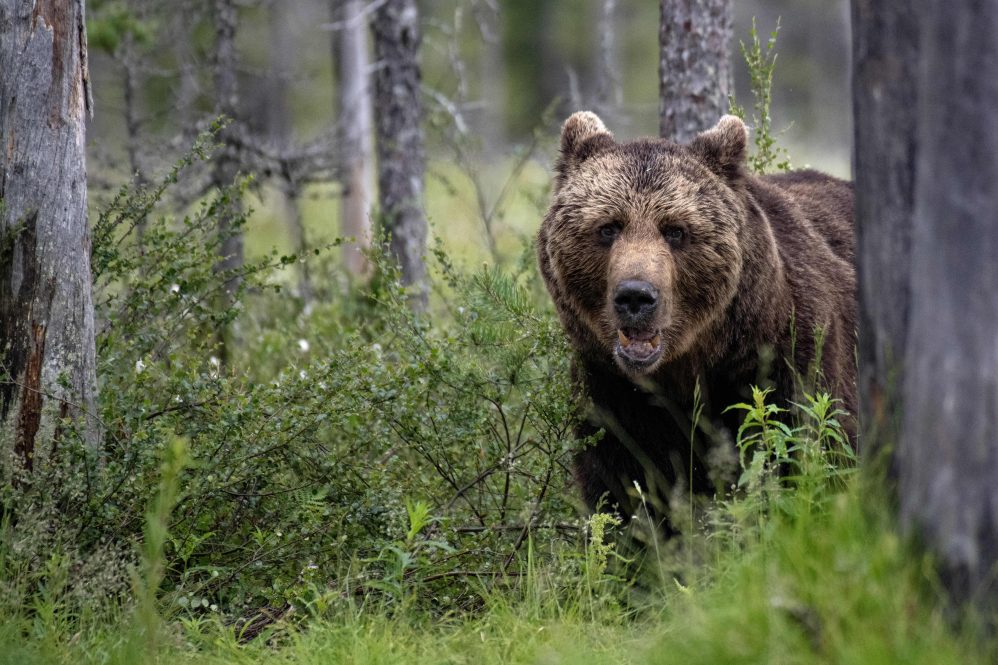
If there’s one thing Erin Tumminello ’26 (CLAS) wants to know from every fellow undergrad at UConn, it’s this: What do they think of Man or Bear, which is, of course, if you’re alone in the woods, would you rather encounter a man or a bear?
It’s a hypothetical question that went viral on TikTok in 2024, quickly migrating to other social media platforms and drawing an overwhelming number of responses from women who said they’d pick the bear any day.
“They were saying things such as, ‘If the bear attacked me, people would believe me,’ or ‘Bears act on instinct. Men can be cruel on purpose.’ They were expressing the fact they felt safer taking their chances with a bear rather than a random man because of gender-based violence and sexual violence,” Tumminello says, noting the “man” in the question is generally assumed to be a cisgender man.

The sociology major took the question to their classmates recently through notice in the Daily Digest and by word-of-mouth, soliciting answers to an online survey that asked not just thoughts on the man-or-bear question but also the person’s political affiliation and gender to see if either of the latter affected how they answered the former.
Tumminello’s results, which will become the basis of their honors thesis, weren’t surprising, they say, considering it’s a sampling of a student body in a fairly politically homogeneous part of the country.
“Of course, anyone of any gender can be a perpetrator and anyone of any gender can be a victim and a survivor,” Tumminello says. “The trend sheds light on gender-based violence, rape culture, and victim blaming. People brought up, ‘I chose the bear because no one’s going to blame me for being attacked or ask what I was wearing.’”
The survey asked five demographic questions and five research-based questions, Tumminello says, including how the person feels about the trend, whether the question makes them feel validated or scapegoated, and if the debate accurately reflects real-world issues.
They received 150 responses, which they pared down to 81 after eliminating ones that were blank or incomplete. It’s a number that was manageable yet one that gave Tumminello some good material with which to work, they say.
Fifty-two of the respondents were women, with only one identifying as conservative, one as somewhat conservative, and a few as no political affiliation, Tumminello says. Nonetheless, the majority of the women, regardless of political preference, noted gender-based violence, harm perpetrated by men against women, or feelings of fear around men. Seven specifically mentioned sexual violence.
“Among women, gender definitely seemed to be a stronger indicator of opinion as opposed to politics,” Tumminello says, adding that most of the women said they agreed with the trend and felt validated by it.
When it came to the men who answered, Tumminello says their results were more mixed.
Among the 13 men who responded, all were liberal except for one who identified as conservative. Half of the men either explicitly or implicitly referenced gender-based violence, while a handful hadn’t heard about the trend and didn’t have much information about it.
Of the 12 liberal men, one disagreed with the trend but didn’t have overly negative feelings, Tumminello says, and another noted that women can also commit sexual violence against men but felt the trend addressed real-world issues.
The conservative man, however, “expressed very strong negative feelings, which is very useful information for me. He expressed the ‘not all men’ sentiment and claimed it was stereotyping against men,” Tumminello says. “That suggested political alignment might have been more of an indicator for men than it was for women.”
Sixteen nonbinary individuals answered the survey, each identifying as liberals to varying degrees and offering positive to neutral views of the trend. One of the respondents said they feel safer when they’re perceived as masculine versus when people saw them as feminine.
Tumminello says they expected political alignment to be a little more impactful, especially among women, and was surprised when both liberals and conservatives said they agreed with the trend and that it addresses real-world issues.
“If I had a more mixed group in terms of politics there might have been more variations, so it might have been a little less predictable if the dataset was more mixed,” they say.
Still, the project has Tumminello reflecting on the comments they found attached to the original TikTok post, some of which said things like, “The scariest thing I’ve encountered while solo hiking was the sound of a beer can crushing a short distance away through the trees,” and “At least we know the bear’s intentions.”
It also has fostered an appreciation for the help their advisor, assistant professor Bhoomi Thakore, has given and the opportunity that UConn afforded them to do their research.
“People don’t talk about gender-based violence and sexual violence enough,” Tumminello says. “Man versus bear specifically raises topics like rape culture, victim blaming, toxic masculinity, and our response to someone who says they experienced sexual violence.”
They continue, “Trends like this are not meant to attack men or any particular gender. They’re meant to bring awareness to the systemic problems in our society.”