The first thing Charlotte Harvey ’26 (CLAS) did last semester was get on state Attorney General William Tong’s press list. That ensured she’d be notified every time Connecticut joined a lawsuit.
Then, to keep track of the swelling number, she built a database to categorize each by topic and took care to note pertinent details, including the date the action was filed and what other states were plaintiffs.
 The journalism major, who admits “it doesn’t take very much to get me interested in something, and once I’m interested in something, I really dive in,” took the project further and linked to the original court documents, summarized what events preceded the suit’s filing, offered an overview of what each says, and noted the effect or potential effect on Connecticut residents.
The state attorney general “is the person who’s representing our state legally, and he’s the one going up against the federal government on behalf of the state. We need to know what he’s doing,” Harvey says. “National politics can seem disconnected from everyday life, but this is exactly what your state is doing about it and that makes it important.”
Even though Harvey’s database analyzed and organized 39 lawsuits filed last year between Jan. 20 and December – and was published by major state news outlets – she says her work wasn’t anything more than what her 13 classmates offered during the fall 2025 semester of Publication Practice.
Newfound Skills in Action
Publication Practice, in the course catalog as JOUR 4016, is unique each semester with a different instructor and topic to give mostly journalism majors the opportunity to delve into a single topic, become experts in it, and publish significant pieces that consider different angles of the overarching theme.
Harvey took the class twice, in spring 2025 when the class looked at sewage issues in Hartford, and again in fall 2025.
It was in the fall session, taught by associate professor Amanda J. Crawford, that Harvey published the piece on Tong as part of the class’s larger project, The Balance of Power, a multimedia research and reporting project examining the history of executive power in the U.S.
Balance of Power recently won the 2026 Provost’s Award for Excellence in Community-Engaged Scholarship in the Student Team category.
Crawford says she considered focusing on Connecticut’s wealth divide – and still has plans of doing that one semester – but with the turn of the calendar to January 2025 and flurry of executive orders and tests of presidential power that followed the inauguration, she decided to pivot to current events.
“In journalism, you don’t really have the ability to not think about current events, especially ones that are being debated and talked about in the press and shaping everyday life in our communities,” she says. “It just seemed like there was a wealth of issues that students could dig into both as reporters and as scholars learning about this.”
Since the class is open to only students who have proven themselves through previous work, it doesn’t teach the skills of being a reporter, photographer, or videographer, Crawford notes. Instead, it puts to work the skills learned in prerequisite classes like Newswriting I and II.
“I’ve gotten so much out of my courses here, whether those were my basic news writing courses, which taught me how to actually write stories, or more in-depth classes like feature writing. This course too really emphasized the importance of doing extensive research for a story,” says journalism and political science major Dan Stark ’26 (CLAS). “I always do some level of research, but this was a very long process.”
Real-Life Reporting: Beats, Interviews, Drafts
Stark and his fellow students were grouped onto different beats, or coverage areas, that allowed them to home in on part of the larger subject of governmental power, looking at it by subject area: immigration, higher education, science, and others. His beat was executive powers and their expanded use to enact change.
One story, he says, required upward of 30 sources. Assembling that “giant document” of notes into a coherent, meaningful, and readable story was an organizational challenge.
“When I submitted my first draft, it was broken into a lot of pieces – sections about rule of law, energy, First Amendment issues,” Stark says. “The feedback I got from Professor Crawford was to merge some of these sections into broader themes. When writing a big story like this, sometimes you’re dealing with a lot of topics that might seem like they don’t go together. But, when you look at them more deeply, you can start to see these themes that emerge.”
The final version of that story clocked in at 2,700 words – for reference, this one is around 1,500 words.
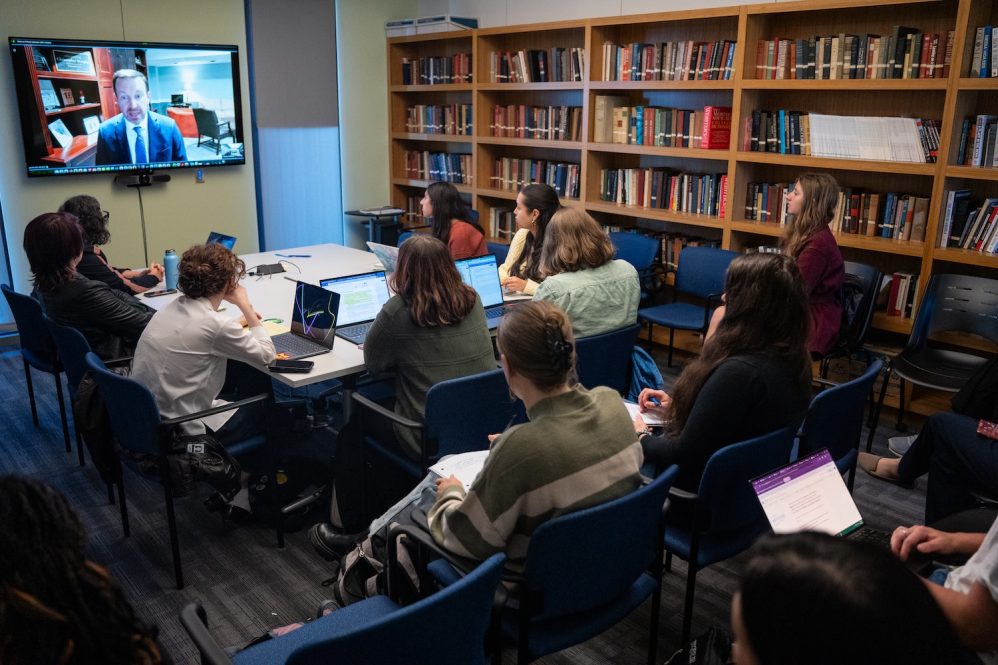
To kickstart students with their interviews, Crawford arranged for political science associate professor Virginia Hettinger, UConn Law professor Jon Bauer, and former UConn President Thomas Katsouleas, an expert in the history of higher education and its relationship with the federal government, to come in and give open interviews to the class.
Then, in their individual reporting, students could use any, all, none, or part of the interviews as needed.
U.S. Sen. Christopher Murphy, ACLU of Connecticut legal director Dan Barrett, and Tong, the state attorney general, also joined the class for hour-long interviews.
“I remember the vibe of the room the day we interviewed Murphy. We were all pretty nervous,” says journalism and political science major Sara Bedigian ’26 (CLAS), who is in this semester’s Publication Practice class that’s reporting on mental health. “Professor Crawford was like, ‘You’re on the higher ed question. This person’s on this question,’ and we all sat around the table and asked the questions. It was nerve-wracking, but afterward, I was like, ‘Wow, that was so fun.’”
Finally, Onto Publication
Bedigian, on the education beat, covered the University Senate’s vote to delay an anti-Black racism course, writing about it as a live story that gained attention from mainstream media that ran it in outlets around Connecticut immediately after happening.
After all, the course title is Publication Practice.
Crawford says journalism majors need to graduate with a portfolio of published work. And while Bedigian has had several internships, including one now at the Connecticut Mirror, and Stark is on staff at The Express News Group, which publishes weekly on the East End of Long Island, not everyone has had those opportunities.
As Crawford served as the student reporters’ editor, journalism department head and associate professor Marie Shanahan would be considered their publisher, having designed The Balance of Power website to publish the more than two dozen written stories, along with photos, videos, and graphics, they produced.
Shanahan also is one of the architects of the Connecticut Student Journalism Collaborative, which publishes the work of student journalists from UConn and other institutions around the state and offers those stories to mainstream media for use in their publications, in part to supplement their own local coverage.
The collaborative republished the full Balance of Power project. Crawford also marketed individual stories, which have been republished in places like the Hartford Courant, Connecticut Public, The Day (New London), Connecticut Mirror, CTNewsJunkie, and Connecticut Examiner.
“Journalists have always said, you learn by doing. We can teach you how to go out and conduct an interview, give you direction on the kind of questions you might ask. But until students go out and do the work, they don’t fully learn the lesson,” Crawford says. “This class takes it to the next level. What you’re writing is going to be read by adults, some of whom are lawyers and politicians and people who aren’t going to like you and who might, no matter how you write the story, think you’re biased.”
Bedigian says classes like this have equipped her for life after graduation.
“I’ve been able to really see how valuable my UConn education has been and how well the journalism department has prepared me, because they’re not taking it easy on you,” she says. “They make you go out into the real world from your first year in the program. I came into college with absolutely no journalism experience whatsoever, so everything I know about the field is what I’ve learned here in the last four years.”
Harvey’s lawsuit database and accompanying story was republished in Connecticut Examiner, which not only invited her and another student to be guests on their podcast, but also offered her a full-time position after graduation, another bonus of the class.
“I’ve always known that I wanted to be a journalist. I can’t picture myself doing anything else, which is great in the sense that I have direction. It’s terrifying in the sense that if I don’t cut the mustard, I’ll never be fulfilled,” she says. “This class gave me the confidence and the feeling that I could do it. It also reaffirmed that I liked doing it. It was an incredible experience.”