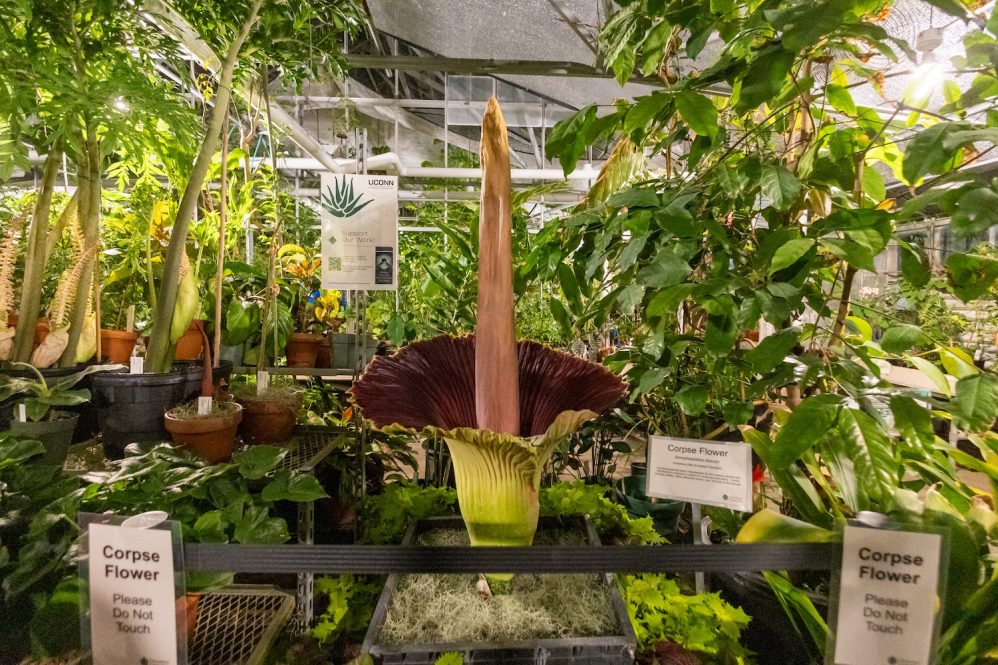
As the semester winds down and campus welcomes the blooming of an abundance of spring flowers, the UConn Botanical Collections spent the last several weeks gearing up for the emergence of a massive, pungent corpse flower (Amorphophallus titanium), or Titan Arum. Living Collections plant manager Meghan Moriarty says the UConn Botanical Conservatory hosted thousands of visitors eager to catch a glimpse of the first corpse flower bloom at UConn since 2013.
This was the inaugural blooming of this corpse flower, named “Bullseye,” and also the first UConn corpse flower to bloom during the semester. Though the plant is native to Sumatra, tropical greenhouse horticulturalist Cole Geissler says this specimen came to UConn in 2012 as a seedling from Ohio State University.
Geissler explains that from seed, if the plant is grown under ideal conditions, it usually takes between seven and 10 years to bloom initially. This long-lived plant can bloom every four to five years and grow to weigh over 300 pounds under the right conditions. When he re-potted Bullseye last November, Geissler says he realized that at 29 pounds, the plant was within the weight range to start blooming.
“We saw the first signs of growth on March 14, but at that point, we didn’t know if it was a flower or a leaf. We didn’t find out it was a flower until earlier this month. We celebrated, and there was a lot of running and jumping around!”
The flowers exhibit unique qualities that enhance their chances of pollination. The rancid aroma attracts pollinators that are also drawn to the fetid bouquet of rotting flesh, for example, flies, beetles, and cockroaches. Geissler says that other members of this family produce odors ranging from feces-like to dirty gym socks. A temperate relative of the Titan Arum, the skunk cabbage, can be found growing right now around Connecticut. Skunk cabbage can start growing quite early in the season because, like other members of this family, it produces its own heat.
“Skunk cabbage uses a process called thermogenesis to break through the snow. The corpse flower also does this even though Sumatra never gets any snow, but the purpose of the heat is to increase the smelliness,” says Geissler. “It flowers in a very short timeframe so it generates heat to be very smelly, it looks smelly, and it gets really big to bring in as many pollinators at once, because of that short timeframe.”
The exact timing for blooming is difficult to pin down, and blooming started earlier than the team initially expected, but everyone sprang into action.
“I started to notice around 1:20 p.m. on Friday as the spathe [the ruffly skirt part] started to pull away from the spadix [the big spike in the center],” says Geissler.
Word spread quickly, and eventually the line of spectators grew so the wait was over two hours. As the night went on and the flower fully opened, the smell became almost overpowering for some, since a more potent aroma draws more pollinators to the flower and many of the pollinators are nocturnal, says Geissler. By the next morning, the bloom was already in decline.
The team planned to collect pollen from Bullseye in hope they can pollinate the conservatory’s next corpse flower to continue the important work of conserving the species. Moriarty says Geissler has perfected the recipe for growing corpse flowers, and now, with the first successful blooming under his care, Geissler is eagerly anticipating the next.
“Between the one that’s about to flower and another that is going dormant right now, it is like they have been racing each other. If we unpot the plant that is going dormant now, it’s probably going to weigh more than Bullseye and we may potentially get a second bloom within the year, which is very exciting,” says Geissler. “Once you figure out how to grow corpse flowers, it’s not super difficult. You just have to pay attention to their life cycle and be careful not to rot them out during the winter, which for us is a bit challenging because we’re surrounded on all sides by buildings which block out a lot of the light and also because our facility is aged, our growing conditions can be a tricky.”
Moriarty says interest in Bullseye’s bloom grew steadily, reflected by increased foot traffic in the weeks leading up to the big event. The first bloom at UConn was in 2004, which was a first for New England, and the event drew over 10,000 visitors.
“Based on our social media interest and past blooms, we expected to see 2,000 to 3,000 people visiting,” says Moriarty. “We were excited for the UConn community and that we can pull people in from the surrounding areas to show off our amazing resources here at the UConn Botanical Conservatory.”
This excitement is testament to the important role of this facility not only for UConn, but the broader community.
“It’s an excellent resource for teaching, education, and conservation at UConn, and we are open to the public. It’s good for the broader community in Connecticut and regionally. We have people that have come from all over, specifically for the conservatory. It is important and events like the corpse flower blooming helps with our outreach.”
Follow the Botanical Conservatory on Instagram and Facebook to keep up to date with more exciting botanical news.