The late Fred Rogers once told us that, in times of uncertainty or fear, to look for the helpers.
“You will always find people who are helping,” he said, because even in the toughest circumstances, there’s always kindness to be found.
On any given day, whether it’s in Storrs or Stamford or New Jersey or Pennsylvania, spreading kindness Mr. Rogers-style is what you’ll find Stephanie Mora Gutierrez ’27 (CLAS) doing.
Because Mora Gutierrez is a helper.
She thinks part of it is how she was raised, she says.
“It the nature of my mom, too,” explains Mora Gutierrez. “She’s a very religious person, raised me in the church. I’m an only child, and I don’t really have a strong connection with religion, but seeing her basis for giving to people, being generous, helping people – I think it stemmed from that.”
But there’s clearly something more when it comes to Mora Gutierrez.
A lot of people are raised in generosity, but it doesn’t come to completely define who they are. Yet it seems that in everything she does – from her studies to her jobs on campus to her extracurriculars to her entrepreneurial pursuits – Mora Gutierrez helps.
“I just like helping people, in general. I love doing that – that’s my passion,” she says.
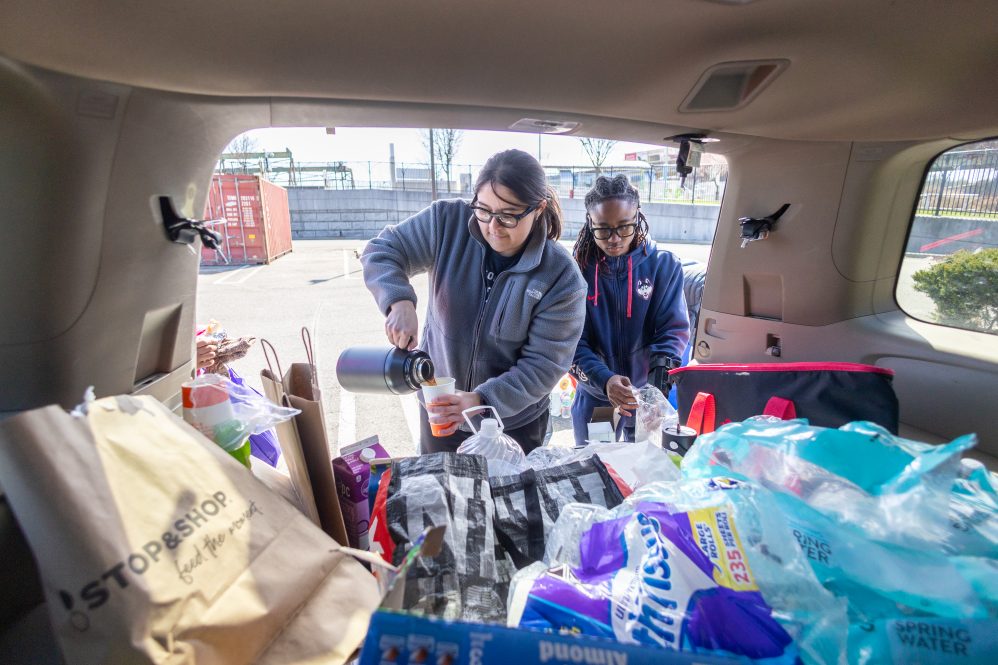
And so, when she’s packing up giveaway portions of macaroni and cheese in her dorm room kitchen, or filling a cooler to the brim with bottled water to hand out from the trunk of her car, or mentoring a first-year UConn student who’s struggling with their college transition, or starting a nonprofit organization as an undergraduate to provide resources to unhoused people in three states – it kind of makes sense.
Because no matter if she’s on campus and off, Mora Gutierrez is a helper.
Dream School
Mora Gutierrez grew up in Rahway, New Jersey. A first-generation college student, UConn was her dream school, she says.
“I really like basketball,” she laughs. “I feel like that’s one of the reasons a lot of people come here, and I really like the campus. But also, when I toured UConn Stamford, it was similar to my hometown – the city kind of vibe, but not too big of a city. A small city. I wanted to go there first.”
And so, she did.
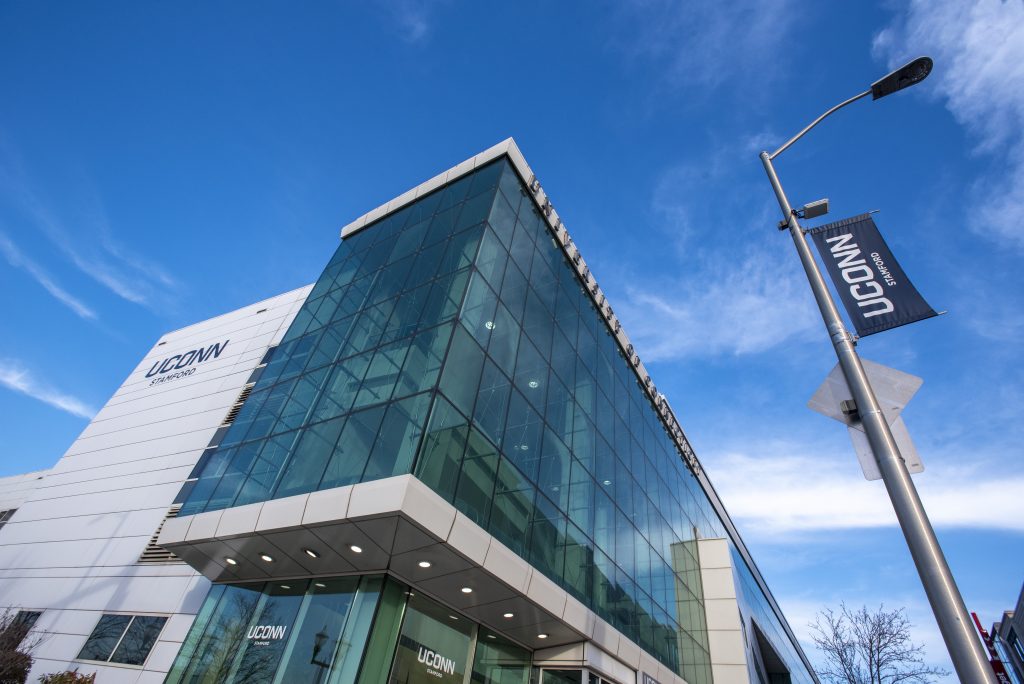
The pre-med psychology major spent her first two years at UConn Stamford, and she immersed herself in the unique UConn experience that Stamford has to offer.
“For me, coming from high school and kind of being a little nervous about the big campus and adjustment, I liked that there were smaller class sizes,” she says. “The library is downstairs, the dean’s office is on the third floor, advisors on the second floor. It’s really easy to navigate that, and living there just reminded me of home.”
In her first year, while searching for a student-worker position on campus, Mora Gutierrez learned about efforts to bring La Comunidad Intelectual, or LCI – already a long-time learning community at UConn Storrs – to UConn Stamford. After meeting with the professor spearheading the effort, Mora Gutierrez joined the team.
“There were no events, no structure to the program yet, because we were a small campus and it was a new thing,” she says. “We had to get people to actually want to do it.”
While working on LCI, Mora Gutierrez also learned about efforts to expand the successful First Year Experience peer mentor program to the regional campuses. Also launched initially at UConn Storrs, FYE mentors play key roles assisting first-year students with their transition to college.
Mentors work cooperatively with instructors to serve as role models, attend and participate in FYE classes, and connect with and assist incoming students inside and outside of the classroom.
In the summer before her sophomore year, Mora Gutierrez and some friends worked with faculty organizers to start putting together their new regional campus mentoring program.
“When it started, we got placed into classes, and I was in the FYE for people who want to learn about Latino culture,” she says. “I was in a special topics class, and I had about 25 students. I loved being there every single day. It was really fun, there’s no power dynamic, it just felt like I was there to guide them and be an extra person in the room.
“When it’s a professor and all the students, there might be a power dynamic, or you might be scared to ask questions. But I was always happy to help, and sometimes lead the class, and I think that made it more engaging for the students. It’s just more fun when someone else, kind of close to your age, is leading the class and you feel comfortable asking them questions and being silly and funny.”
She used her interactions as a mentor to also help introduce interested students to LCI.
“They’d come to our lounge, or to our events,” she says.
And she created a new map activity for her FYE students to help them learn more about the city of Stamford and get out into and more comfortable with the community around them. She and her students began by meeting at Mill River Park in Stamford, just across the street from campus.
“And then we just went around, all through downtown, where all the main restaurants are, kind of just making a little circle,” she says. The students then had to do a reflection exercise and list three places they saw, and upload a photo of the spot and where it was.
“There’s probably 50 establishments there, so it just had the student familiarize themselves with where they are and what places they might want to go to eventually. If they commute, maybe they haven’t even stepped outside into the town, because they just go to class.”
The activity, she said, is still in the curriculum – and it, along with her dedication to her students, helped earn her an inaugural John T. Szarlan First Year Experience Peer Mentor Award, presented by UConn’s provost in 2025.
Where to Go
The provost’s award ceremony in Storrs helped open even more doors for Mora Gutierrez when she changed campuses for her junior year. She was encouraged to apply for a Jordan Smith Undergraduate Fellowship from the National Resource Center for the First-Year Experience and Students in Transition, based at the University of South Carolina.
The fellowship recognizes students for their work on behalf of first-year students and the impact their efforts make on the students and cultures of their institutions.
Mora Gutierrez learned she’d been one of five students nationwide selected for the fellowship last summer while on vacation with her family.
Her mom traveled to Seattle with her in February to attend the organization’s annual conference and accept her award.
“She met me there and she was like, ‘This is so cool,’” she says. “We just had a blast there.”
At the conference, she learned about the proliferation of AI use amongst high school students, particularly those using platforms like ChatGPT for companionship, as well as aways to help retain students through their first year in college and onto graduation.
“I definitely think that the first-year experience is incredibly important, and I realized how important it was when I took a step back and looked at other schools,” Mora Gutierrez says. “There were a lot of professors from other schools saying how they don’t even have a program yet. And I couldn’t imagine my first year without this program in it.”
Since changing campuses from Stamford to Storrs this year – a move that she acknowledges was bittersweet for her – she’s continued working as an FYE peer mentor. Instead of taking students around a city-based campus, her courses had her leading first-year UConn students over the Discovery Trail and Horsebarn Hill.
“That was a very interactive class,” she says. “At first, it was kind of hard to get students talking, which it always is. But this was a very special group. It was like a 20-person group of friends.”
Which is what Mora Gutierrez hopes she’ll be to the students she works with as a mentor: A friend. Someone they can talk to when they need to. Someone to help them when they can’t figure out where they’re supposed to be, or how things around campus work.
“I had an international student, and English wasn’t his first language,” she says. “Sometimes, there was an announcement for class, but he didn’t know how to use HuskyCT because he’d not used that type of platform, coming from school in another country. He didn’t know where all the spots were on campus or how to search for them.
“The instructor saw he was skipping class, and then, when I dug into the matter, I was able to pinpoint the problem. I gave him all the links in one document, so he could just click in it. They’re all labeled. And then, he would start showing up for class, because he knew where to go.”
A Collective of Caring
“Sometimes, we have to see what everyone is going through, really,” says Mora Gutierrez.
And that lesson doesn’t just translate to people on campus for Mora Gutierrez.
Not growing up in Connecticut, she took some of her first weekends after moving to Storrs to visit Hartford, where she’d never been.
“It’s the capital, so let me go see,” she says. “And when I was alone, maybe getting food, there were a lot of homeless people on almost every corner. It was summer. I didn’t really understand why there were so many people, and a lot of people just didn’t look happy. Obviously, I wouldn’t be happy either if I’m just out in the heat.”
She’d been told all her life, she said, not to approach people. They’re dangerous. But that’s not what she saw in Hartford.
“There were a group of homeless people with chairs, and they’re sitting, and it’s like, ok. They’re nice people,” Mora Gutierrez says, and so she asked a friend to help. “I bought a cooler, bought some water, bought some ice, and we just went to Hartford and gave out water bottles. And that was the first part where I realized I really like doing this. It’s really fun. I like seeing the smile on everyone’s faces.”
Mora Gutierrez started going back to Hartford every weekend, bringing food and different supplies with her and handing everything out.
She began recognizing faces, and they started recognizing her, and it soon became more than an exchange of items between strangers.
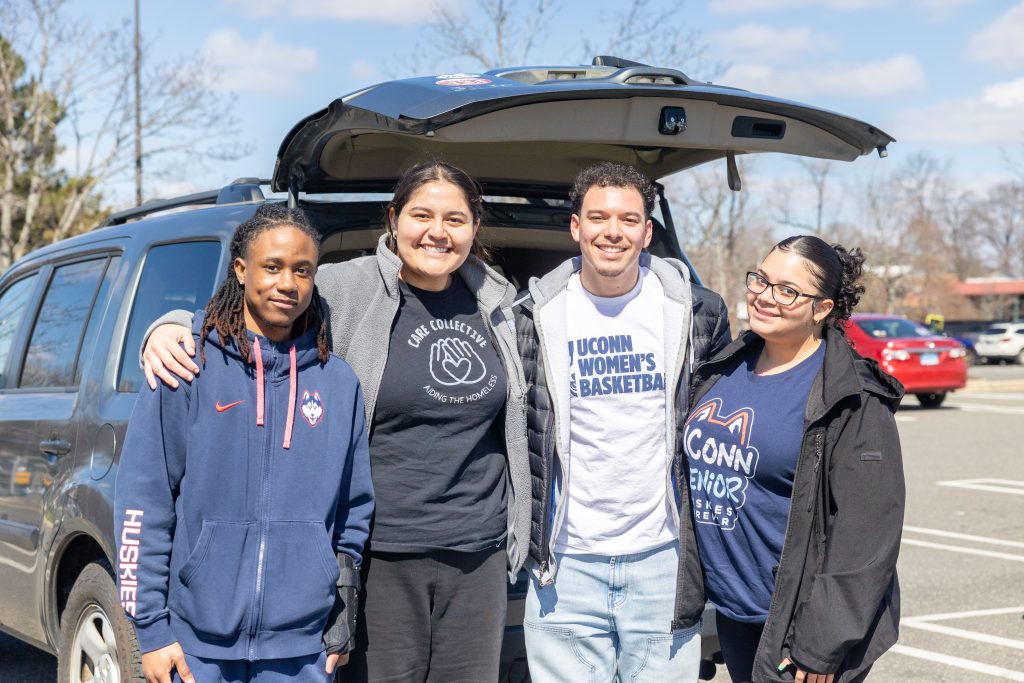
“They would look forward to seeing me and saying hi, even if I’d run out of supplies for the day,” she says. “The would be like, can you just stay for a second, talk to us, ask what I’m doing in school. And it was just like, wow. They’re not scary. They’re not mean. They’re not dangerous. They’re sharing their stories and talking to me.
“So, alright, let’s make something with this.”
Last June, Mora Gutierrez established a 501(c)(3) nonprofit organization based in her home state of New Jersey called Care Collective. Her organization is currently working in three states – Connecticut, New Jersey, and Pennsylvania – to provide care kits to unhoused people.
“We are completely student-led,” Mora Gutierrez explains. “I have about 30 interns, we’re all unpaid, and all randomly around the country – we have six UConn students, but some in New Jersey at Rutgers, in Maryland at Morgan State, and then we’re all the way in California at Stanford University, with someone who just wants some research experience.”
Mora Gutierrez has done most of her recruitment through her LinkedIn page, and focuses her volunteers in different sections: health, business, communication, education, and research. Volunteers on the ground help distribute donated items, and items purchased through donations to the nonprofit, to unhoused people to help meet basic needs.
“We don’t get a lot of money, actually,” Mora Gutierrez says. “We thrive on the tangible items. Like today, a company sent me some coffee to distribute at an event next week.”
An email to dental care company Colgate asking if they had extra items resulted in a donation that went into dental care kits to hand out.
“You don’t need a bunch of money to make a difference,” Mora Gutierrez says. “It’s a matter of just asking around.”
Some of Care Collective’s volunteers help with the financial side of maintaining the organization. Others are reaching out to those companies in search of donations, while still others are researching state health policies, issues impacting unhoused populations, and how to recognize conditions like heat stroke or frostbite while they’re out distributing supplies.
Mora Gutierrez hasn’t had any shortage of fellow students interested in joining her.
“It’s volunteer hours, it looks great on your resume, but it’s not too much commitment, and enough to gain some skills,” she says.
One of her interns, she says, is a UConn student doing their senior internship for class credit, and there are plans to begin collaborating with UConn Stamford to provide paid micro-internships with Care Collective to FYE students at the regional campus.
The Right Place
FYE mentor. National fellow. Nonprofit founder. College student.
It’s no small feat managing everything on her plate, and Mora Gutierrez admits it’s not always been sunshine and roses. She’s had to learn to say no sometimes, to walk away from things – like an unpaid job in athletics and an interest in participating in undergraduate student government – when it felt like too much to handle.
But she’s surrounded herself with a dedicated team at Care Collective that she trusts to help keep the organization moving forward.
And she says her own personal support system is strong.
“It’s important, having a good support system people to give you positive constructive criticism – a reality check once in a while,” she says. “You have finals next week – no, you can’t go out and do five events. Having someone to watch your back, to encourage, but also just keep you in check.”
After her undergraduate studies, she plans to attend medical school. Because the best doctors are, of course, helpers.
Like Mora Gutierrez.
She’s not sure what sort of medicine she’s likely to end up pursuing – likely something to do with psychology, so psychiatry or neuroscience – but she’s wanted to be a doctor since she was a child. She wants to help youth and adolescents someday.
She said she’s proud of herself for what she’s accomplished so far in her UConn experience, and grateful for those along the way who she says saw her and understood her.
“I have to send gratitude to the people who have believed in me, because growing up, there was a big section of people who said, ‘You’re not going to do well, because you’re too talkative, or you’re too goofy, you’re too personable,’” Mora Gutierrez says.
“But in high school, there were those people who were like, even though you’re loud sometimes, even though you have so many ideas, eventually you’re going to end up in the right place.”
To connect with Mora Gutierrez and learn more about her nonprofit work through Care Collective, visit carecollective.help.