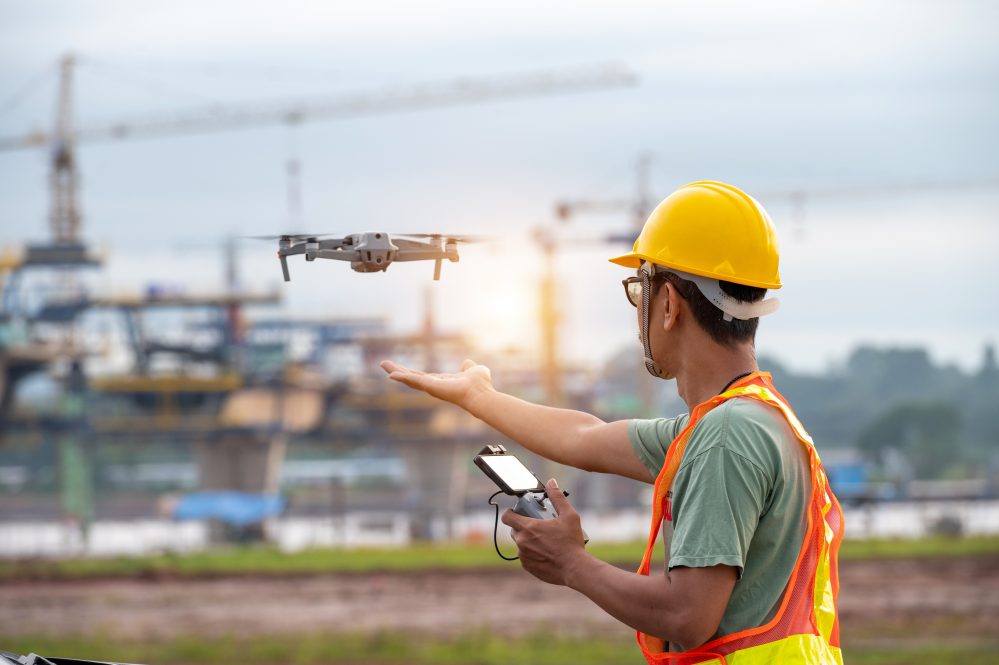
Under the leadership of George Bollas, Associate Dean for Research at UConn’s College of Engineering and Director of the Pratt & Whitney Institute for Advanced Systems Engineering, UConn researchers are uniting to shape the future of drone technology.
Bollas, Jonathan Shihao Ji, and Shalabh Gupta are working together on two major initiatives. One is a proposed collaboration between UConn, the United States Coast Guard Academy, and the United States Coast Guard Research & Development Center, designed to bolster the Coast Guard’s mission capabilities with UConn engineering acumen. This partnership will pilot a research and development program focused on AI-enabled autonomous and swarm-based maritime drone operations, involving engineering staff and students at both UConn and the USCGA, to support USCG missions such as search and rescue, maritime domain awareness, environmental monitoring and pollution response, intelligence gathering, and port and event security.
The other initiative, a collaboration between UConn, RTX, Sikorsky, and the Connecticut Center for Advanced Technology (CCAT), seeks to boost the capabilities of multi-drone systems, allowing these vehicles to better learn from one another and their environment.
Using AI algorithms, edge computing, and network and system integration, this project will apply to all applications of multi-drone systems – including traffic management in major cities, large-scale facility inspection, aerial photography, precision agriculture, and search & rescue.
These UConn engineers are leading innovative work at the intersection of engineering, computer science, and systems design. Together, their research is helping redefine drones as intelligent collaborators capable of making decisions, adapting to uncertainty, and operating safely in dynamic settings.
At the core of this work is a focus on autonomy. Traditional drones rely heavily on human operators, but these researchers are developing algorithms that allow drones to interpret their surroundings and act independently. Their scholarly collaboration leverages their unique individual expertise in diverse subfields of engineering, including chemical, mechanical, and computing.
George Bollas brings expertise in complex systems and energy processes, examining how drone technologies can integrate with broader infrastructure systems. His work considers how aerial platforms can support industrial operations, environmental sensing, and energy efficiency, opening new possibilities for drones in sectors like manufacturing and sustainability.
Associate professor Jonathan Shihao Ji directs the Intelligent Systems Lab, which combines AI and robotics. With his work exploring how AI can be integrated into various robotic systems (including drones, robotic dogs, and robotic arms), Ji’s efforts are key for the multi-drone sensing initiative, which could significantly improve communication and sensing abilities in a drone swarm.
An AI-powered approach can help drones “collaborate with each other to detect objects, like vehicles, on the ground,” Ji explains. Drones in the field can have difficulty sensing objects when they are obscured by other objects or by weather conditions, but this new approach strengthens their ability to accurately “see” their environment and respond to challenging situations. This is critical for applications like search-and-rescue missions or environmental monitoring across large areas.
Associate professor Shalabh Gupta is the director of UConn robotics engineering program and runs the Laboratory of Intelligent Networked Systems (LINKS). He is focused on combining AI and robotic motion planning to improve the functioning of drones in real-life environments. Gupta contributes to the perception, diagnostics, and autonomy aspects of the equation. His research focuses on integrating smart perception and planning technologies using data-driven learning approaches that allow multi-drone systems to detect anomalies, gather situational awareness and plan time-risk optimal flight paths in real time in constricted environments. These capabilities are essential for applications such as surveillance, bridge and pipeline inspections, agriculture, manufacturing, and other critical infrastructure systems where safety and accuracy are paramount.
He points out that multi-robot collaborative teams, including multi-drone teams, face unique engineering challenges.
“Things change very fast, and they need to be able to make real-time decisions to adapt,” says Gupta. “How do those robots perceive and adapt in real-life situations?”
Improving the answer to this question is the cornerstone of his research. He focuses on resilience in multi-robot systems – for example, if the battery fails in one machine, “the others should take over and finish the job.”
“They can make a team optimal decision about who to help and what they should do,” says Gupta.
Another project kicking off soon at UConn, “Technology-Assisted Culvert Inspections in Confined or Hazardous Areas,” is being finalized for award by the Connecticut Department of Transportation’s (CTDOT) Research Unit. This project is led by engineering faculty Shinae Jang, Kai Wang, Alexandra Hain, Yuan Hong, and Shan Zuo. This effort will advance the use of drone and AI-assisted technologies for culvert inspection and infrastructure management.
The proposed work focuses on using drones and other robotic technologies to improve culvert inspections in confined, hazardous, and difficult-to-access environments. The research will evaluate unmanned aerial systems (UAS), LiDAR, sonar, AI-driven defect detection, and GPS-denied navigation technologies to create safer, faster, and more reliable inspection workflows for CTDOT. Pilot field inspections will be conducted to validate the effectiveness, accuracy, and operational feasibility of drone-assisted inspections under real-world conditions. The project will ultimately develop CTDOT-ready guidance, safety protocols, and integration plans that support long-term adoption of AI-integrated drone technologies for infrastructure inspection and asset management.
What makes UConn’s approach to drone research especially powerful is the collaboration across disciplines. By combining expertise in sensing, control, artificial intelligence, and systems engineering, the team is building integrated drone systems that are greater than the sum of their parts. These efforts are supported by UConn’s commitment to interdisciplinary research and innovation, including initiatives within robotics, intelligent systems, and advanced manufacturing.
The potential impact of this work is far-reaching. Smarter drone systems could help first responders navigate disaster zones more effectively, enable more sustainable monitoring of natural resources, and improve the safety and efficiency of infrastructure maintenance. As these technologies continue to evolve, UConn researchers are ensuring they do so with reliability, scalability, and real-world impact in mind.