In 2023, a population of a small, rare butterfly called the frosted elfin was found in UConn’s Hillside Environmental Education Park (HEEP). This exciting discovery brought together a team of researchers from the Department of Natural Resources and the Environment (NRE) in the College of Agriculture, Health and Natural Resources, the Connecticut Department of Energy and Environmental Protection (DEEP), and the UConn Office of Sustainability, who are collaborating on a project to learn more about the species, including what measures can be taken to help the population grow.
The frosted elfin is in decline, to the point of being considered for federal protection under the Endangered Species Act due to factors like habitat loss and fragmentation, says Charlotte Brennan, an NRE graduate student whose thesis focuses on learning about the frosted elfin and how to support the species.
“The recovery in Connecticut is focused on habitat restoration and habitat expansion for the species. We’re trying to figure out where the species lives throughout the state, how far they can move, and how we can expand their habitat. Since habitat loss is the main threat, expanding their habitat is the main way that we’re going to help them,” says Brennan.
Brennan’s work is helping to fill knowledge gaps about Connecticut’s diverse animal populations. DEEP identified invertebrates, including insects, as the least understood taxa and for conservation and recovery, it is imperative to locate and document more populations so we can learn as much as possible about their needs.
NRE associate professor-in-residence Chadwick Rittenhouse says they are already gaining valuable insights about the butterflies.
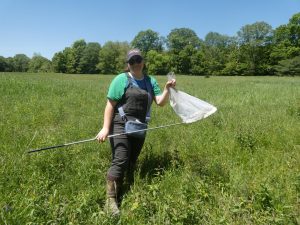
“One of the things that we’re finding through Charlotte’s work is that frosted elfin butterflies live a lot longer than we thought,” says Rittenhouse. “The lifespan was thought to be anywhere from two days to maybe a week or 10 days, but some live closer to a month. It was something previous researchers thought, but we were able to document it through this process.”
The HEEP frosted elfin population was first documented by Charles Brown ’08 (CLAS),’18 (CLAS), ’18 MS using the citizen science app iNaturalist. Since the species is rare, it was flagged for further investigation and soon became the fourth confirmed population in Connecticut. Brennan was pleasantly surprised to have a population so close to campus to study.
Spotting such a petite, well-camouflaged insect across the state may seem like finding a needle in a haystack, but the process is aided by a tiered exploratory process, says Brennan. For this project graduate student Kathryn Bischoff created a model using remote sensing data and citizen science data from iNaturalist to identify different habitat features like plant distribution to help highlight areas where the frosted elfin may be found. These tools are pivotal for the project, says Brennan,
“The species distribution model has been like a roadmap for me and citizen science is definitely a major player.”
Another important clue for finding frosted elfins is that they rely on early successional habitats, or habitats dependent on disturbances, Brennan explains. Species that rely on these types of habitats are frequently found in areas like powerline right-of-way corridors, train tracks, airports, military bases, or places like the HEEP which is a landfill remediation and habitat restoration site.
“It is surprising to many that these early successional habitats are among the most rare and threatened in Connecticut,” says DEEP wildlife biologist Shannon Kearney ’06 MS.
These dry habitats are attractive for development but if they remain undeveloped, they require disturbance, for example fire, mowing, or tree removal, to continue to exist as early successional habitats, Kearney explains.
“In cases like HEEP, we’re learning that restoration and land management can unintentionally or intentionally create conditions where the species can persist, which is an important lesson for us,” says Brennan. “Our research is focused on trying to figure out how to expand the habitat, and we are finding these unintentional habitat restoration projects can be what’s right for the species.”
The team is studying the HEEP population and another population at a similar site a few miles from campus, and Brennan notes the HEEP frosted elfins may have lower numbers due to their isolation from other populations.
“Even though it’s a miracle that the species is there, we are trying to learn what additional steps we can take to make it an even better habitat,” says Brennan.
The UConn Office of Sustainability (OS) provides stewardship over the 165-acre nature preserve, and Patrick McKee, the director of the OS, says the HEEP is truly a “trash to treasure” story for UConn.
“The HEEP is a valuable resource to UConn in terms of its usefulness as a living laboratory in research, and for its three miles of hiking trail networks that are accessible to students and the community,” says McKee. “Its combination of forest, upland, and wetland habitats make it home to many important plant and animal species. This discovery gives us even more reason to invest in its long-term health as an ecosystem.”
Another important question the researchers hope to answer is how far the butterflies can move to help inform restoration efforts. For this, the researchers use a strategy called the capture-mark-resight method to see how far they move day to day. This is how they determined the HEEP population was relatively small, though, as things can change year to year, the team is excited to see what this year holds.
“They’re called ‘elfin,’ because they’re so little,” says Brennan. “Spotting them is hard, but this is what we do every single day, and we get used to it. We mark them and then release them from the net. Sometimes, after we release them, they crawl on us and hang out.”
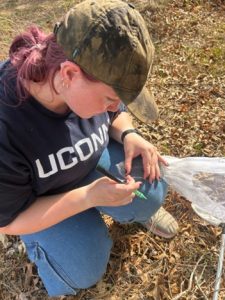
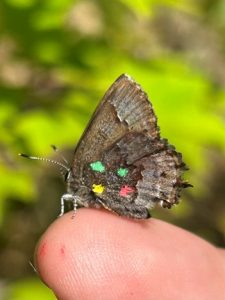
Once spotted, the researchers use a net to carefully catch the butterflies. Brennan explains that when they have a butterfly in the net, they gently guide it into a marking chamber and position it for painting. The rainbow of colorful marks helps the researchers track individuals. The researchers also get attuned to the flight pattern of frosted elfins, which is different from other, similarly sized and colored species.
“When we go out and look, we look at the host plants and typically the butterflies are right there,” says Brennan, who credits a great research team, including talented undergraduate students, for its success in locating the butterflies.
Beyond the immediate research questions, Brennan says the discovery at HEEP highlights a broader lesson for conservation in Connecticut.
“Rare species don’t only exist in remote or untouched places,” Brennan says. “Sometimes they’re quietly surviving in restored or actively managed landscapes that people might not immediately think of as ‘wild.’ If we maintain open habitat and protect host plants in these spaces, they can become part of a real recovery strategy.”
She adds that having a population on campus makes conservation more tangible for the university community.
“It’s easy for students to think of rare species conservation as something happening far away,” Brennan says. “But this is happening right here, and that makes it real.”
After Brennan graduates, DEEP plans to continue restoration and habitat expansion efforts informed by this research, building on the collaboration between the university and the state.
“DEEP partnered with UConn to refine the key scientific information we need to successfully target our limited funding on the most effective land management and protection actions for frosted elfin conservation,” says Kearney.
This effort will also serve as an umbrella for other species that rely on similar habitats in Connecticut, says Kearney. Invertebrates that rely on critical habitats with sandy soil types are a top priority in the most recent State Wildlife Action Plan.
“As an added bonus, Charlotte has forged interest and excitement among many landowners. The combination of the revised conservation plan and partnerships like this one with the HEEP will really help ensure success.”
Funding for the project is provided by the CT DEEP Wildlife Division NDDB Program and the federal State Wildlife Grants Program. Since 2017, UConn has been designated a Bee Campus USA by the Xerces Society, thanks to a multitude of sustainability projects and initiative undertaken around campus.