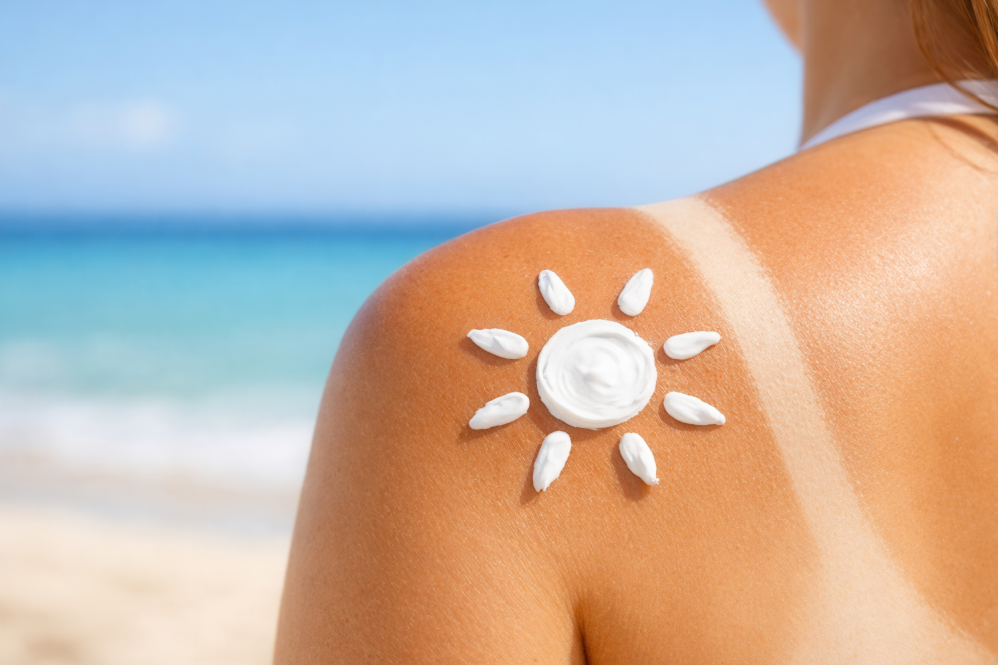
As summer begins, a new social media trend called “tanmaxxing” is gaining popularity among teens and young adults. The trend encourages people to seek out peak ultraviolet (UV) exposure in hopes of achieving a darker tan often while minimizing or avoiding sunscreen.
For dermatologists, it’s a concerning reminder that despite decades of education about skin cancer prevention, the appeal of tanned skin remains deeply ingrained in popular culture.
“There is no such thing as a healthy tan,” says Mary Wu Chang, MD, associate professor of Dermatology and Pediatrics at UConn Health. “A tan is actually a sign that the skin has been damaged by ultraviolet radiation. Every tan represents injury to the skin’s cells and increases the risk of premature aging and skin cancer over time.”
For Cara Koster, that message hits close to home.
With a family history of skin cancer and years of significant sun exposure growing up, Koster wasn’t entirely surprised when doctors began finding suspicious spots and atypical cells in her early adulthood.
“I have a family history of skin cancer, and because of my sun exposure as a youth, I was scared, but not totally surprised,” she says. “I’ve had suspicious spots removed since my early 20s.”
Like many people of her generation, Koster grew up at a time when a tan was often viewed as healthy and desirable.
“Growing up, my family loved being in the sun, and a tan was viewed as desirable and looking healthy,” she says. “I rarely used sunscreen. In high school and college, I would occasionally go to tanning beds to get a base tan at the beginning of the summer or to maintain a tan.”
She remembers using tanning accelerators as a teenager and only applying sunscreen if she was worried about getting burned.
“I don’t remember ever being worried about skin cancer until I was in my 20s,” she says. “I had heard of it, but I didn’t think it would happen to me.”
Today, awareness is much higher, but social media trends continue to influence how young people think about tanning and sun exposure.
According to Chang, many people don’t realize what is actually happening beneath the skin surface when they tan.
“When ultraviolet radiation penetrates the skin, it damages DNA within skin cells,” Chang explains. “The body responds by producing more melanin, which creates a darker appearance. What people see as a tan is actually evidence that the skin has been injured and is trying to protect itself from further damage.”
That damage accumulates over time. Even though a sunburn heals after 1-2 weeks, the UV accumulation and damage remains in the skin’s cells and continues to build up with every tan and every sunburn.
“Skin cancer is unfortunately a very common type of cancer in the United States, and much of that risk is tied to cumulative sun exposure over a lifetime,” says Chang. “The damage may occur during childhood, adolescence and young adulthood, but the consequences often don’t appear until years later.”
Repeated UV exposure increases the risk of both melanoma and non-melanoma skin cancers. While melanoma is less common, it is one of the deadliest forms of skin cancer because it can spread to other parts of the body if not detected and treated early.
For Cara’s daughter, Kate Koster, tanning culture remains a powerful influence among her generation.
“I would say that almost all of my peers participate in tanning in some way,” Kate says. “It has become such a normal part of the season that having a tan is often a goal rather than something people think twice about.”
She says social media and pop culture frequently portray bronzed skin as a symbol of beauty, confidence, vacations, and summer.
“Being tan is definitely considered part of the beauty standard,” she says. “I feel like there is an unspoken expectation that looking tan is more attractive.”
Many teens monitor the UV index, spend time intentionally tanning outdoors, use tanning oils, and seek visible tan lines. Some even avoid sunscreen because they believe it will prevent them from getting darker.
That misconception is one of many dermatologists are working to combat.
“There is overwhelming scientific evidence supporting sunscreen as an important tool for skin cancer prevention,” Chang says. “Sunscreen does help reduce UV damage, but remember to apply it generously, and to reapply often.”
Despite understanding the risks, Kate admits the appeal of tanning can still be difficult to resist.
“For me, it’s less about following a trend and more about feeling confident in my appearance,” she says. “It is difficult to balance the immediate confidence that comes from being tan with the knowledge that there may be long-term health consequences.”
Her perspective reflects what Chang sees among many younger patients.
“When you’re young, skin cancer can feel like a distant problem,” Chang says. “But every sunburn, every intentional tanning session, and every period of excessive UV exposure contributes to cumulative damage that stays with you throughout your life.”
Skin cancer is not the only concern.
“Ultraviolet radiation breaks down collagen and elastin, essential proteins that help keep skin firm and youthful,” Chang says. “Over time, excessive sun exposure can lead to wrinkles, uneven pigmentation, sunspots, and loss of skin elasticity. Many of the cosmetic concerns people try to address later in life are directly related to years of unprotected UV exposure.”
Cara says her own experiences have made her especially diligent about protecting her children.
“I have always been diligent about making sure that my children wear sunscreen,” she says. “I always make sure I have their favorite brands readily available, and I frequently ask if they’ve applied and reapplied, especially if they’re spending the day outside.”
Still, she understands why many teenagers struggle to appreciate the risks.
“I don’t think they realize the long-term consequences of tanning,” she says. “It’s hard to conceptualize those risks when you’re young.”
Kate agrees.
“I think many teens are somewhat aware that tanning can be harmful, but they don’t fully worry about the long-term consequences,” she says. “Skin cancer and premature aging don’t seem real or urgent because they feel distant in the future.”
For those who want the appearance of a tan, Chang recommends sunless alternatives such as self-tanning lotions and spray tans rather than intentional UV exposure.
“If you’re looking for a bronzed look, self-tanners and spray tans are much safer options because they don’t damage the skin,” she says.
Chang also recommends a comprehensive approach to sun protection:
- Apply a broad-spectrum sunscreen with SPF 30 or higher every day.
- Reapply sunscreen every two hours when outdoors and after swimming or sweating.
- Seek shade during peak UV hours, typically between 10 a.m. and 4 p.m.
- Wear wide-brimmed hats, sunglasses, and sun-protective clothing.
- Avoid tanning beds entirely.
- Schedule regular skin examinations and monitor for new or changing moles.
Today, Cara makes sun protection part of her daily routine.
“Every day I try to wear sunscreen on my face, and during the summer months, I always wear sunscreen if I’ll be outside for longer than a few minutes,” she says. “Our family loves outdoor activities, so I have sunscreen available at home, in the car, and in my bag.”
She also keeps up with regular dermatology appointments, while her children receive annual skin checks.
Looking back, she knows exactly what she would tell her younger self.
“I would tell myself to use SPF 30 or higher sunscreen, not tanning oil, wear sunglasses, hats, and protective clothing, and avoid tanning salons,” she says. “Opt for self-tanner or a spray tan if you’re looking for a golden tan.”
More importantly, she hopes younger generations learn to appreciate the skin they already have.
“I hope they understand the real risks and appreciate their beautiful youthful skin,” she says. “They have the ability to reduce their sun exposure and take protective measures now.”
For Chang, that’s the message she hopes rises above the latest social media trend.
“We want people to enjoy being outdoors and staying active,” she says. “The goal isn’t to avoid the sun completely. It’s to enjoy it safely. The choices you make today can have a lasting impact on your skin’s health for decades to come.”