For more than two years after a serious car accident, Katie Ralston did everything she was told.
She attended physical therapy, strengthened the muscles around her injured knee, waited for it to heal, and sought care from multiple orthopedic specialists. Yet despite her efforts, the pain never truly went away.
“I could walk around work, so from the outside I looked fine,” Ralston recalled. “But I couldn’t run anymore. I couldn’t take long walks without pain. Every night I went to bed hurting.”
The crash had left her with a sprained ACL, bone bruising and significant swelling. While the injuries gradually healed, the persistent pain continued to limit the active lifestyle she had always enjoyed.
“I knew something still wasn’t right,” she said. “I wasn’t looking for surgery. I just wanted someone to help me understand why I was still hurting.”
After more than two years without answers, her primary care physician recommended she make the drive from her home in Waterford to UConn Health’s Women’s Center for Motion & Performance.
It proved to be the turning point.

When Ralston met Dr. Allison Schafer, medical director of the Women’s Center for Motion & Performance at UConn Health, she immediately noticed something different.
“She listened,” Ralston said. “My pain was difficult to explain because it was deep inside my knee, and I couldn’t always describe what caused it. She took the time to ask questions and really hear what I was saying.”
Before the appointment even began, Schafer had carefully reviewed Ralston’s previous imaging. During the visit, she walked through the MRI with her, explained the anatomy of the knee, discussed what had healed, what might still be causing her pain, and outlined several treatment options.
“It sounds simple, but no one had ever really explained everything to me before,” Ralston said. “I finally felt like someone had looked at the whole picture instead of just telling me to wait.”
Rather than offering a one-size-fits-all solution, Schafer developed a personalized treatment plan based on Ralston’s symptoms, activity level and goals. Updated imaging confirmed that her knee had healed structurally, allowing them to focus on treating the lingering pain.
“It is important to remember that we are treating patients and not just MRI findings,” Schafer said. “Katie had done all the right things in her recovery. She was motivated, committed to physical therapy and strengthening, yet it wasn’t adding up that she continued to have pain unless it was stemming from an area that hadn’t been treated yet.”
She explained that persistent knee pain isn’t always caused by damage inside the joint.
“When we evaluate knee pain, it’s important to remember that not all pain stems from inside the joint,” Schafer said. “There are numerous extra-articular issues that can cause knee pain, including gait mechanics. These can be more difficult to diagnose because they don’t always show up on an MRI.”
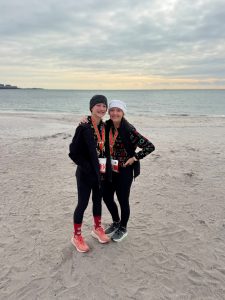
A cortisone injection became one part of Ralston’s personalized treatment plan.
“It wasn’t just about getting a shot,” Ralston said. “It was about understanding what was happening in my knee, having a plan, and knowing there were options.”
The treatment gave her something she hadn’t experienced in years.
Relief.
“It felt incredible,” she said. “For the first time in over two years, I felt like myself again. I could enjoy the activities I loved without constantly thinking about my knee.”
While she still pays attention to how her knee feels and may require treatment again in the future, Ralston says the biggest difference wasn’t simply the reduction in pain, it was having a physician who partnered with her throughout the process.
“They collected all the information, reviewed everything carefully, and talked to me like a real person,” she said. “When you’ve been frustrated for so long, that matters. I finally felt heard.”
That individualized approach is central to the mission of UConn Health’s Women’s Center for Motion & Performance, where providers recognize that every patient has different goals, experiences and barriers to recovery.
“We know that health care disparities exist across the spectrum of medicine, and how women receive musculoskeletal care is no different,” Schafer said. “At the Women’s Center for Motion & Performance, we try to be champions for women and help them reach their individual goals. But to know those goals, you have to take the time to ask and understand, and that is something we strive very hard to do.”
Although traveling to Farmington meant more than an hour’s drive from southeastern Connecticut, Ralston says the trip was well worth it.
“If someone asked me where to go for orthopedic care, I would absolutely recommend UConn Health,” she said. “When you’re not a surgical patient, it’s easy to feel like there aren’t any options. They showed me that there are, and they helped me get back to living my life.”
She hopes her experience serves as a reminder that patients should never feel dismissed when they know something isn’t right.
“Sometimes people don’t need someone to rush through an appointment,” she said. “Sometimes they just need someone to listen.”