Academic success and extracurricular excellence go hand-in-hand, according to Jason Candle.
“I think that whether you’re on campus, and whatever other extracurricular activity you’re involved in – if it’s athletics or something else,” Candle says, “you would understand that what you really love doing, coupled with the process of getting in and obtaining a degree that is really going to help you lay the foundation and give you the platform for what you want to be in your career someday, is critically important.
“And you would have the understanding that you can’t have one without the other.”
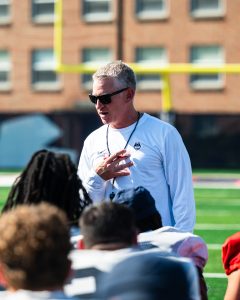
It’s a mentality that Candle is carrying with him to UConn in his first season as head coach of UConn football at Connecticut’s flagship R1 public research university, where student-athlete success is an integral piece of its Division 1 athletic programs.
Candle brings with him 10 seasons as head coach at Toledo, 81 career victories, two Mid-American Conference championship titles, seven bowl game appearances – and an open mind after relocating to Connecticut with his family in June.
Beyond a career of on-field success, Candle’s culture of academic excellence on his rosters is nothing short of impressive. At Toledo, the football program surpassed a 3.0 GPA in nine seasons under his leadership and ranked among conference leaders in academic progress assessments.
Success, Candle notes, is as much about mindset as it is about wins and losses – which he says aren’t his primary focus as he takes the helm of UConn’s program.
“High achievement starts from how you wake up, what your process and what your routine is each and every day,” he says. “It’s not, ‘Man I got an A on that test.’ It’s not, ‘We won that game.’ Because the next day is going to challenge you, there’s going to be the next task, just like in life.
“So, I think there’s a balancing act of, hey, I really have to be dialed into the details of what my particular sport or extracurricular activity is going to ask of me. But I also understand that there’s a real reason why we’re here. Because these cleats are going to come off someday and, ultimately, at the end of the day, this is an opportunity for you to pave a way to your future.”
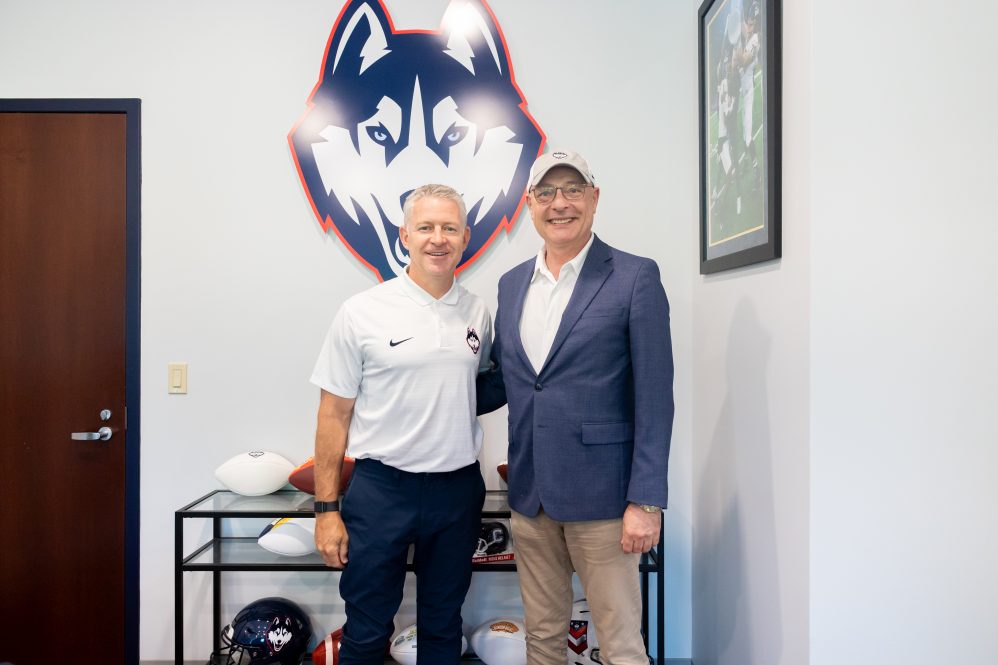
On a recent August morning, while his team did yoga on the indoor practice field at the Burton Family Football Complex in Storrs, Candle joined UConn’s Provost and Executive Vice President for Academic Affairs Pamir Alpay for a conversation about student-athlete success, recruitment, and expectations for the coming football season.
*****
Alpay: You’re new to Connecticut, right? How easy or difficult has it been for your family relocating here and joining the UConn community from Ohio?
Candle: I think change, first of all, can be an intimidating thing, especially when you’re in a place for a long time. But what has been such a pleasant surprise, and made for a smooth transition, is just the people. Everywhere you turn, whether it’s in our community where we live, whether it’s on campus, whether it’s other people in the athletic department, there’s strong support for this institution and a drive to be successful. And for anyone who is new to that, they want to help and engage, and it’s been awesome for my family to feel that.
Alpay: That’s excellent. That’s great to know. You’re originally from Ohio, and came here from Toledo, where you had tremendous success. What was your interest in joining UConn? What did you see here that made you think, “Hey, I want to be a part of that”?
Candle: In college athletics, there’s so many variables going on right now. I think the main thing is to find alignment, from administration to coaching staff to then, ultimately, student-athletes. We have a unique opportunity to represent the institution on a lot of platforms that many don’t get to. We have the opportunity to take a place that’s had some recent success and then try to make it even better.
But I think what I found through the process is really – and I said this when I first got here – that this is a place that has a lot of highly intelligent people who are really passionate.
Alpay: I remember your first interview.
Candle: And I think if that’s the starting point? Man, you can really do some special things if that’s the case.
So, in a world where the winds of change of college athletics can go a lot of different ways, you have the ability to steady the ship when there’s great alignment and there are people who are passionate about their place on it.
Alpay: The changes within college athletics in terms of recruitment, your engagement with the transfer portal – how does that change from how thing were five or six years ago?
Candle: It’s very different, but I also do believe that you have to understand who you are and what you’re trying to bring into your program. For us, we’re still going to recruit really high-character people who value what a free college education can do for somebody in today’s day and age.
And then, ultimately, we want guys on our team who are really passionate about the sport of football, and love to go to work, and really love what I always say are the 353 days out of the year when there’s not a game. We have to find people who are really, really good at that, because this is a long process to play only 12 guaranteed opportunities a year.
So many sports play 30, 40, 50 contests in their season. We play 12.
You really have to buy into that process, and I think that process is really reflective of what your future is when you start a career as a young graduate and, ultimately, what you want your life to be someday.
So, that’s what we’re looking for in the recruiting process, and whether it’s the transfer portal or whether it’s bringing high school kids onto our campus, we really try to stick to that. We try to find like-minded people, like the people in our building and the people that we go to work with each and every day.
Because I think, in football, adversity is going to show up, and it’s going to show up often. The trick is that you don’t know when it’s coming. So, you want guys who really believe that this is the opportunity to grow, in those moments. Those tough situations aren’t an indictment of their character, who they are, what they’ve been, that they’ve been going through. And they have the ability to rebound.
So, we’re looking for high-character individuals who are serious about their academics and who really love football. That’s a starting point for us.
Alpay: I’m glad that’s the thought process you have in mind. I don’t want to put you on the spot, but what should we expect for the first season? How do you see it playing out? And I’m not talking about wins and losses, more about what you want to see on the field as you’re putting this football team together.
Candle: I think that the outside perspective would be that goals should be reflective of wins and losses. But I think that’s a fixed mindset. And we can’t talk about the process, we can’t think about a growth mindset internally here if we start to approach things inside out, if you would.
So, can we wake up every day and put our energy in the right place? Can we really keep the main thing the main thing and, at the end of the day, really have a burning desire for improvement?
If we can master that process, and do a really good job with that, the days will stack, the weeks will start to fall into place, you’ll have really good months, and then all of the sudden, you’ll start to have a really good season. And those 12 opportunities that you get to go out there and compete in front of your fanbase will be a byproduct of a really good process. I think that’s what we’re after.
We want to keep that growth mindset and not fall into the “we want to win.” We don’t want to fall into that trap of an ultimatum, where if you don’t do these three things then you’re viewed as a failure. That’s never been my thought process. Because in college athletics, there’s so many things that can go wrong, many of which are out of your control.
So, we have to pay attention to, and put energy into, the responses to the moments, rather than it’s either really good or really low, when it comes to what happened. That’s been our thought process since we got here in January. You have the off season, you have spring practice, you have summer workouts, and now you have fall camp, and that leads into the season. I think our guys have done a good job understanding that the days do count.
Alpay: Excellent. So, you’re working with student-athletes, and you’re a role model to them on the field and off the field. How do you view academic success and success on the field? How do they correlate to each other in your mind as you’re shaping the futures of our student-athletes?
Candle: Great question. I’m a firm believer that how you do one thing is how you do everything. I think most student-athletes aren’t going sit here and tell you that they love school right off the start. They understand the importance of an education. They understand the importance of commitment to the process that allows them to have a meaningful degree. They understand that once their general elective classes get out of the way, then they can streamline into what they really want to be in their career, and their energy probably picks up, and their academics would reflect that.
I think that whether you’re on campus, and whatever other extracurricular activity you’re involved in – if it’s athletics or something else – you would understand that what you really love doing, coupled with the process of getting in and obtaining a degree that is really going to help you lay the foundation and give you the platform for what you want to be in your career someday, is critically important.
And you would have the understanding that you can’t have one without the other.
High achievement starts from how you wake up, what your process and what your routine is each and every day. It’s not, “Man I got an A on that test.” It’s not, “We won that game.” Because the next day is going to challenge you, there’s going to be the next task, just like in life.
So, I think there’s a balancing act of, hey, I really have to be dialed into the details of what my particular sport or extracurricular activity is going to ask of me. But I also understand that there’s a real reason why we’re here. Because these cleats are going to come off someday and, ultimately, at the end of the day, this is an opportunity for you to pave a way to your future.
Alpay: One last question, and this is a recruiting question, actually. What advice would you give to students who are thinking about playing football at UConn? What is it that makes this place unique? What advice do you have for students who want to be getting involved more with athletics at this University?
Candle: I think we’re in a unique time. College athletics have just caught fire, and it has such a massive impact on a college campus. It draws attention in a lot of ways, and I think that you can really understand and use that platform in a positive way to impact the entire campus community, no matter what sport you’re in.
Ultimately, we have a ton of responsibility to put a great product on the field in those 12 opportunities that we have. But I think it’s bigger than that. I think it’s: can you leave Connecticut a better place than you found it? Can you consistently live by it? Do you always give more than you take? And can you really, at the end of the day, be who you said you were going to be?
If you can follow those things, I think you’ll be really successful in our program. And I think you’ll be really successful on campus, because you’ll leave a legacy here that will be remembered for way more than just what you did on a Saturday afternoon at 2:00.
Alpay: I really appreciate the way you articulated that. Thank you, and welcome to UConn. Welcome to Connecticut. I know you’ll be super successful here.