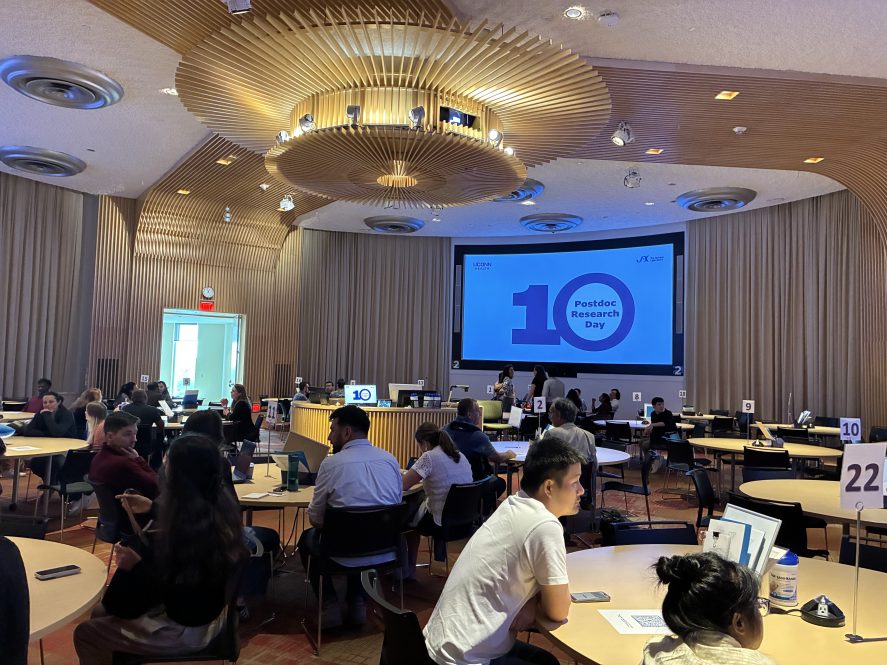
Postdoctoral researchers from UConn Health and the Jackson Laboratories competed against each other on Sept. 17 to give the best short presentation on their research topic. The Speak4Science event was the highlight of the 10th Annual Postdoc Research Day.
“They were given a tough assignment,” to explain the significance of their research in four minutes or less, says Chris Heinen, director of postdoctoral affairs and molecular oncologist in the UConn School of Medicine. “And they all knocked it out of the park!”
As a professional science writer who has interviewed hundreds of scientists over a quarter century, your correspondent concurs: never before have so many researchers explained so many advanced medical topics so clearly in so short a period of time. Bladder confetti, craniometaphyseal dysplasia, and primordial oocytes all got their four minutes in the spotlight, along with 22 other areas of medical research.
All the Speak4Science talks were by postdoctoral researchers working at either UConn’s School of Medicine, School of Dental Medicine, or the Jackson Laboratories. Postdocs are Ph.D. scientists just beginning their careers as independent researchers. They work in a more established scientist’s lab, gaining experience and mentorship in preparation for starting their own. Learning how to communicate the importance of their research is another key part of being a scientist.
The three winners of the competition were:
First place winner Anna Truong, of the Mok lab in the School of Medicine, asked “how is Pseudomonas aeruginosa beating these double stranded DNA breaks” that would kill other bacteria? Her talk conveyed how amazing it is that P. aeruginosa, a bacteria that causes dangerous infections, is able to resist fluoroquinolone antibiotics.
Luke Trinity, who works in the Ucar lab at the Jackson Laboratories, said in his second place-winning speech that cytomegalovirus might have a lot to do with why older adults have reduced immune systems.
“But most past research doesn’t identify who is cytomegalovirus positive and negative,” he said. Trinity is working on a retrospective method to figure out who was infected with the virus, potentially opening up past data to new research.
Third place winner John Stout, who works in the Spellman lab in the School of Medicine, succinctly described the relationship between cognitive flexibility and inhibitory control in the brain, and the pathways for inhibitory control he was identifying in the brains of mice.
The event also included poster sessions in which attendees had the opportunity to visit the presenters and ask more detailed questions.
There was a keynote presentation by Bruce Spiegelman, a researcher at Harvard Medical School and the Dana-Farber Cancer Institute and member of the National Academy of Medicine and of Sciences.
As the event marked its 10th year, Postdoc Research Day continued its tradition of celebrating scientific excellence, collaboration, and communication. It had the largest attendance the organizers could recall and the most Speak4Science participants. And it offered a reminder that behind every breakthrough are researchers dedicated to not only advancing knowledge, but also to sharing it with the broader community.