As if Yvonna Maxie had only one goal for her monthlong trip around Europe this summer, she realized this one early on in London after approaching a Black couple struggling to photograph themselves without the benefit of a third person.
They were skeptical at first, but Maxie says she assured them that, yes, she was happy to snap a pic to document their trip. Thankful, the Nigerian couple told her they were visiting Europe for the first time and enjoying every minute.
“It was good to talk to them and get their experience,” Maxie ’27 (SFA) says. “The African American and the African experience are two completely different things, and they experience very different types of racism, so it was good for me to hear that they feel safe and they’re feeling welcome as well.”
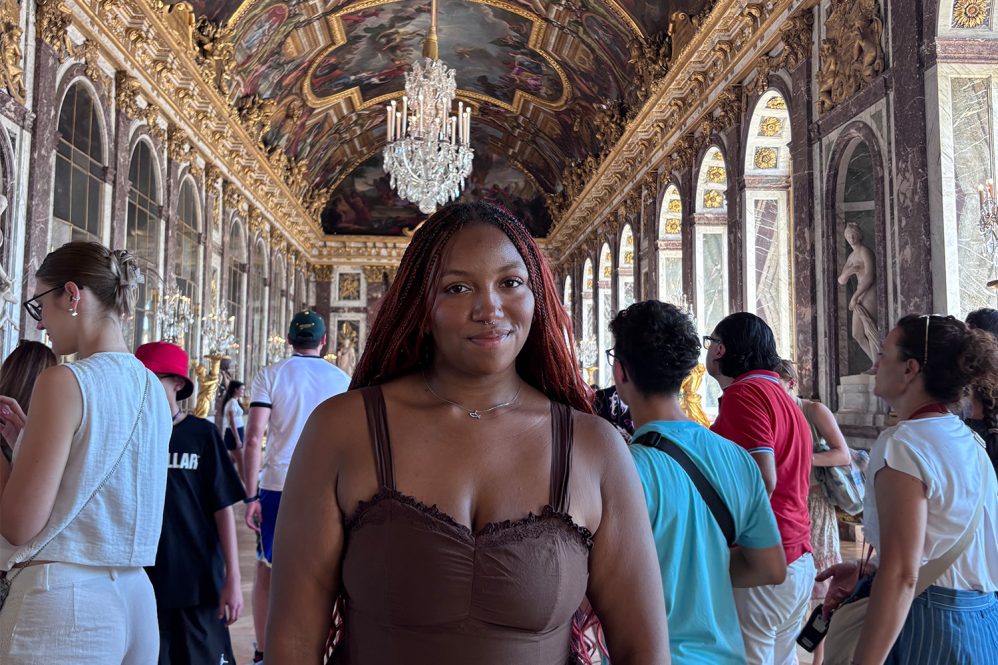
Maxie was solo on her journey in London that day and at other stops along the way including Dublin, Paris, Amsterdam, and Berlin, as the recipient of a scholarship from the BOLD Women’s Leadership Network at UConn who was overseas from late June until late July.
Her travel is the first part of a larger project to document the experience of a young Black woman navigating and living alone in European countries with Caucasian histories and cultures built around white people.
In addition to seeing the major sites at each locale, she sought to visit everyday places to measure how effortlessly and comfortably a Black woman could live abroad, for instance pharmacies to survey the aisles for products designed for Black hair care.
Her experiences will be the subject of an interactive magazine the digital media and design student is creating this academic year for other Black women thinking of studying abroad or following in her travel footprint. She hopes for it to eventually be distributed to high school and college-age students.
Connections to Africa
Maxie says many of her friends who’ve traveled outside the United States have gone to places in the Caribbean or Africa, not Europe because they didn’t feel like it was a place for them. But she was eager to cross the proverbial pond.

“I found that Ireland was one of the nicest places to be, just the hospitality and the way people serve you and talk to you,” she says. “Even when I went out to restaurants by myself, the bartender or the server would always talk to me, asking questions.”
At the Collins Barracks, which houses the National Museum of Ireland, she learned about the struggles involving Ireland and Northern Ireland and about their support for the African country of Rwanda during its genocide in the mid-1990s.
Throughout her travel, she learned a lot about European influence in Africa.
The AfricaMuseum just outside Brussels in Belgium featured an exhibition about the country’s dark history with Congo, during which a government-supported propaganda campaign attempted to rally favor for Belgium’s continued rule over the central African nation during a time when public support waned.
“The Belgians were exporting Congo’s resources and using the people as slaves, so they doctored pictures of it being a lively place, showing animals, their culture, and their dances, and they displayed them near the World Fair, so people could come in and see how Belgium was transforming and using Congo,” Maxie says. “Flash forward, once they realized this is an evil part of their history, they didn’t shy away from devoting a museum to it.”
She saw pictures of the murals used as propaganda versus the actual images that are devoid of trees and animals and show shackles on people’s legs, she says, adding, “That was one of my favorite museums of the whole trip. It’s very rare for people to accept their history.”
People Who Look Like Her
When Maxie stepped off the train in Edinburgh, Scotland, the beauty of the small, touristy town couldn’t be missed. But for the first few days she was there, there was one thing noticeably absent.
“I didn’t see anyone who looked like me,” she says. “It was the third day I was there, and I was walking in the city center when I saw a group of Black women and children. They were singing to get other people to come to their church. A lot of the places I went had Black people advertising their religion, ‘Come to church with us, come to this church music festival.’”
Those three days were the first time in her life, she supposes, during which she truly was the only Black person around. High school would have been the closest example, when she was one of the only Black students in her honors courses.
In Amsterdam, the Netherlands, where there’s a comparatively small population of Black people, Maxie says she felt heartened after visiting Rijksmuseum, where she saw the work of an illustrator who drew outlines of children on a background, sketches of younglings doing child-like things.
“Even without color, the children looked different enough to know they were from different backgrounds,” she says. “You could see the curly hair and the straight hair or the waves. I really enjoyed that because it’s important for children to see that people look different from them but they’re all together in the same space.”
Feeling a Bit Unwelcome
Of course, a month of travel doesn’t come without letdowns.
“Berlin, I don’t think I gave it my best shot personally,” Maxie says, reflecting on the trip. “I didn’t see a lot of other Black people and when I went to their museums, there wasn’t a lot of Black art. They had the bust of Nefertiti, which is from Egypt, in a building with Greco-Roman art. It wasn’t showcased in the way it should have been.”
And Paris, even with its magnificent sites, Maxie says she didn’t feel wholly welcome.
To be fair, she admits, she doesn’t speak French, which is known to irritate native speakers, and she’s American, also known to be grating on other cultures. Getting around and mixing with everyday people was doubly difficult – triple that when she met up with a white friend from UConn, who also was overseas, and had dinner with her.
“It’s important to see that side-to-side treatment because sometimes I just think it’s me,” she says. “To have that comparison, it’s like whoa, I didn’t know you could be treated this well until there was someone else being treated this well next to me. The rudeness was heavier toward me.”
She continues, “Sometimes I get scared to call something racist because it feels like such a buzzword almost, people trying to make every little thing about race. I don’t want to do that and have people think of me that way. But at the same time, you’re treating me poorly, and she’s not being treated as poorly. It was a big wake-up call.”
Places on the ‘Go-Back-To’ List
Still, the trip came with some big highs. Take London, England, for example. It’s where she met that couple from Nigeria and took their picture. It’s also where she says she felt most free.
“When I got up and went somewhere, I didn’t have to actively think about it or think that I would feel odd or look out of place. I didn’t have to spend so much time getting myself together. I felt like I could just exist there and not get a look or a stare. It was the place I felt most comfortable in immediately, and it was one of the most diverse places,” she says.
Madrid, Spain, the last place on her itinerary before coming back home, also was a highlight.
Excited by the culmination of a successful trip and the prospect of reuniting with family in just a couple days, Maxie’s excitement grew as the country welcomed home the national soccer team after its historic win over Argentina in the World Cup.
Her arrival to the city was delayed after being held up on the tarmac to allow the team to deplane just ahead of hers, and when she stepped onto her hotel balcony on Grand Via the next morning and saw masses of people lining up for the celebratory parade, she knew what she needed to do.
“I put on my red shirt, I put on my shorts, and I went,” she says. “It was people on people – I looked the next day and there were 2 million people – but it was beautiful. Being able to go there and see other people who looked like me celebrating their sport was amazing. A lot of the Black people I saw were wearing the names of Black players on their jerseys, so it was nice to see that solidarity with each other.”
I put so much into this trip, and I feel like everyone was expecting me to have a revelation or transformation, like I went to Europe and found myself. But I came back, and I’m still me. I didn’t know that I’d still be me, that I’d know so much more about myself and the world and still be me. — Yvonna Maxie ’27 (SFA)
Expected – and Unexpected – Takeaways
Emily Schwab, director of the BOLD program at UConn, says Maxie’s travel abroad was the capstone experience for her time in the program.
“Important to her, and the goals of our program, is a focus on self and career development, alongside social impact in carrying out their summer leadership projects,” she says. “By reading travel writing by Black authors, researching the trends of where Black Americans typically travel, and working with mentors in digital media and design and Experiential Global Learning, Yvonna developed a project plan to generate data through her own travels by chronicling her own experience and connecting with Black expats and travelers abroad.
“She methodically documented her learnings about her experiences traveling through Europe in the hope she could share her insights with other young women through an engaging, accessible, and creative final product, informed by her expertise honed as a DMD major,” Schwab adds. “She also thought intentionally about how the project could be used to boost her portfolio as a DMD major and future professional, utilizing those storytelling skills to elevate narratives that don’t always break through to the mainstream.”
But there’s something, Maxie says, that she got from the experience and never expected.
“I put so much into this trip, and I feel like everyone was expecting me to have a revelation or transformation, like I went to Europe and found myself,” she says. “But I came back, and I’m still me. I didn’t know that I’d still be me, that I’d know so much more about myself and the world and still be me.”
It’s something she’d tell anyone considering applying for a BOLD scholarship through UConn’s Office of Undergraduate Research – along with the advice to dream big.
“I never thought I’d go to this many countries and do this many things,” she says. “When I first applied, I thought I could do to one or two places, and then I set the expectations bigger for myself. It’s important to find something that you really care about and just find a way to make it work for yourself.”