Palm oil and palm kernel oil are versatile oleochemical feedstocks widely used in food and personal care products and can be converted into industrial products such as biolubricants and bio-based plasticizers.
Despite its ubiquity, though, there are serious problems with palm oil. Palm oil production has led to deforestation and biodiversity loss, as well as unjust labor practices in Southeast Asia, where the majority of the world’s palm oil supply is produced.
Because it is derived from a tropical plant, the United States currently relies on imports to meet 100% of its demand for this critical platform chemical across the food, cosmetics, industrial lubricants, and plasticizer sectors creating significant supply chain vulnerabilities.
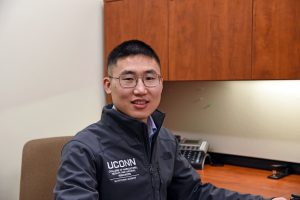
Mingyu Qiao, assistant professor of innovation and entrepreneurship in the Department of Nutritional Sciences (CAHNR), has received a $1.875 million grant from the Department of Energy’s Alternative Fuels and Feedstocks Office to turn seaweed into a replacement for palm oil and other medium-chain fatty acids (MCFAs) like coconut oil.
Seaweed farming has already established a foothold in Connecticut and New England as a sustainable and easy-to-grow crop.
Not only doesn’t seaweed consume fertilizers, water, or pesticides, as other crops do, but it also acts as a natural filter to clean the water in which it grows. Seaweed can be produced rapidly and on a large scale without competing for space with land-based crops.
“With seaweed, you can just put it in the ocean, and it’ll grow itself,” Qiao says. “You don’t need to apply any pesticides or fertilizers because the ocean has all the nutrients it needs.”
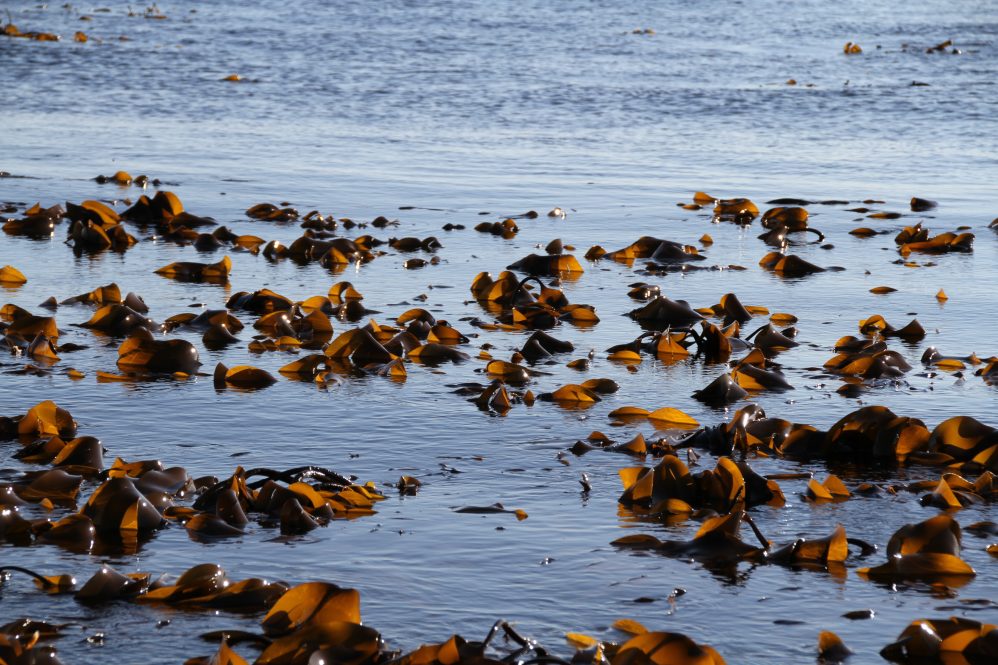
Qiao is using sugar kelp, a popular edible seaweed that is native to and already produced in Connecticut’s waters, for his research.
Qiao is using a biological process known as arrested anaerobic digestion to transform seaweed into MCFAs. Anaerobic digestion is a natural process through which bacteria break down organic matter in the absence of oxygen.
Normally this process produces methane, a potent greenhouse gas. However, the natural salinity of seaweed inhibits methane-producing microorganisms, redirecting the process toward volatile fatty acid production. These acids can then be separated and upgraded into medium-chain fatty acids (MCFAs), creating a more sustainable pathway.
This project is a collaboration with the Idaho National Laboratory, the recipient of $200,000 of the grant. The Laboratory will develop a method for preserving seaweed biomass long enough for it to be processed. Normally, seaweed rots within a few days of being out of the water. By adding lactic acid bacteria – the same bacteria found in yogurt – the researchers can stabilize and store the seaweed for months.
“That is the biggest problem for seaweed compared with something like corn or soybeans,” Qiao says. “This will solve that problem.”
Because the MCFAs Qiao’s team will produce are derived from seaweed, they can be used in all industries, like food and personal care, that require additives to be all-natural.
“For anything that comes into contact with the body, consumers increasingly prefer natural or bio-based materials because petroleum-derived products may contain trace impurities, some of which could pose toxicological or carcinogenic risks,” Qiao says.
This work will help support the U.S.’s supply chain resilience of critical chemicals and materials.
“For critical materials, [it’s important to be able to] produce them domestically,” Qiao says. “Even if it’s a little bit more expensive, those companies are willing to pay for that because it’s more secure. You can fully control that.”
This project is a collaboration between researchers in the College of Agriculture, Health and Natural Resources and the College of Engineering with co-PIs Baikun Li, professor in the Department of Civil & Environmental Engineering; Jeffrey McCutcheon and Xiao-Dong Zhou, professors, and Burcu Beykal, assistant professor, in the Department of Chemical & Biomolecular Engineering; and Bradley Wahlen, research scientist at Idaho National Laboratory. All UConn faculty are part of the Center for Clean Energy Engineering (C2E2).