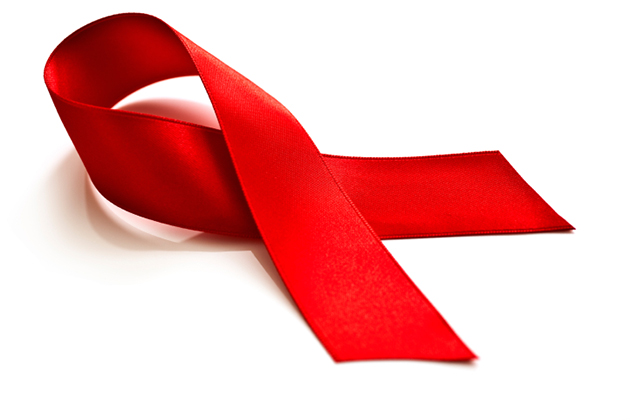
These days, Seth Kalichman takes note of the lack of headlines about HIV and AIDS, especially as compared to the number of stories that dotted front pages in the 1980s and 1990s.
“It’s what we were all working for,” says Kalichman, a professor of psychological sciences at UConn. “It’s just not the same crisis that it once was. It’s still a personal crisis for every individual who contracts HIV infection, but in terms of being the same public health crisis, we’re past those days thanks to the success of HIV treatments.”
What is a problem today, he says, is the growing number of AIDS denialists and their efforts to undo those successes.
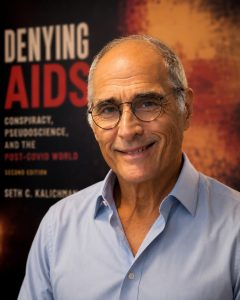
Kalichman’s 2009 book, “Denying AIDS: Conspiracy Theories, Pseudoscience, and Human Tragedy,” tackled denialists head on, calling out their junk science and foolish claims.
A newly released second edition, published this year with the revised title, “Denying AIDS: Conspiracy Theories and Pseudoscience in a Post-COVID World,” has been substantially rewritten to address a new surge in AIDS denialism prompted by the COVID pandemic and fueled by the antivaccine movement.
“We’re in a very dark time in public health, and I don't have any reason to believe that it's going to get any better anytime soon,” he says - even as the crisis headlines from 30 and 40 years ago have waned.
Kalichman talked with UConn Today recently about AIDS denialism, his recent research, and where we go from here.
What’s the status of AIDS denialism and is it growing in the U.S. and around the world?
AIDS denialism has been a problem since the early 1980s at the start of the HIV pandemic, and it has morphed as HIV epidemics have themselves changed. AIDS denialists have always been there, asking questions long answered. But they rose to prominence at the turn of the 21st century, when South Africa’s former President Thabo Mbeki discovered them while doing “his own online research.” Mbeki started questioning whether HIV causes AIDS. He listened to leading AIDS denialists, particularly Peter Duesberg from the University of California Berkeley. He brought several denialists on as health policy advisors, ultimately stymying access to HIV testing and treatments. Studies now show that those policies were responsible for more than 350,000 deaths in South Africa and 80,000 children senselessly born with HIV. After Mbeki resigned and HIV treatments further advanced, AIDS denialists were no longer in the spotlight. But they were still there, on the internet and social media, confusing people and influencing their health decisions. They were mostly ignored by scientists, health professionals, and policymakers. All of that changed with the COVID pandemic. AIDS denialists latched onto the fear and uncertainty of COVID, saying that the pandemic, like HIV, was manufactured by the government and pharmaceutical companies for profit. AIDS denialists became leading COVID denialists. They also joined with the antivaccine movement. They blamed Dr. Anthony Fauci for COVID, pointing out that Fauci was also at the center of manufacturing the AIDS crisis. Their conspiracy theories were amplified by Robert F. Kennedy Jr. in his book, “The Real Anthony Fauci.” RFK Jr. gave new life to the AIDS denialists, dedicating more than a third of his book to painting a picture of AIDS denialism with broad strokes of conspiracy theories and debunked pseudoscience, placing Fauci at the center of corruption and collusion leading up to COVID. Of course, RFK Jr. is now the secretary of health and human services, so here we are living in a state of public health denialism unlike anything seen since the Mbeki years.
Why is it dangerous to deny something like HIV exists or believe that COVID was overblown?
If what denialists are saying didn’t involve matters of health and medicine, life and death, they would be nothing more than a curiosity, like recounting UFO abductions or Nessie sightings, a curious anomaly that's kind of quirky. But these are medical and public health denialists. They are targeting people who are making health decisions. They are getting the attention of people in positions that impact the whole country. Many people have provided testimonials stating that because they've listened to Peter Duesberg, and other AIDS denialists, they refused to get HIV tested or if they tested HIV positive, they disregard the result. The impact of AIDS denialism on testing those who may be at risk for HIV is one substantial problem. Another problem is that people who have tested positive may refuse treatment or come to believe that the treatments are toxic poison. These individuals are making decisions based on misinformation. AIDS denialists are now even targeting preexposure prophylaxis, known as PrEP, the use of medications to prevent HIV infection. So, people who can benefit most from PrEP may come to believe these drugs are dangerous, that they do more harm than good, and that they're toxic and should be avoided. COVID denial poses similar problems. Reframing the COVID pandemic as overblown impacts vaccination rates, even as new variants of the virus emerge. And it is not just COVID vaccines. We are seeing the worst measles epidemic in decades because vaccination rates have fallen. Today, our country, our governmental enterprise, is driven by an antiscience, denialistic president who has appointed an AIDS denialist and antivaccine activist as the health secretary, who in turn has appointed an NIH director who is publicly sympathetic to AIDS denialists. So, the things I’m concerned about are the changes in public health policy that are affecting not just individuals, but the entire country and beyond.
What are some of your latest research findings?
Between the first edition of the book and COVID, nothing much changed. There are AIDS denialists on every continent. They continue to have podcasts and YouTube channels, and new platforms such as Substack. Some of the leading denialists have died. But they are replaced with new believers. It’s like playing whack-a-mole. They’re always there and they're always a menace. People who have paid most attention to the AIDS denialists have historically been people living with HIV who have not accepted their diagnosis. They are looking for a way out and would like to believe it is not true. In this respect, denialism fuels denial. Then COVID emerged in 2020, the entire landscape changed, and the AIDS denialists reemerged, making the same baseless arguments they’ve made about AIDS but applied to COVID. A good example is that during the peak of COVID when people were frightened, there was a 5G network conspiracy theory that rapidly spread. A former physician - he had lost his medical license - said COVID isn’t caused by a virus, it is caused by the proliferation of 5G cellular networks. The doctor who spread these false claims is also an AIDS denialist. The other thing that happened during COVID was a resurgence of the antivaccine movement. AIDS denialism, COVID denialism, and the antivaccine movement have coalesced, and it doesn't make sense anymore to talk about them separately. They've all melded together and because they are promoted by the U.S. health secretary, they have become a substantial threat to public health.
Where do we go from here?
There are multiple ways to approach denialism. One thing that is clear is that ignoring denialism doesn't help. Thinking that it'll just go away, doesn't help. It is just not good to ignore these people. As Dr. Fauci stated in his own memoir, he underestimated AIDS denialism only to see it fester into a public health threat. Making sure our elected officials know we are paying attention is important. When they listen to experts and remain grounded in reality, we should thank them. And when they are spreading conspiracy theories, embracing pseudoscience, and rewriting history, we should call them out. This is very important because elected officials have to know we are paying attention. I also think it's important that people be good consumers of health information and that they think critically about the sources of their information. This is becoming increasingly difficult because it's harder every day to distinguish what's real and what's not real and what's true and not true. Don’t just pay attention to credentials when determining someone’s credibility. It should matter if they have spent their career searching murky waters for monsters of Loch Ness, refute that any germs cause disease, or have been abducted by aliens – these things are true for some leading AIDS denialists. But to be honest, for me the dark period we are living through does not have a clear end in sight. Mounting cases of measles and whooping cough, exploding cases of avian flu, and the removal of disease surveillance systems that prompted this summer’s cyclospora outbreak, all point to things getting worse. As vaccine rates decline, we can expect diseases like polio to come back. So, our best way forward is to call out denialism, expose conspiracy theories, and debunk pseudoscience. As the activist Gregg Gonsalves at Yale University is saying, we have to defend public health. If we don’t, we will be in real trouble.