To study the origins of the universe, astronomers need a variety of tools to capture as many pieces of the picture as possible. While observatories like the James Webb Space Telescope (JWST) can capture images in the mid-infrared range, and pioneering facilities like the Atacama Large Millimeter Array (ALMA) observe the universe in the submillimeter range, there remains a sizable gap within the far-infrared range that we cannot currently observe, leaving many questions unanswered.
UConn researcher Cara Battersby is among an international team of researchers who are working to fill the far-infrared gap in data and continue pushing our limits of understanding of the universe with a project called PRIMA (PRobe far-Infrared Mission for Astrophysics), which was recently selected by NASA to move to Phase B of development.
“PRIMA will give us a new view to the universe, enabling observations of unprecedented sensitivity in the far-infrared,” says Battersby. “About half of the light from stars is absorbed by dust before being re-emitted by the dust in the far-infrared. Since these wavelengths of light are absorbed by Earth’s atmosphere, we can only observe far-infrared light from space, making it a relatively unexplored window into the cosmos.”
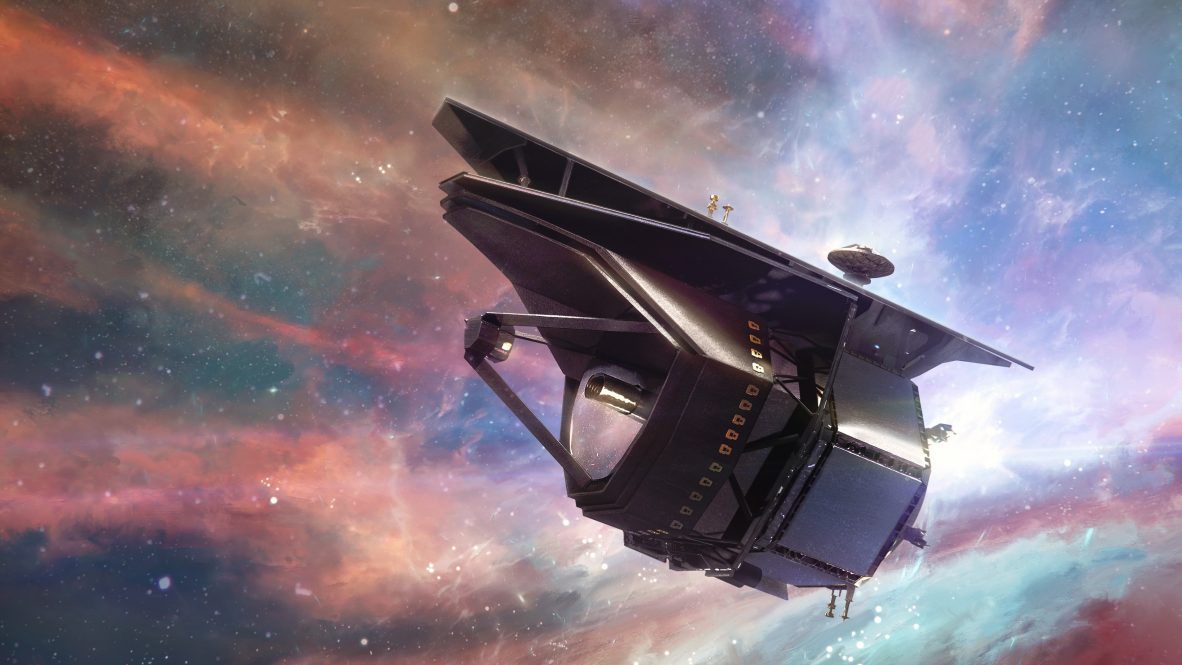
The PRIMA concept study calls for an observatory with a 5.9 foot (1.8 meter) far-infrared telescope to perform surveys that are currently outside the observational capacity of existing instrumentation. Jason Glenn, who led the PRIMA concept study says PRIMA will dramatically change our understanding in several areas of fundamental contemporary astrophysics, such as the role of water in planet formation, when huge black holes grew in the centers of galaxies, and how and when cosmic dust formed.
“With its ultra-sensitive technology, PRIMA will enable us to understand the critical role of water in planet formation and how and when black holes grew in galaxies to be the monsters we see in our present-day universe,” says Glenn.
The project received $5 million in funding in a preliminary phase of development with the NASA Explorers Program to design the mission, and PRIMA is the first from that program to advance to phase B. In Phase B, the team will continue to develop project and upon further review, the project may proceed to Phase C.
“Moving into Phase B is incredibly exciting for the PRIMA team and astronomy community overall. While 25% of the mission is focused on our three key science objectives, 75% will be open to the community for General Observer operations,” says Battersby.
Battersby and her group will be assisting the team to understand how planets form around young stars and how they get their water. In particular, she will be leading efforts to extract total protoplanetary disk masses using the Hydrogen-Deuteride (HD) molecule, a key astrophysical measurement that is only possible in the far-infrared.
The project also presents an exciting opportunity for UConn students to be a part of this groundbreaking mission.
UConn Ph.D. student Rachel Lee led early theoretical work on the potential of PRIMA to uncover the primary mode by which stars gain their mass. Future UConn students will have an opportunity to work with Battersby and the PRIMA team on this project. Battersby is the Associate Director of the PRIMA Internship Program (PIP), a new opportunity that offers summer internships as part of the PRIMA program at NASA-GSFC and NASA-JPL. PIP provides undergraduate students cross-disciplinary exposure across the major aspects of mission planning, specifically science, engineering, and management where they get hands-on experience in mission development.
If the project is selected to proceed to Phase C, PRIMA’s project cost will be capped at $1.2 billion, not including launch and other non-project costs. The observatory will be targeted to launch in 2033, for a planned five-year mission. The mission is managed by NASA’s Jet Propulsion Laboratory (JPL).
“We have a very strong collaboration ready to work together to implement PRIMA for the astrophysics community, including JPL, Goddard and Marshall Space Flight Centers, extraordinary international partners and U.S. industrial partners, and key university co-investigators,” says Glenn.
Battersby sees a bright future for astronomy at UConn: “PRIMA brings humanity a new view of the universe as well as new opportunities for cutting-edge astronomy research at UConn.”