UConn Fire Department Celebrates 50 Years of Paramedics
Ceremony honors the first class of paramedics in the region, which included 4 UConn Health firefighters
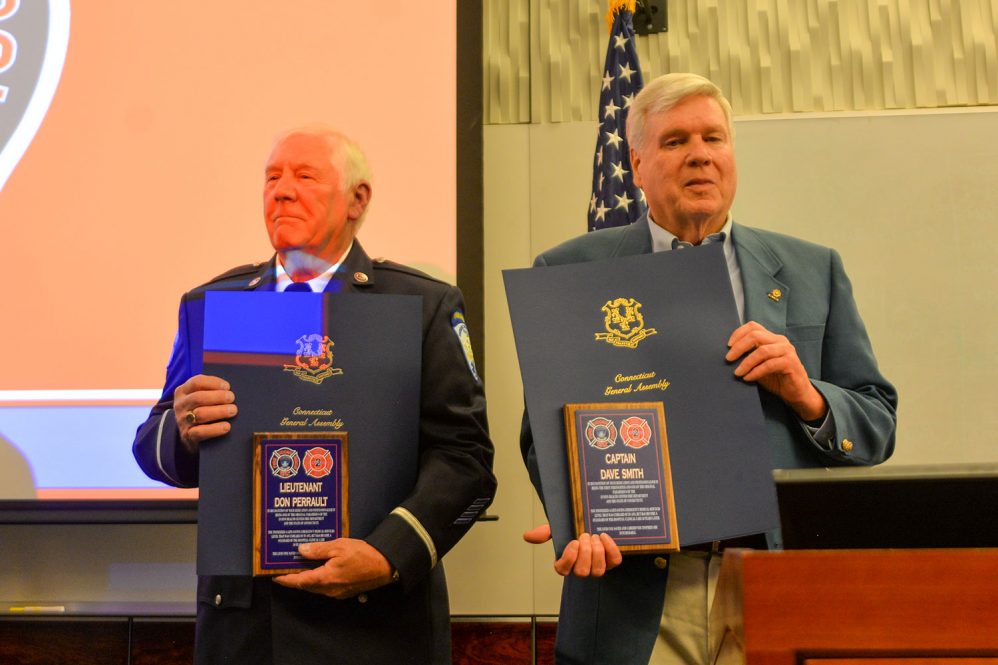
Retired UConn Fire Lt. Don Perreault (left) and retired UConn Fire Capt. Dave Smith, two of the four UConn Health firefighters who were in the first class of paramedics in Connecticut in 1975, show the plaques and citations they received in recognition as their service. (Photo by Coral Ruggiero)
A brave new world in emergency medicine traces its Connecticut origins to UConn Health in 1975, when 12 firefighters enrolled in the Northeast’s first paramedic training class this side of Pittsburgh.
Paramedicine was a new and largely unheard of concept at the time Greg Metcalf — then the public safety director at what was known as the UConn Health Center — proposed, advocated for, and ultimately won the support for bringing paramedics to the state, with an inaugural class of 12.
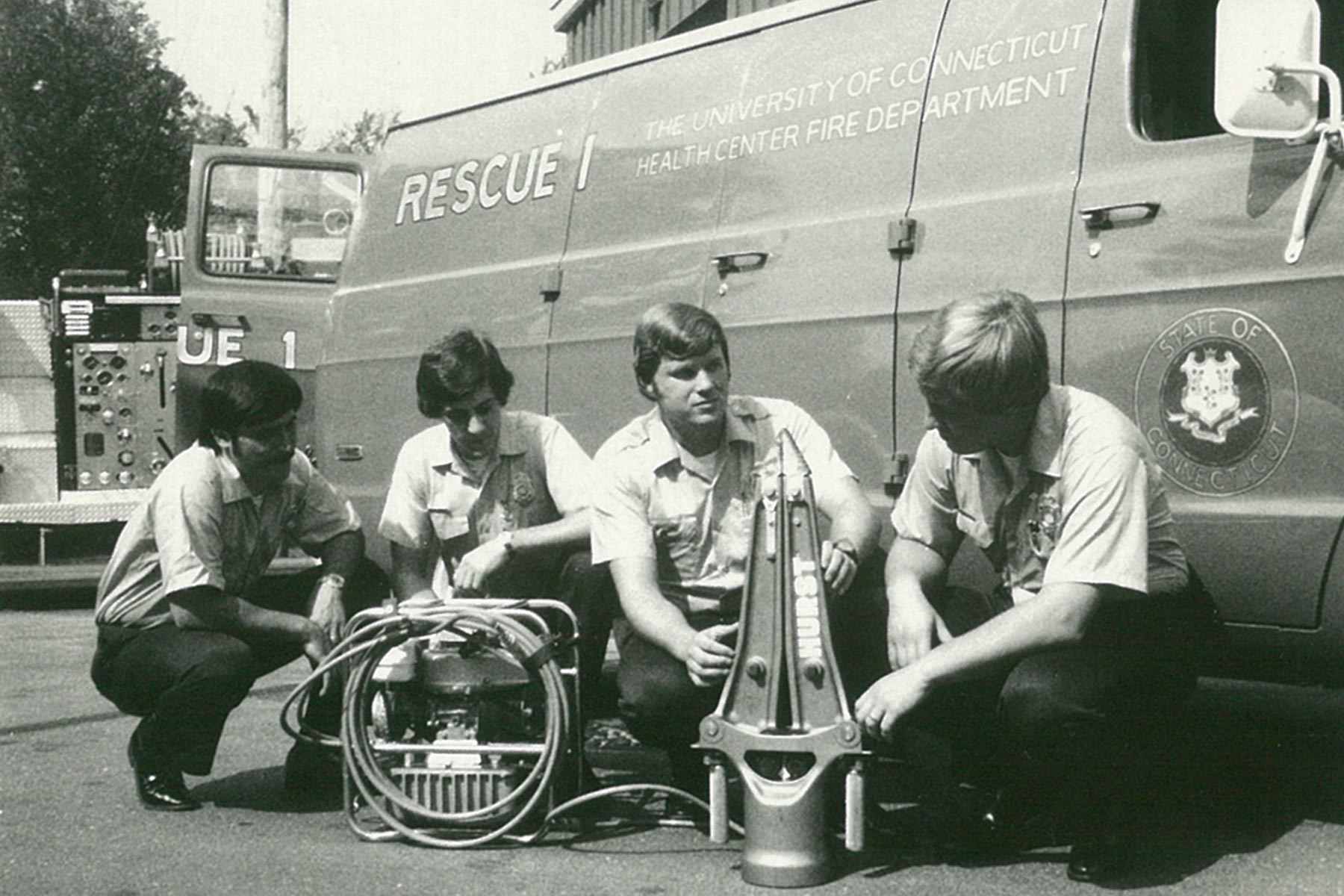
The first UConn Health firefighter paramedics demonstrate a Hurst tool, also known as “the jaws of life.” From left: Jerry Rio, Don Perrault, Dave Smith, and Walt Rasmussen. “We had the first one in the Farmington Valley; only Wethersfield and Enfield had one at the time,” says Smith, who was an extrication instructor for the state. It weighed about 45 pounds, plus at least another 60 pounds for the motor. (Photo provided by Dave Smith)UConn Fire Capt. Anthony Ruggiero emcees the UConn Fire Department’s celebration of 50 years of paramedic service April 17, 2026. (Photo by Coral Ruggiero)
“Eight East Hartford firefighters and four UConn Firefighters — Capt. Dave Smith, Capt. Jerry Rio, Lt. Don Perreault, and firefighter Walt Rasmussen — bravely stepped forward to blaze a path for EMS in Connecticut that had never been attempted, let alone dreamed of, before,” said UConn Fire Capt. Anthony Ruggiero, himself a paramedic, at a UConn Fire Department ceremony to celebrate 50 years paramedic services in Connecticut. “Today we stand on the shoulders of these giants, pioneers of modern medicine in a world where paramedicine is now a household name.”
Perrault and Smith attended, each presented with a plaque and a proclamation from the Connecticut General Assembly to honor their service as Connecticut’s first paramedics. Rasmussen and Rio were unable to attend.
How many jobs can you talk about 50-something years later and have something like this? It’s unbelievable. — Dave Smith
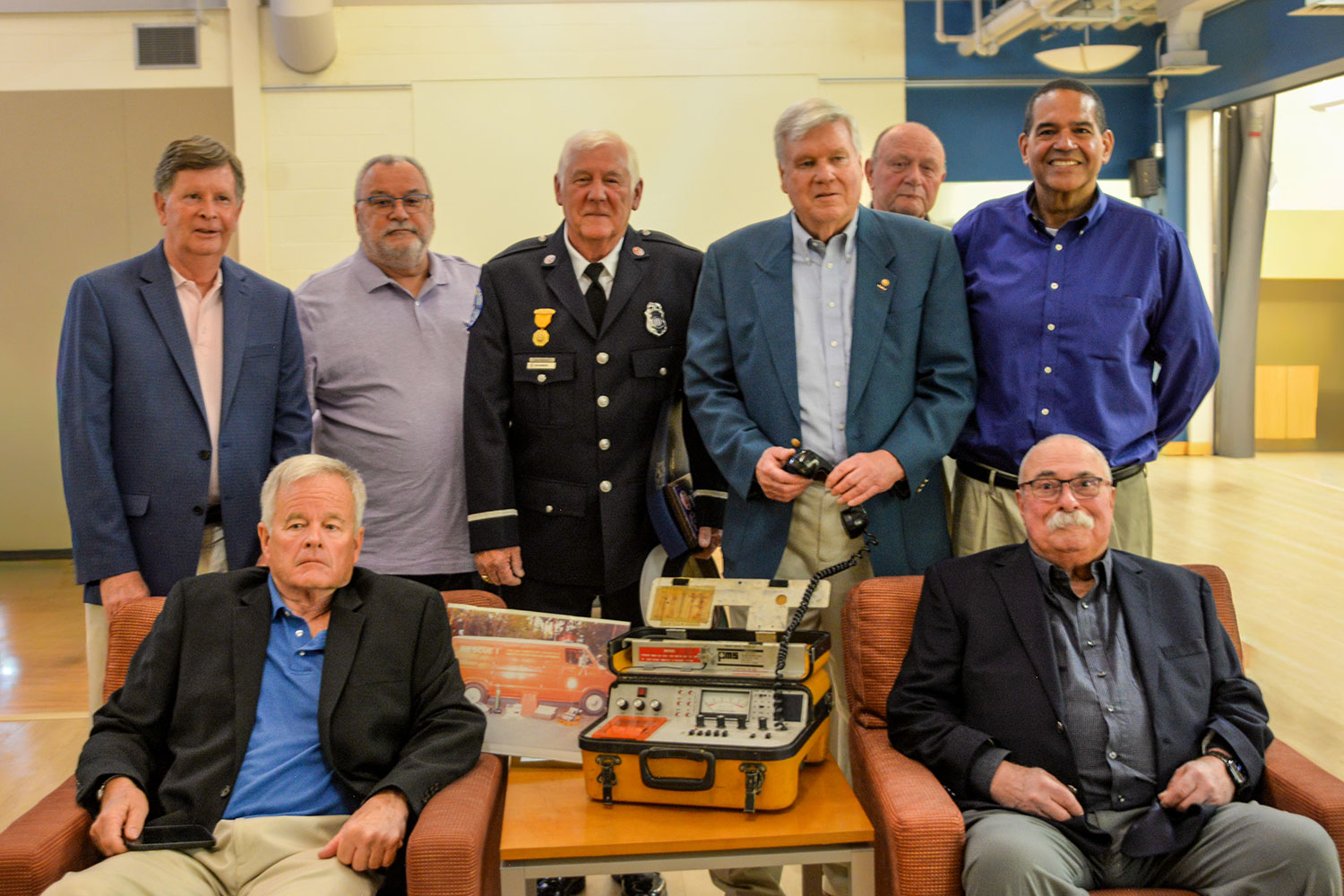
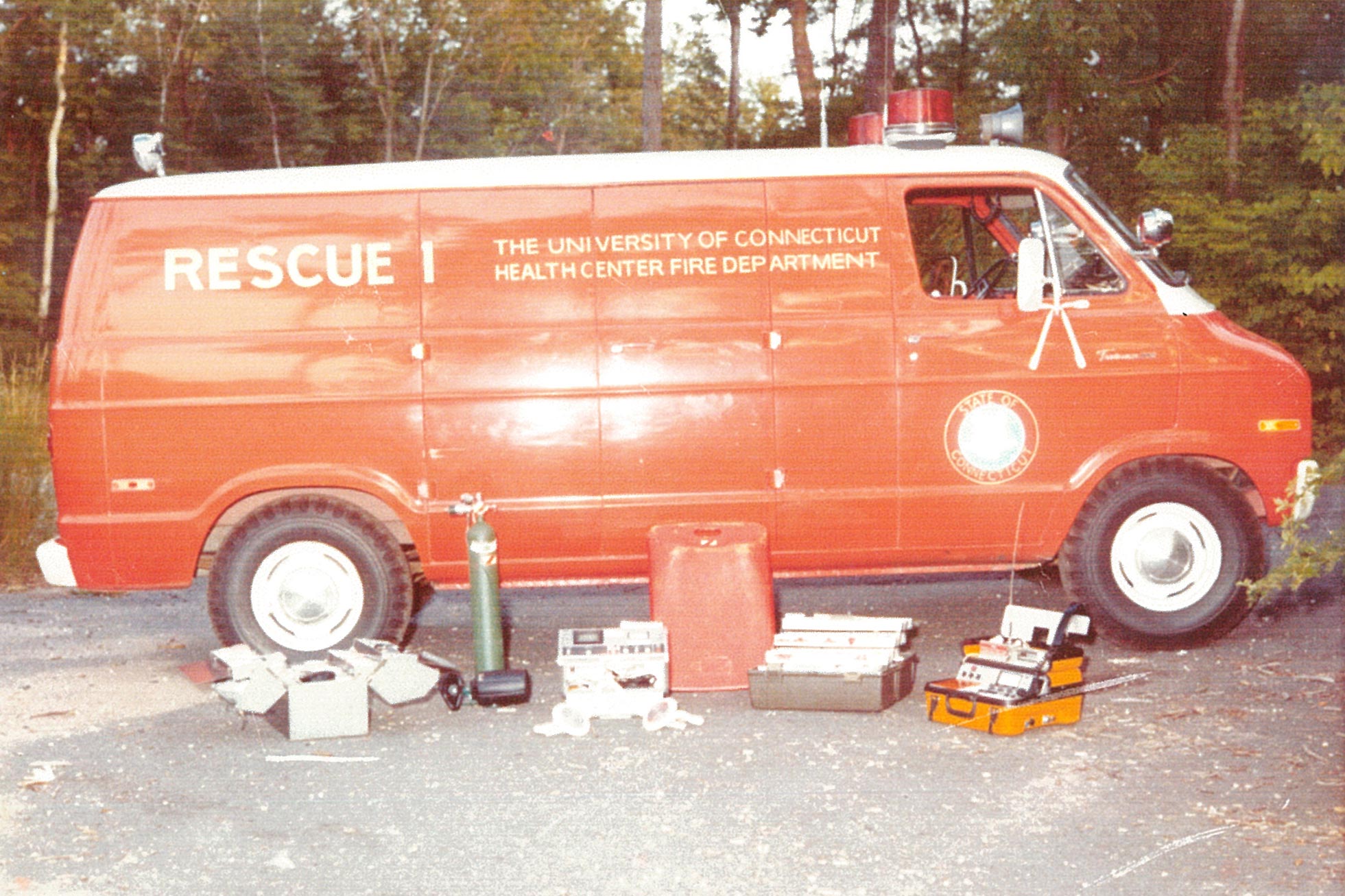
Retirees who attended the UConn Fire Department’s celebration of 50 years of paramedic service April 17, 2026, include (front row, from left) firefighter/EMT Al Madden, Deputy Chief/paramedic Bob Howe. (back row, from left) firefighter/paramedic Dave Marsland, firefighter/paramedic Francis Brunet, Lt. Don Perrault (one of the original paramedics), Capt. Dave Smith (one of the original paramedics), firefighter/paramedic Ed Higgins, and Capt./paramedic PJ Roche. Also pictured is a photo of Rescue 1, UConn Health’s first paramedic vehicle, and a “Biophone,” a mid-70s version of a portable EKG/communications unit. (Photo by Coral Ruggiero)
Metcalf, who lives in Utah, flew in for the ceremony, also accepted a plaque, reluctantly, after Perrault told him, “Without you, none of this would have happened.”
“I would’ve said there’s no way we would have made it this far, that, quite honestly, if we made it to the next day, that was always a pleasant surprise,” Metcalf said when asked if he was told in 1975 he’d be attending a ceremony marking 50 years of paramedics in in the UConn Fire Department. “No, I never thought I’d be seeing you here at the 50th.”
“I’m really grateful, I mean, I’m kind of amazed,” said Smith, who in 1971 was the first firefighter hired to the UConn Health Fire Department. “How many jobs can you talk about 50-something years later and have something like this? It’s unbelievable.”
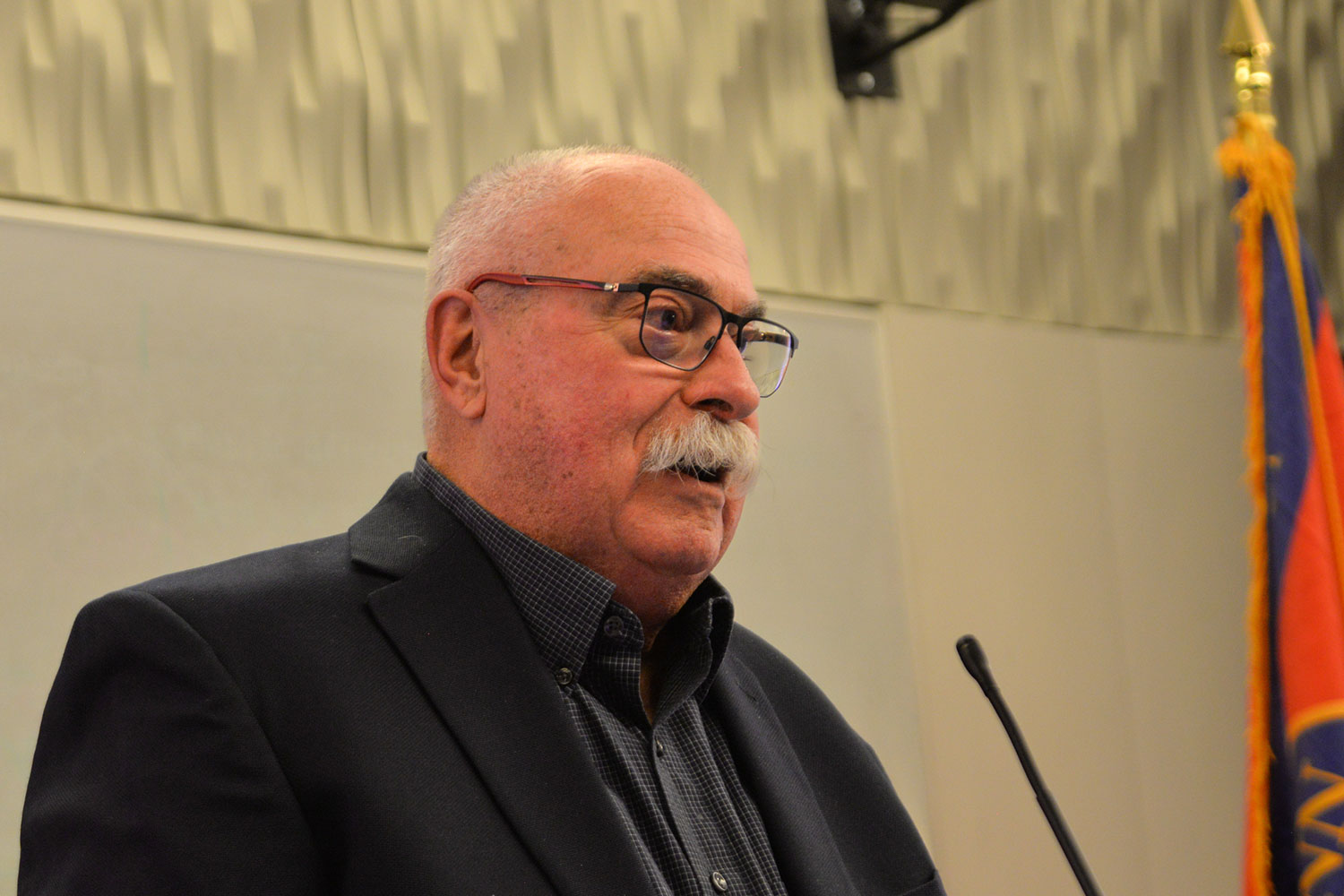
Bill Perkins speaking at podium
260417-paramedics-50-perkins-1500x1000-DSC_7186
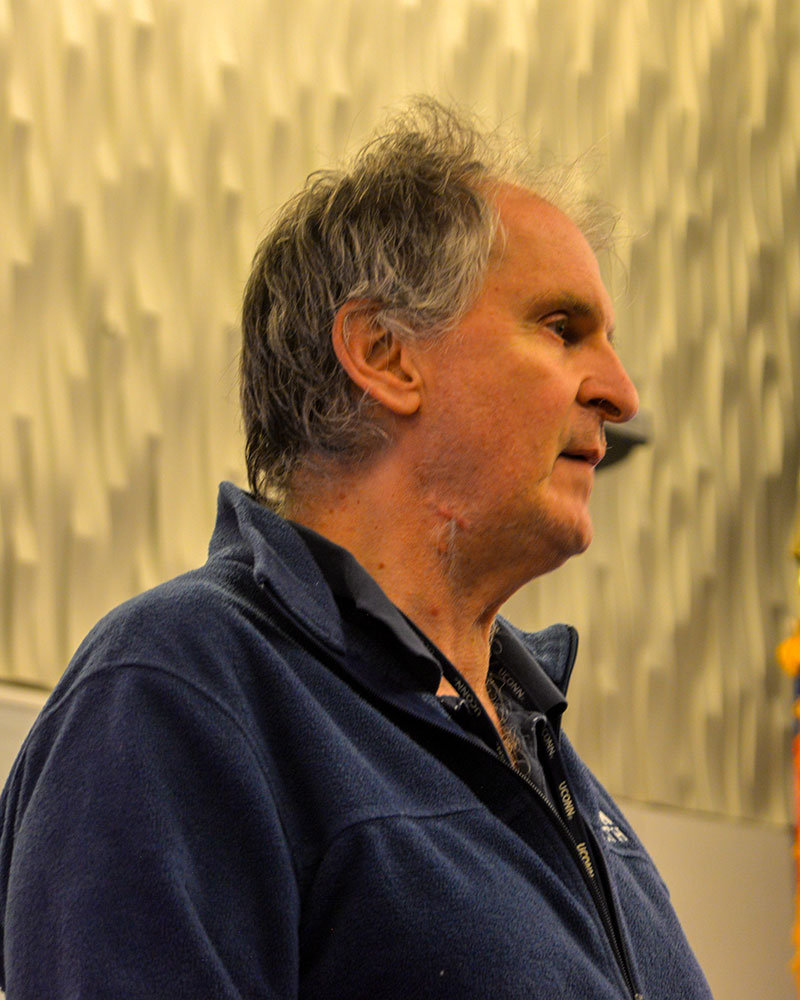
Retired UConn Health Fire Chief William Perkins (Photo by Coral Ruggiero)
Bob Howe speaking at podium
260417-paramedics-50-howe-1500x1000-DSC_7161
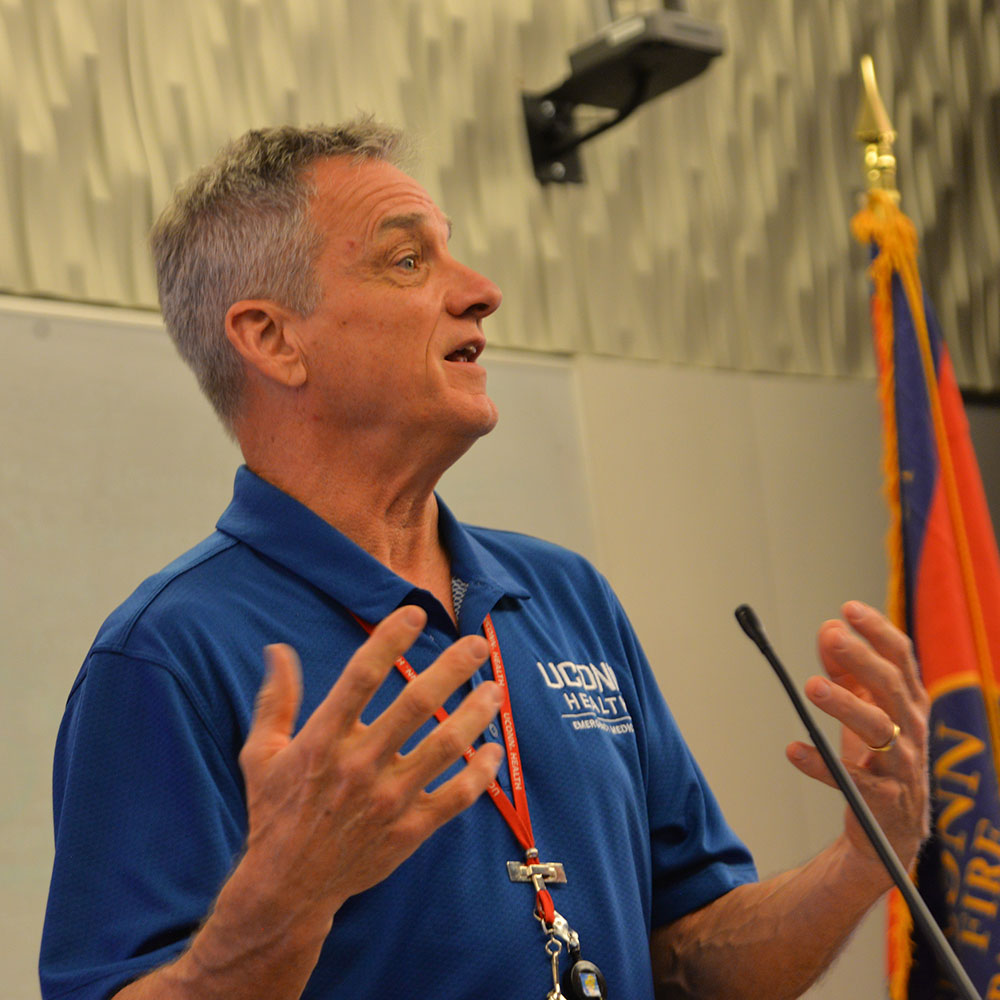
Retired UConn Health Deputy Fire Chief Bob Howe (Photo by Coral Ruggiero)
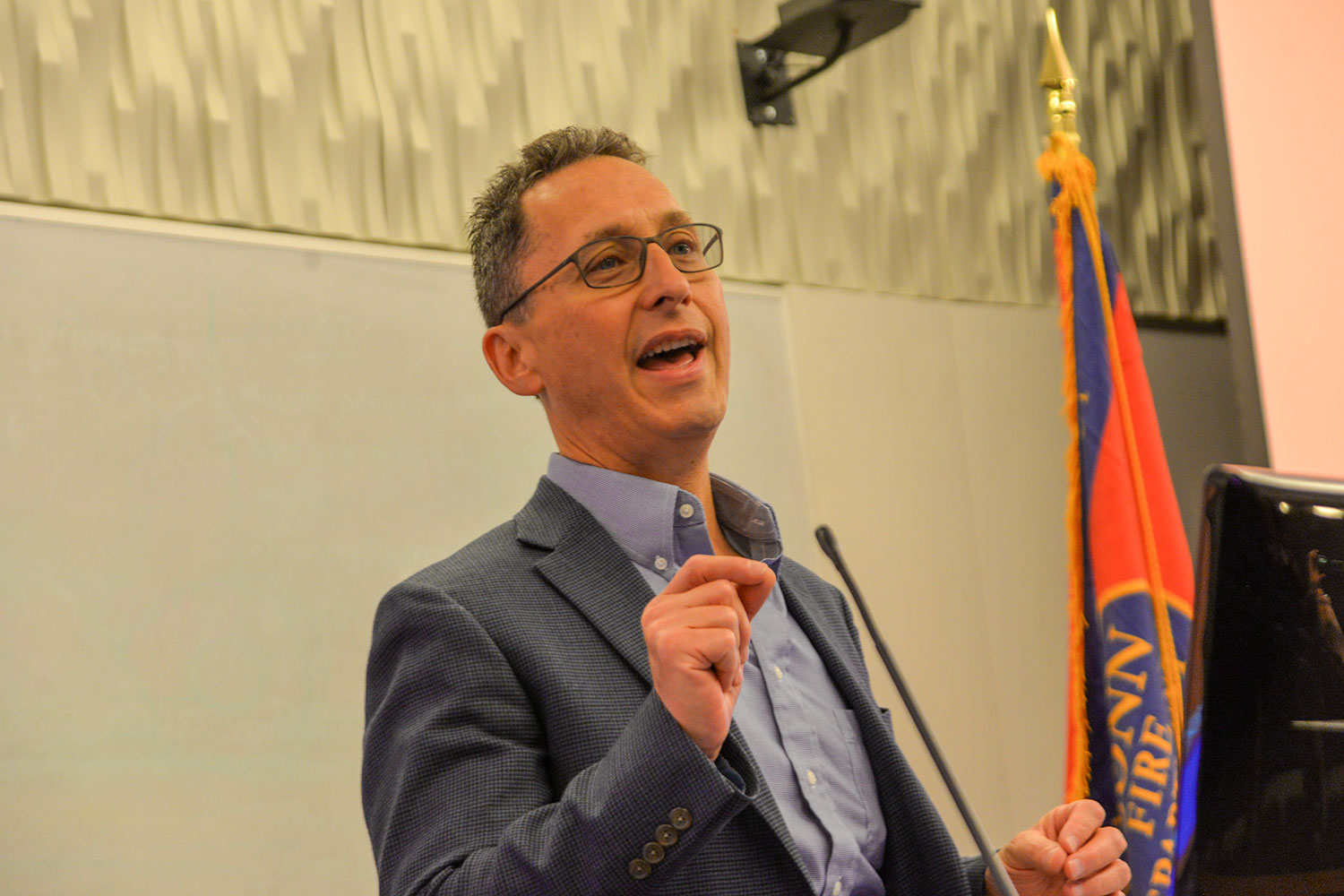
Rich Kamin speaking at podium
260417-paramedics-50-kamin-1500x1000-DSC_7117
Dr. Rich Kamin is UConn Health’s EMS program director and also serves as medical director for the Connecticut Office of Emergency Medical Services. (Photo by Coral Ruggiero)
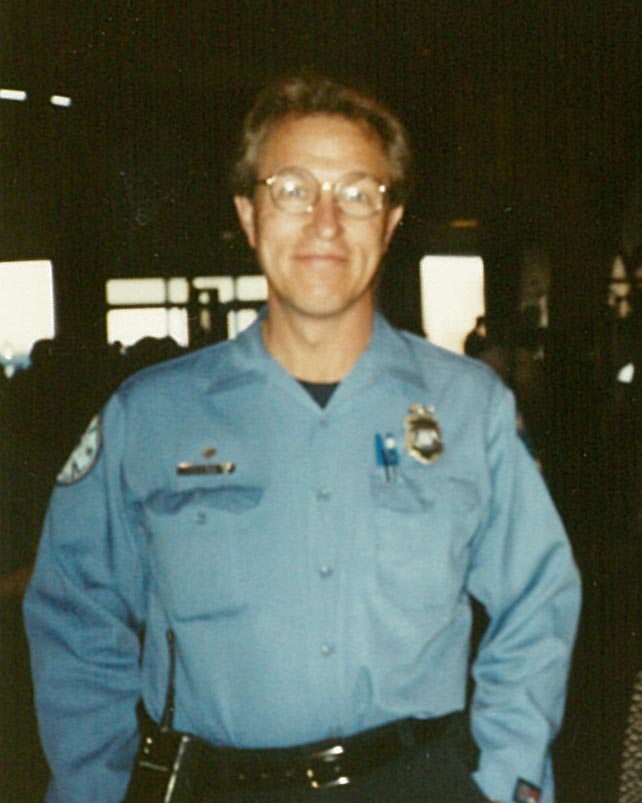
environmental portrait man in blue firefighter uniform
Walt
Walt Rasmussen is one of four UConn Health firefighters who graduated from Connecticut's first class of paramedics, held at UConn Health in 1975. (Photo provided by Irene Engel).
UConn Health's original paramedic van, Rescue 1
Rescue-1-color
Rescue 1 was the UConn Health Fire Department's first paramedic vehicle. (Photo provided by the UConn Health Fire Department)
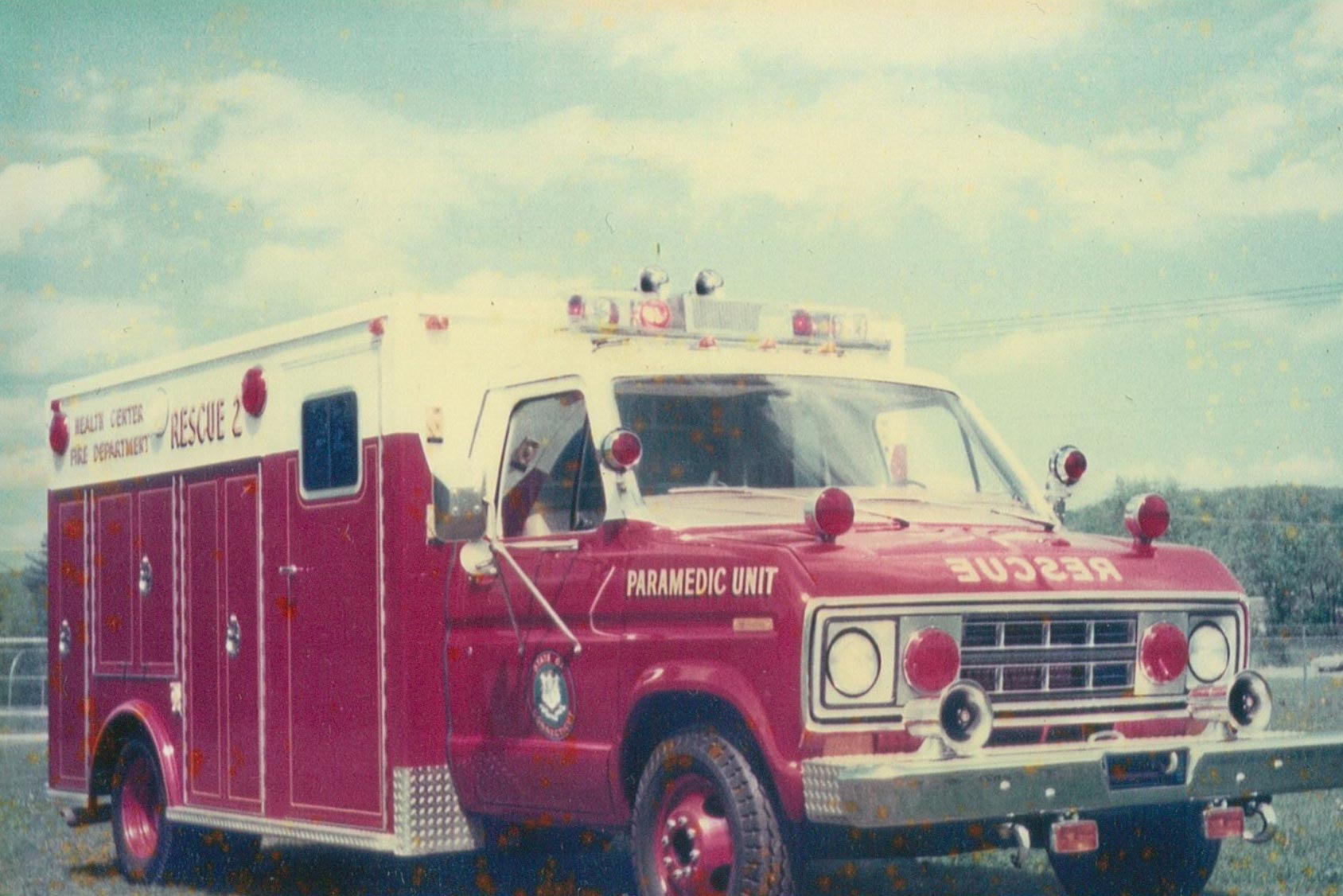
UConn Health Fire Department's Rescue vehicle
Rescue-2
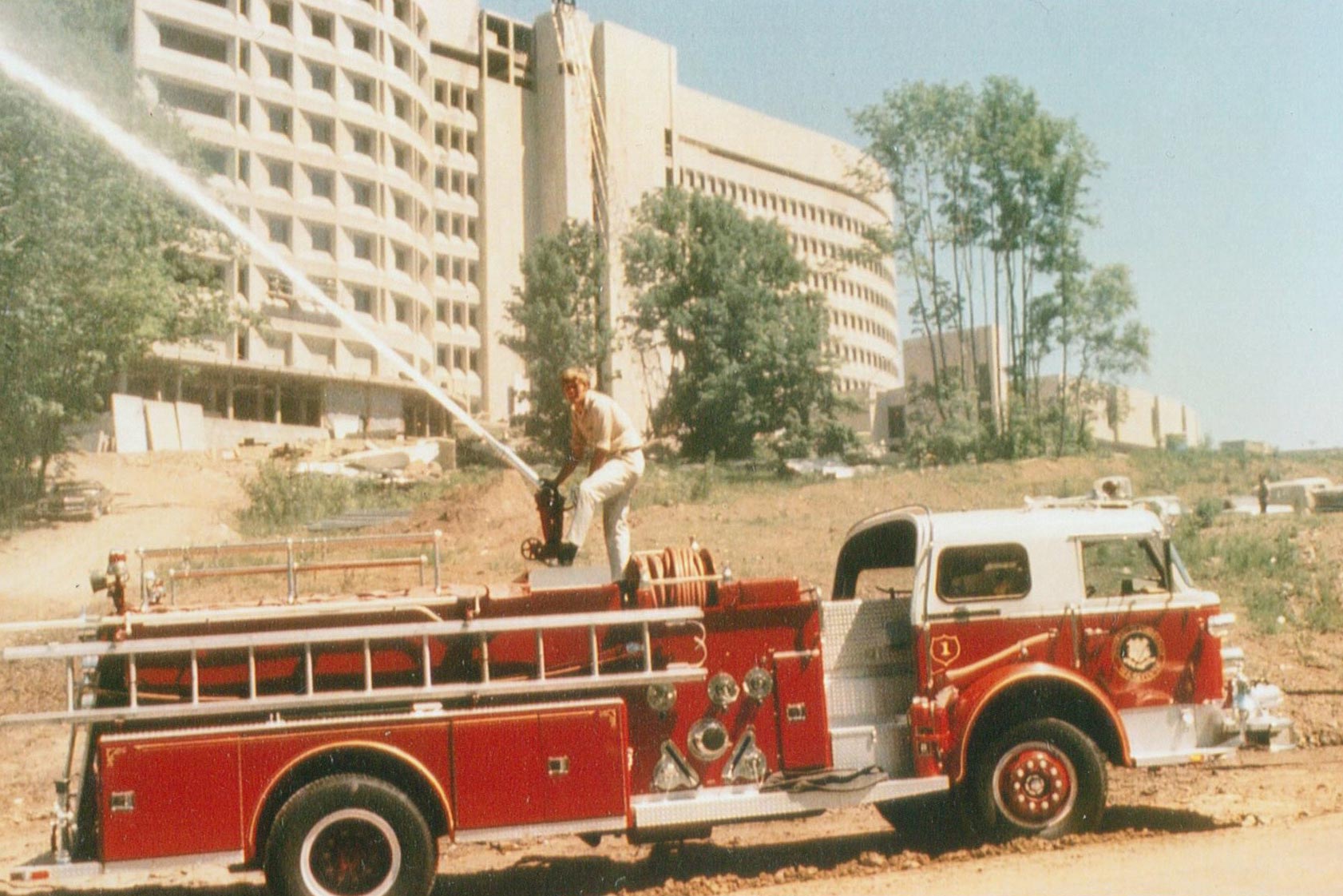
Dave Smith, the first firefighter hired by UConn Health, tests the hose on Engine 1 in the mid-70s on what later would be paved as main road on campus. (Photo provided by Dave Smith)
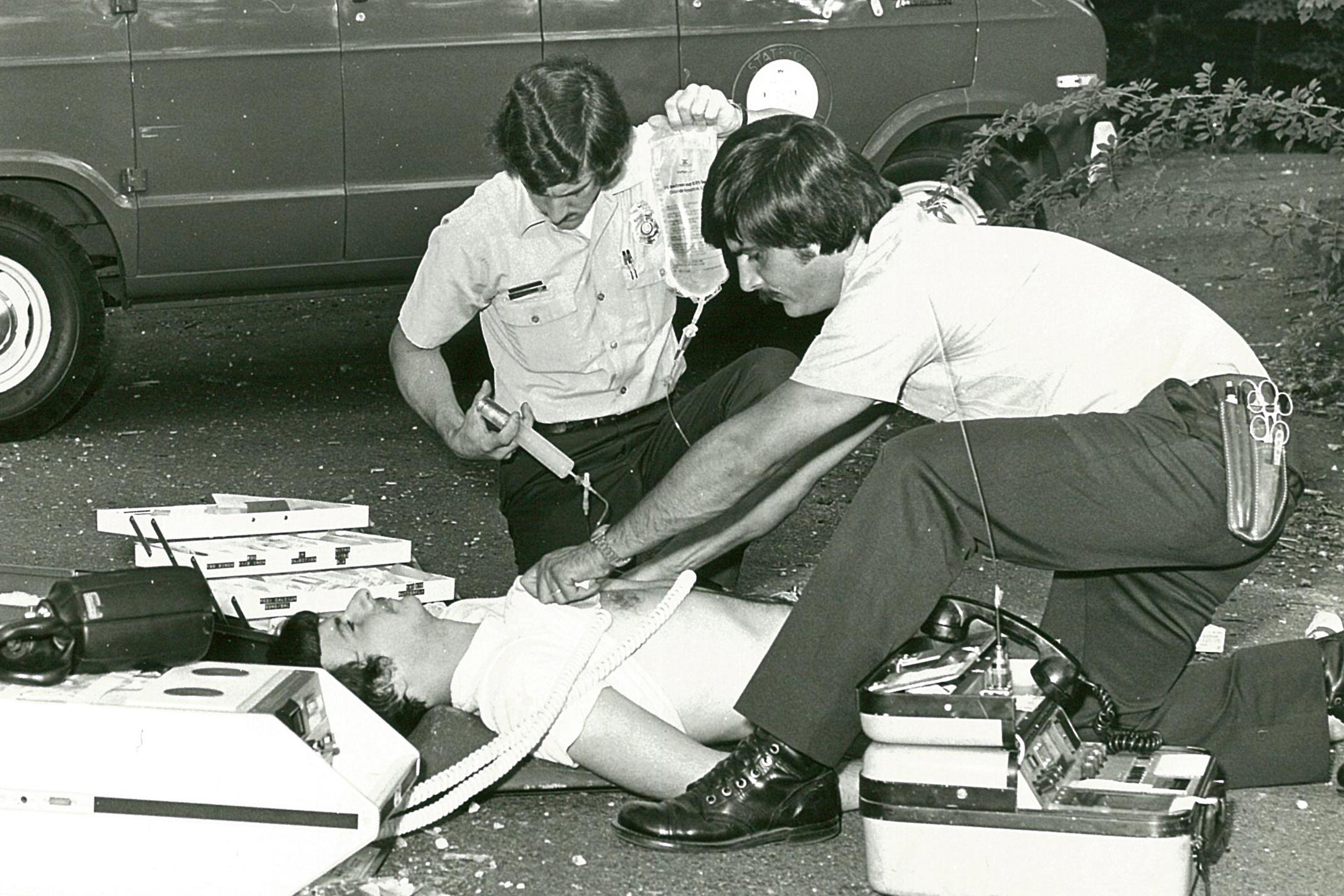
paramedics demonstrating paramedic equipment in 1975
Rescue-1-demonstration-cropped-again
UConn Health firefighters Don Perrault and Jerry Rio, two of Connecticut's first paramedics, demonstrate a defibrillator in 1975. At lower right is a telemetry unit that enabled communication with the emergency department so the paramedics could work under the direction of a physician in real time. (Photo provided by Dave Smith)
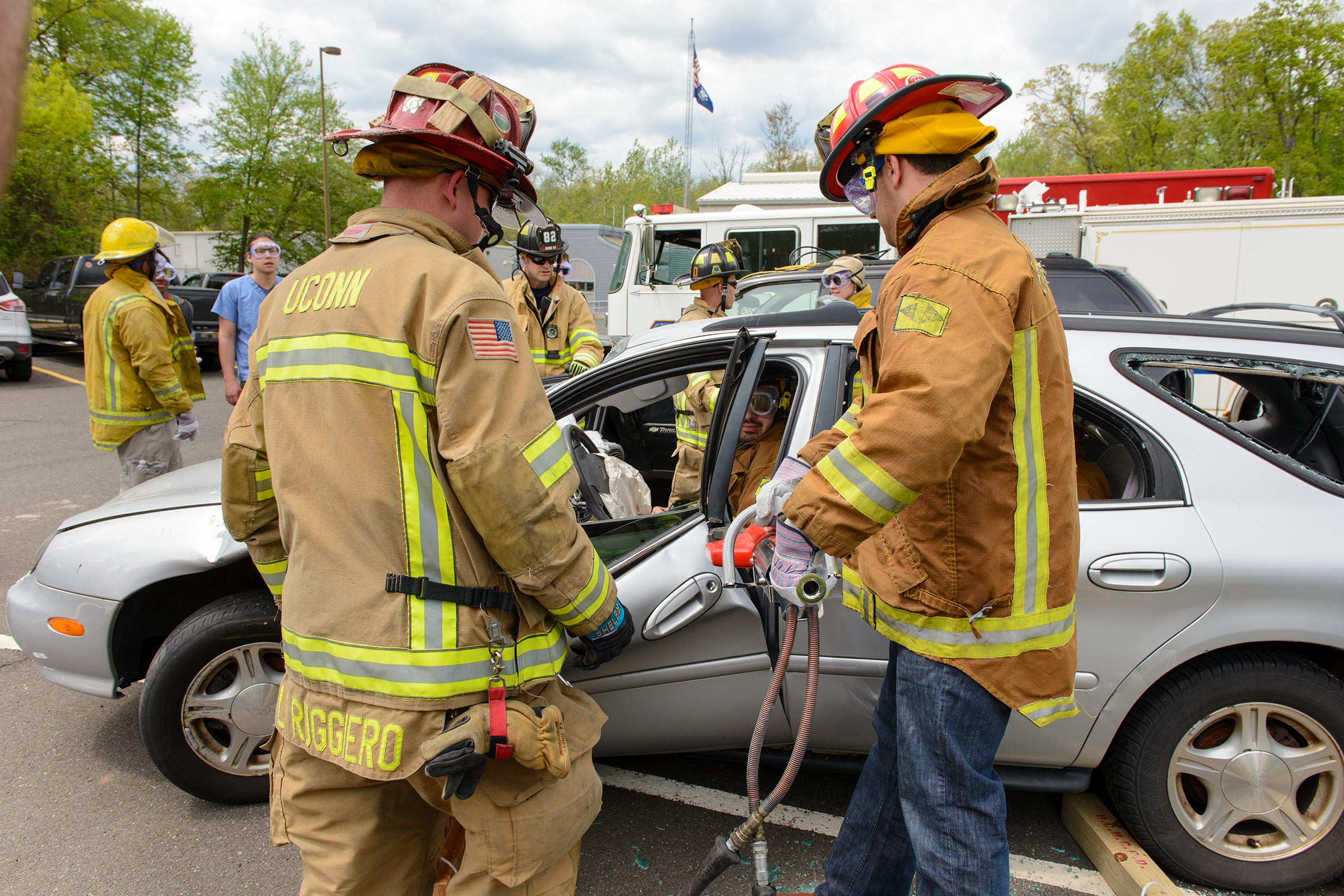
firefighters demonstrate jaws of life on a car
FirefightersCarRescue_JGelineau7346s
Lt. Anthony Ruggiero leads a vehicle extrication exercise for emergency medicine residents May 2016, part of the UConn Health Fire Department's continuing mission of training and education. (Photo by Janine Gelineau)
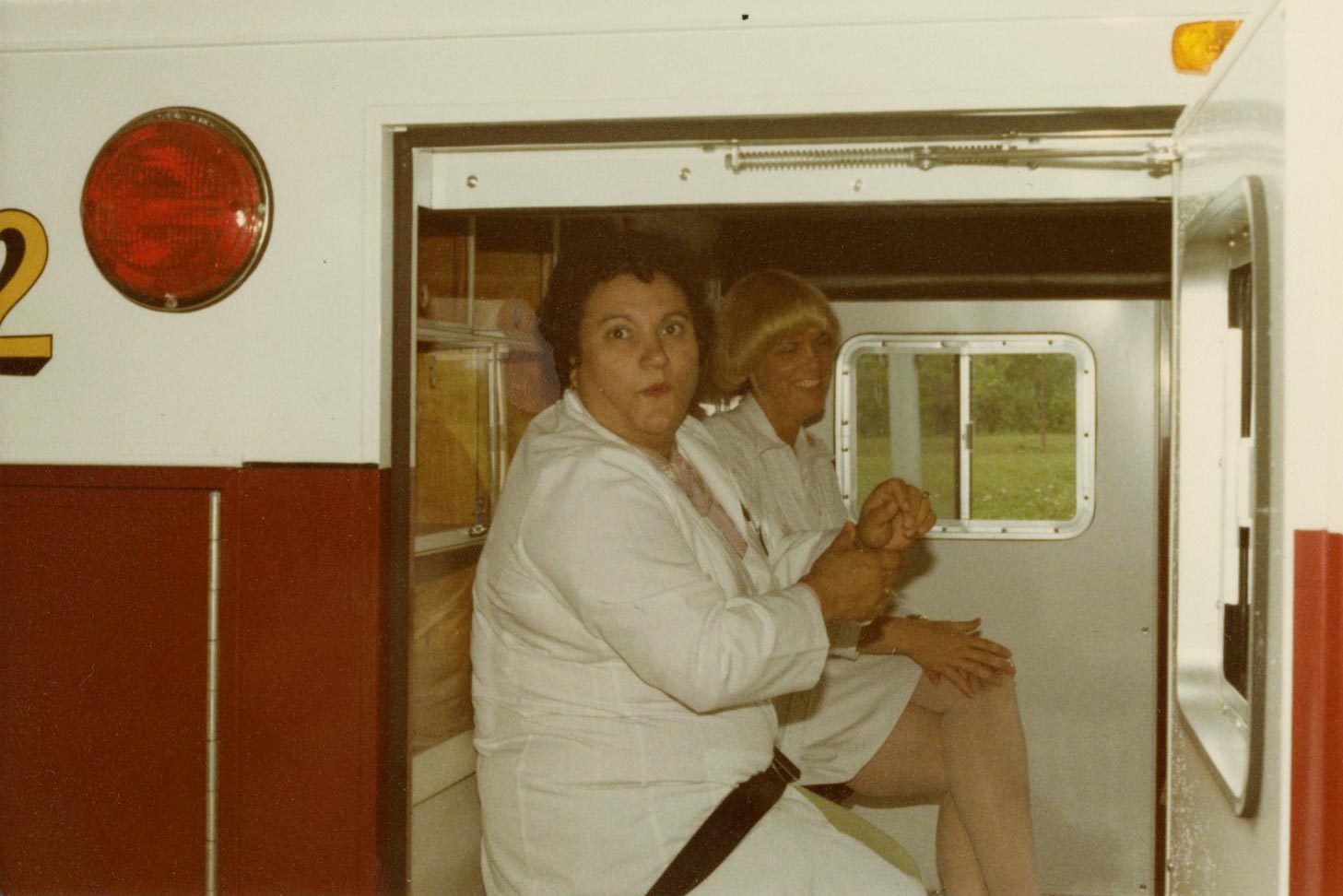
file photo from 1970s two women in fire vehicle
Rescue-2-Irene-with-Cindy-Shipps
From left: Nurse supervisors Irene Engel and Cindy Shipps, pictured here in the UConn Health Fire Department's newly acquired Rescue 2 paramedic vehicle in 1979, helped familiarize emergency department nurses with paramedics by having the nurses go out on calls with them. (Photo submitted by Irene Engel)
group portrait at former World Trade Center site in New York City within hours of the 9/11 attacks
uchc_ny
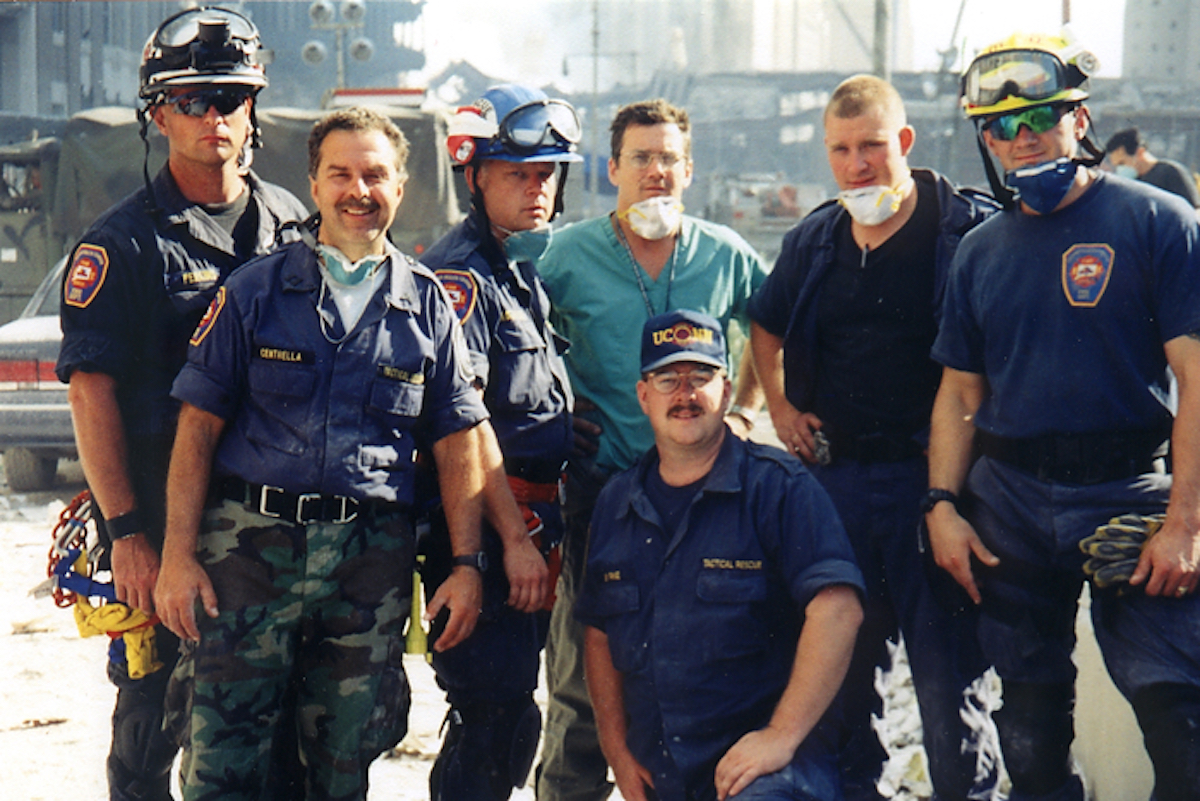
Members of the UConn Health Special Operations Unit traveled to New York City in a specially equipped vehicle and were assigned to provide medical support for the New York Urban Search and Rescue Team. They are from left to right: William Perkins, Carmine Centrella, John Kowalski, Dr. Robert Fuller, Greg Priest, Ben Sonstrom, and, kneeling, Daryl Byrne. Fuller at the time was chair of emergency medicine. The others were paramedics with the special tactical training. (File photo)
file photo of fire truck and old fire house circa 1970s
Engine-1-in-1st-firehouse
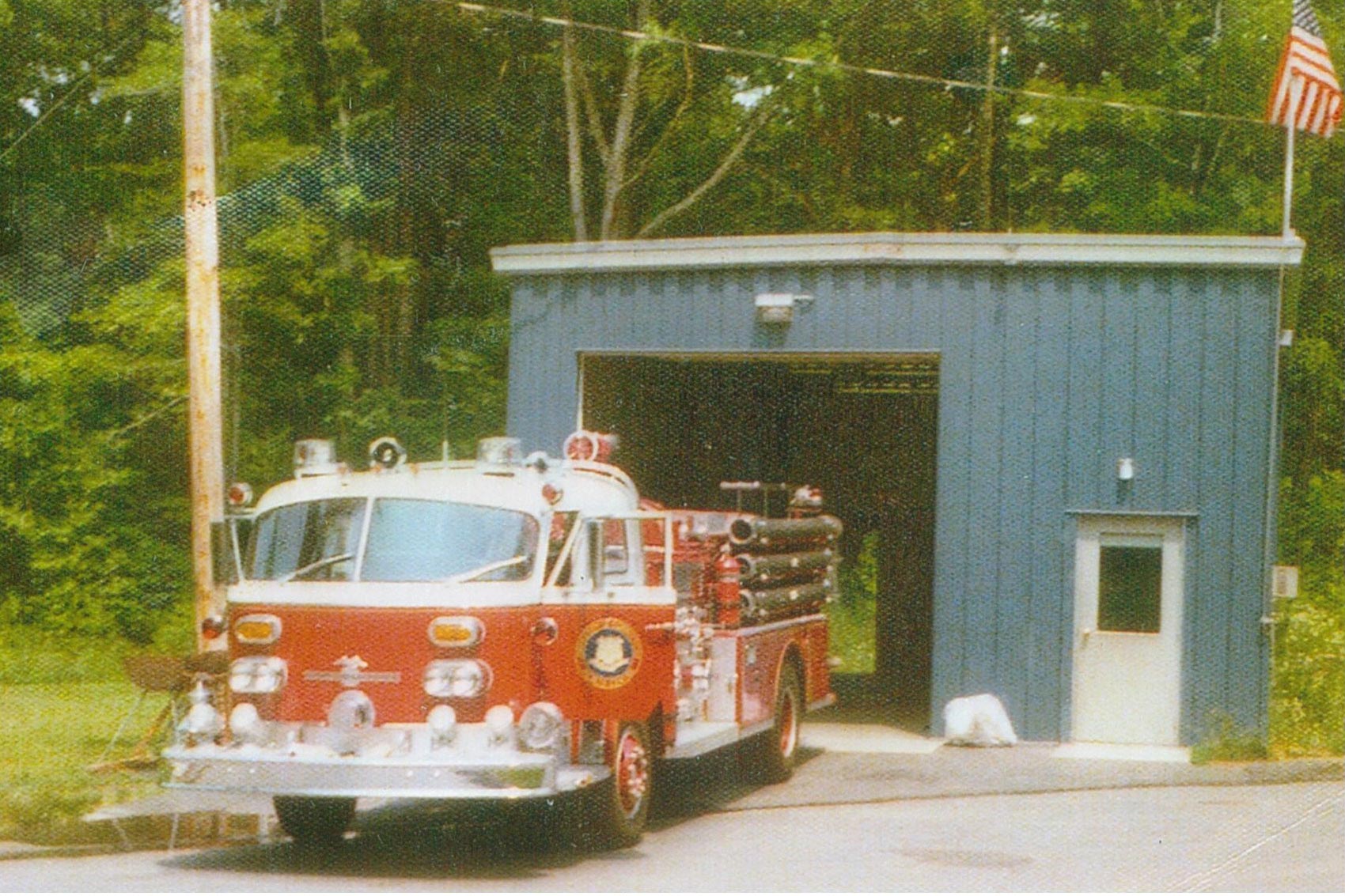
Engine 1, the first UConn Health fire truck, was acquired in 1971. The original fire house, pictured in 1974, was little more than a garage bay to house that engine. (Photo submitted by Dave Smith)
firefighter testing hose on fire engine
Dave-on-Engine-1-unpaved-road
Dave Smith, the first firefighter hired by UConn Health, tests the hose on Engine 1 in the mid-70s on what later would be paved as main road on campus. (Photo provided by Dave Smith)
paramedics in lower Manhattan on 9/11
photo2_ny
The response team from UConn Health Center used their skills and training to assist search and rescue efforts after the attacks.
paramedics in lower Manhattan on 9/11
photo1_ny
A team of UConn Health tactical paramedics and an emergency medicine physician responded to lower Manhattan Sept. 11, 2001. (Photo courtesy of the UConn Health Fire Department)
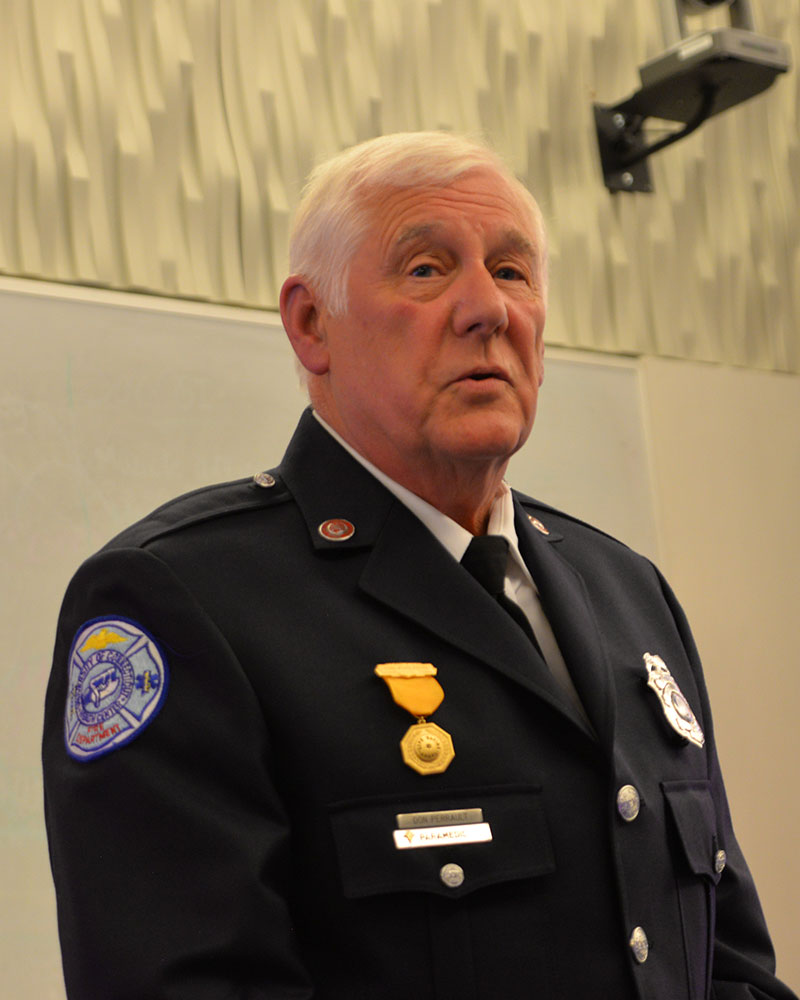
Retired UConn Health Fire Lt. Don Perreault speaks after being presented with a plaque and a legislative citation as a member of Connecticut’s first class of paramedics in 1975. (Photo by Coral Ruggiero)
Metcalf says there were growing pains and challenges with this new concept, but Smith, Rio, Rasmussen, and Perreault followed with a blind loyalty.
“This was not a job, it was something more, it was a calling, I think,” Perreault said. “And I think every one of us who decided to take up that call can walk away from their career later on and have a smile on your face and say, ‘I did the best I could.’”
It was a gathering of UConn firefighters, current and retired, most of them, paramedics, and other members of the emergency medicine community, including Peter Canning, paramedic and nurse who’s been UConn Health’s emergency medical services coordinator since 2008.
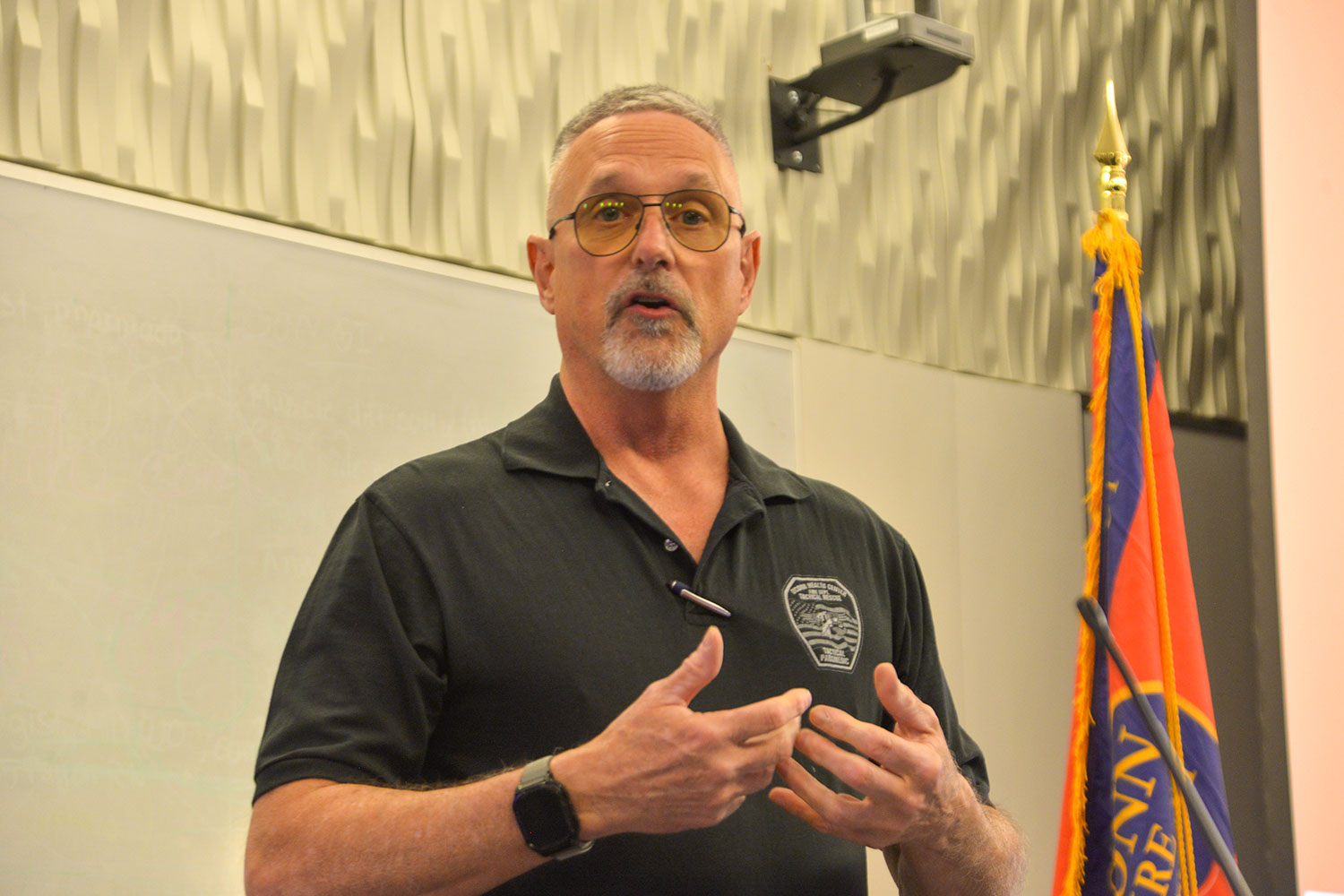
UConn Health EMS Coordinator Peter Canning speaks at the UConn Fire Department’s celebration of 50 years of paramedic service April 17, 2026. (Photo by Coral Ruggiero)
“All of us who have had the privilege to be EMS responders are grateful for the guidance we have received from our preceptors, guidance that they were given by their preceptors, and the ones who came before, guidance we ourselves have passed down to the ones who came after us,” Canning said. “We honor our original paramedics with a ceremony today, and with our actions every time we respond.”
“I remember thinking, it requires a lot of trust and a lot of confidence in a team to respond to something like that, and we had that as a team. That was a pretty awesome and important moment for our group,” Fuller says. “The UConn medics were always motivated to be innovative, and they probably got that inheritance from the original team, they had this idea about innovation.”
Dr. Rob Fuller, retired UConn Health chair of emergency medicine, speaks at the UConn Fire Department’s celebration of 50 years of paramedic service April 17, 2026. (Photo by Coral Ruggiero)
The television drama “Emergency!” ran from 1972 to 1977 is largely credited with opening the nation’s eyes to paramedicine. It was a drama about two Los Angeles County paramedics of Squad 51 who worked with medical staff at fictional Rampart General Hospital. In a fitting coincidence, the role of Dr. Kelly Brackett, the hospital’s chief of emergency medicine, was played by an actor named Robert Fuller.
UConn Health’s first deputy fire chief, Bob Howe, recalled the days when paramedics were far from widely accepted in the medical community.
“I remember bringing a patient into the ER and getting yelled at by the nurse for the way we tied off an IV,” Howe said. “And then we took that same nurse out on a call with us one day, and we got done she said, ‘I’ll never say a bad word again about how you tie off an IV.’ And it was things like that; the education went both ways, and I’m just proud as anything that I was a part of it.”
Dr. Rich Kamin is UConn Health’s EMS program director and also serves as medical director for the Connecticut Office of Emergency Medical Services.
“The relationship, the opportunity, the privilege of being the medical director, a part of a service that pioneered prehospital care in the state and change it dramatically, was something that I’ve always been appreciative of,” Kamin said.
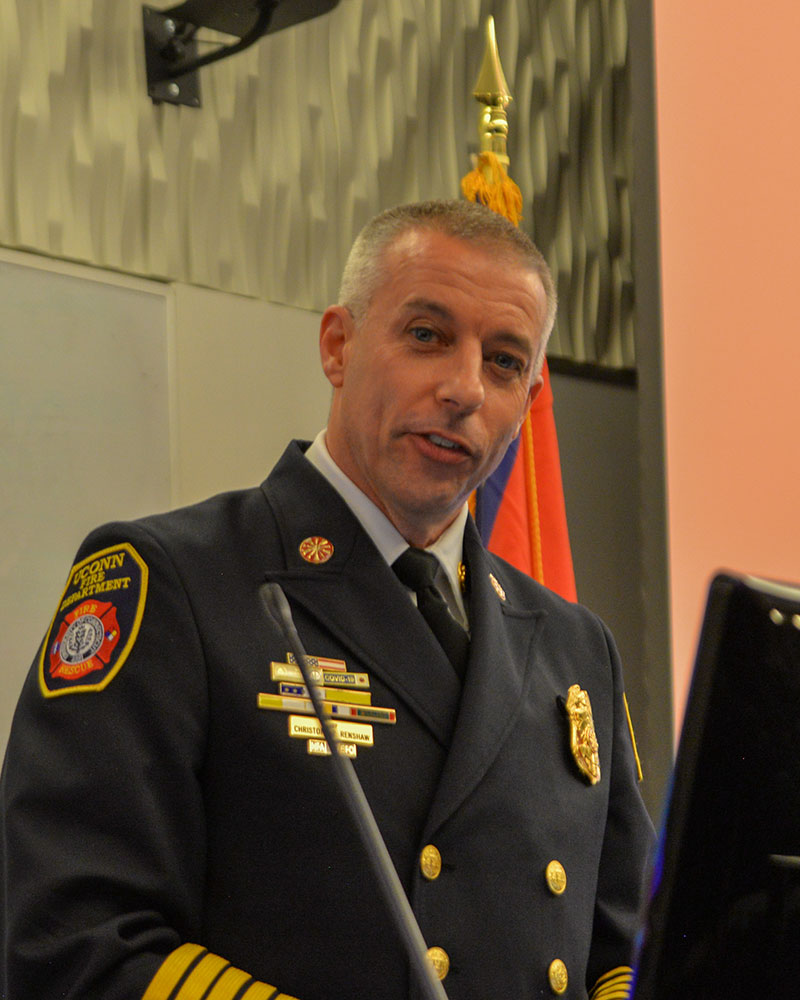
UConn Fire Chief Chris Renshaw speaks at his department’s celebration of 50 years of paramedic service April 17, 2026. (Photo by Coral Ruggiero)
UConn Fire Chief Chris Renshaw tried to offer some perspective the paramedic program’s impact on the community.
“There are quite literally people who are living their lives right now specifically because of an idea turned into a reality, and practiced with such professionalism, that shaped an entire culture of emergency services across this state,” Renshaw said.
Our websites may use cookies to personalize and enhance your experience. By continuing without changing your
cookie settings, you agree to this collection. For more information, please see our University Websites Privacy Notice.
What are cookies?
Web cookies (also called HTTP cookies, browser cookies, or simply cookies) are small pieces of data that websites store on your device (computer, phone, etc.) through your web browser. They are used to remember information about you and your interactions with the site.
Purpose of Cookies:
Session Management:
Keeping you logged in
Remembering items in a shopping cart
Saving language or theme preferences
Personalization:
Tailoring content or ads based on your previous activity
Tracking & Analytics:
Monitoring browsing behavior for analytics or marketing purposes
Types of Cookies:
Session Cookies:
Temporary; deleted when you close your browser
Used for things like keeping you logged in during a single session
Persistent Cookies:
Stored on your device until they expire or are manually deleted
Used for remembering login credentials, settings, etc.
First-Party Cookies:
Set by the website you're visiting directly
Third-Party Cookies:
Set by other domains (usually advertisers) embedded in the website
Commonly used for tracking across multiple sites
Authentication Cookies
Authentication cookies are a special type of web cookie used to identify and verify a user after they log in to a website or web application.
What They Do:
Once you log in to a site, the server creates an authentication cookie and sends it to your browser. This cookie:
Proves to the website that you're logged in
Prevents you from having to log in again on every page you visit
Can persist across sessions if you select "Remember me"
What's Inside an Authentication cookie?
Typically, it contains:
A unique session ID (not your actual password)
Optional metadata (e.g., expiration time, security flags)
Analytics Cookies
Analytics cookies are cookies used to collect data about how visitors interact with a website. Their primary purpose is to help website owners understand and improve user experience by analyzing things like:
How users navigate the site
Which pages are most/least visited
How long users stay on each page
What device, browser, or location the user is from
What They Track:
Some examples of data analytics cookies may collect:
Page views and time spent on pages
Click paths (how users move from page to page)
Bounce rate (users who leave without interacting)
User demographics (location, language, device)
Referring websites (how users arrived at the site)
Opt Out
Here's how you can disable cookies in common browsers:
1. Google Chrome
Open Chrome and click the three vertical dots in the top-right corner.
Go to Settings > Privacy and security > cookies and other site data.
Choose your preferred option:
Block all cookies (not recommended, can break most websites).
Block third-party cookies (can block ads and tracking cookies).
2. Mozilla Firefox
Open Firefox and click the three horizontal lines in the top-right corner.
Go to Settings > Privacy & Security.
Under the Enhanced Tracking Protection section, choose Strict to block most cookies or Custom to manually choose which cookies to block.
3. Safari
Open Safari and click Safari in the top-left corner of the screen.
Go to Preferences > Privacy.
Check Block all cookies to stop all cookies, or select options to block third-party cookies.
4. Microsoft Edge
Open Edge and click the three horizontal dots in the top-right corner.
Go to Settings > Privacy, search, and services > cookies and site permissions.
Select your cookie settings from there, including blocking all cookies or blocking third-party cookies.
5. On Mobile (iOS/Android)
For Safari on iOS: Go to Settings > Safari > Privacy & Security > Block All cookies.
For Chrome on Android: Open the app, tap the three dots, go to Settings > Privacy and security > cookies.
Be Aware:
Disabling cookies can make your online experience more difficult. Some websites may not load properly, or you may be logged out frequently. Also, certain features may not work as expected.