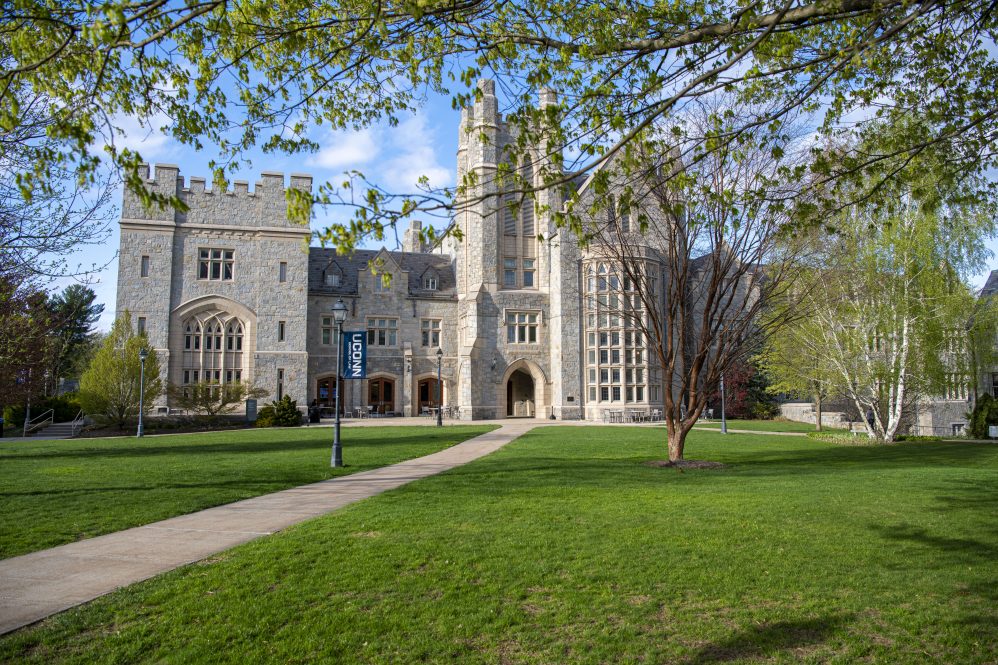
Even as water seeped through the walls of the UConn Law Library in the late 1990s and early 2000s, and even as scaffolding shrouded its granite exterior during a massive repair project that spanned a long 18 months, the heart of the campus never stopped beating – how could it?
The Law Library is one of those special places where, for 100 years since its opening in 1926, UConn Law students have done more than just study. They’ve rested there, laughed there, found love there, and everything in between.
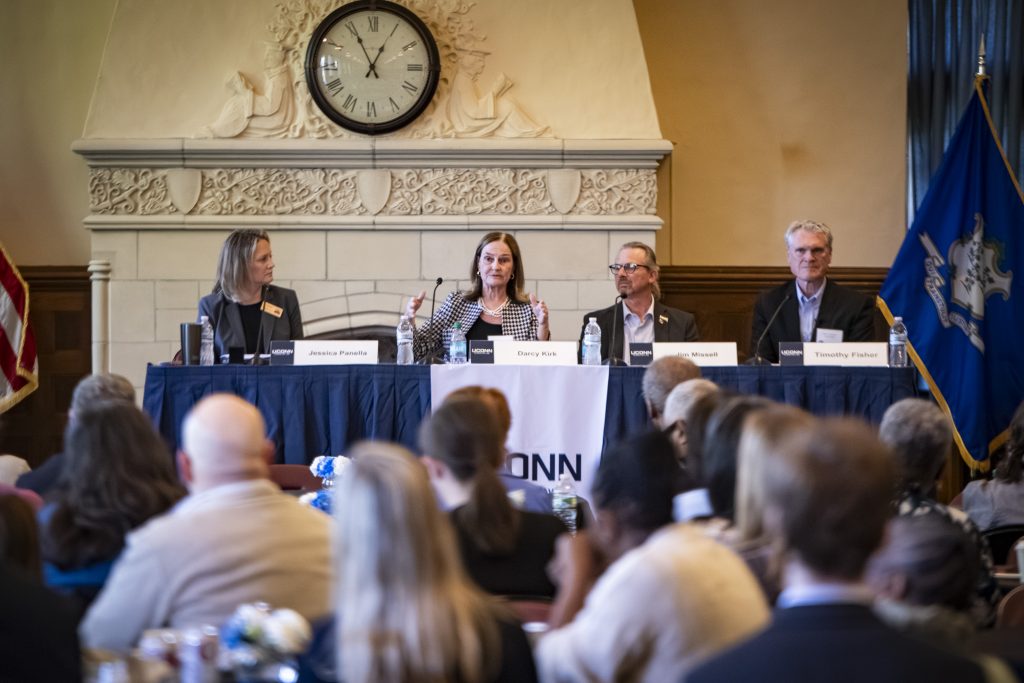
“There’s a reason why we celebrate the library building,” Timothy Fisher, Professor of Law Emeritus and Dean Emeritus, said April 23 during a culminating centennial event marking the milestone anniversary. “It’s an everything building. … It belongs to everybody.”
For a third of its history, Shirley Bysiewicz was one of the people who ensured the library was a haven for students and the public, serving as its first library director from 1956 to 1989 after having graduated from UConn in 1951, then UConn Law in 1954. She also was the first female tenured professor at the Law School.
“We are so happy to be here to celebrate this library,” Connecticut Lt. Gov. Susan Bysiewicz said on behalf of her mother and family. “This has been a launching pad not just for so many public officials in our state, so many judge colleagues, so many legislators, and so many highly successful lawyers and professors.”
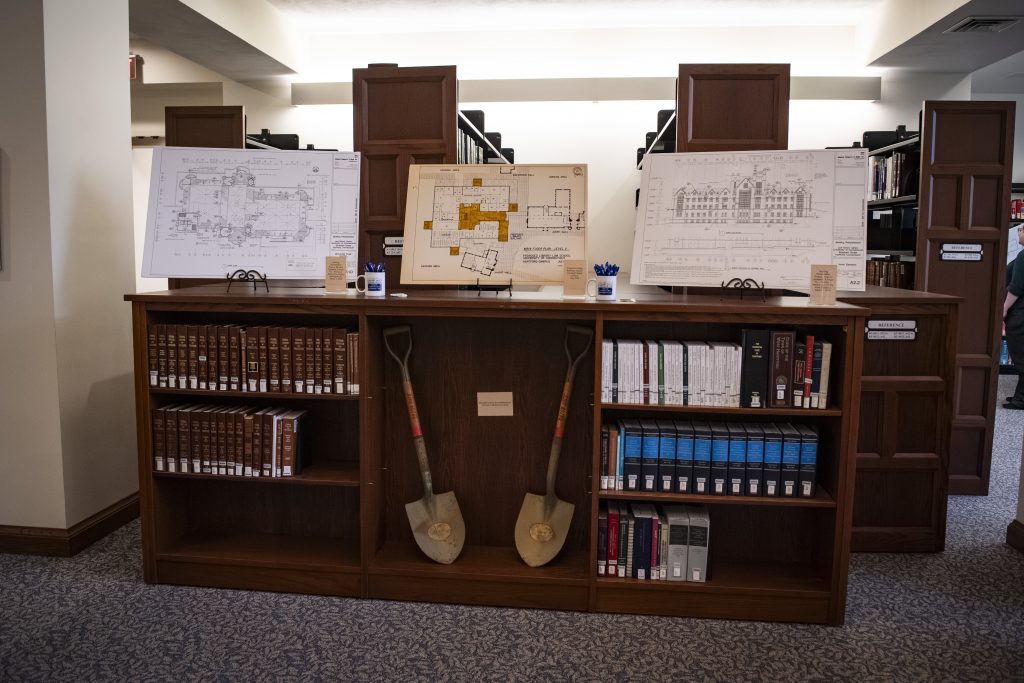
The Law Library has undergone many iterations during its lifetime, shifting physical locations from its first permanent home on Niles Street in Hartford to Woodland Street, Asylum Avenue, and the former Hartford Seminary. But one thing has stayed constant: the belief that it gives people a sense of place, said Jessica Panella, the library’s head of outreach and community engagement.
Around the time of the library’s 70-year mark in 1996, the world was starting to go digital, and Darcy Kirk, Distinguished Professor of Law Emerita, said there was a belief that libraries would need to adapt.
A computer lab was built. The Reading Room was abandoned. Workstations were wired.
“As a result, we lost that social connection,” she said.
To give students a reason to congregate, the library added classrooms and a café. It became the home of admissions, financial aid, and campus police. Meeting rooms gave study groups a place to congregate. The patio became a destination between classes.
“We spent a lot of time recreating that old library, so we could have a library of place,” she said.
When facilities manager Jim Missell relocated from UConn Storrs to the Law School’s campus in 1998, he recalled thinking that his new job included “caring for the most precious property the University owned.”
The one-stop approach to the new library’s configuration – that is, bringing as many functions as possible under one roof – invigorated the campus, he said, and enlivened the feel of the space. People were excited to talk to one another, see each other.
Then came the first time the third floor flooded, he said, and even the building’s contractors couldn’t figure out why.
Kirk said librarians learned quickly not to put books on the lowest shelves, and plastic bins – for the next dozen years anyway – became the best way to keep the collection safe.
Fisher said that as a boy growing up in Hartford, he spent significant time at the Law Library, which at that time was halfway between home and school. His full circle moment came when he, now a construction lawyer and Law School dean, helped with the state’s lawsuit to fix the water problem.
The Thomas J. Meskill Law Library, an $18 million construction project in the mid-1990s, was put together wrong, he said. Forensic engineers found that its concrete block walls weren’t mortared together. There was no reinforcing rebar within. The granite façade was primed to fail, like chafing paint on an unkempt wall.
There was no doubt, he added, that a strong gust of wind or a small group of strong students could have toppled parts of the building.
But the court initially dismissed the lawsuit against the project’s contractors – its statute of limitations had expired, it said, too much time had passed since flooding started in 1996, and a cause was found around 2008. An appeal to the state Supreme Court overturned the ruling, and an $18 million repair project commenced.
Kirk said the library stayed open the whole time, devoted to its mission of serving its students and the public.
“We were constantly trying to accommodate,” Missell said.
Because it was that important.
“The Law Library is the intellectual hub, a central gathering space for our beloved law school,” Dean Eboni S. Nelson said. “I am so very proud of our extraordinary and dedicated library staff and faculty, both past and present, and the legacy of excellence that they have built, not only for the Thomas J. Meskill Law Library, but for UConn Law as a whole. I thank them for their tireless efforts that have advanced knowledge and justice in our law school, community, state, and beyond.”