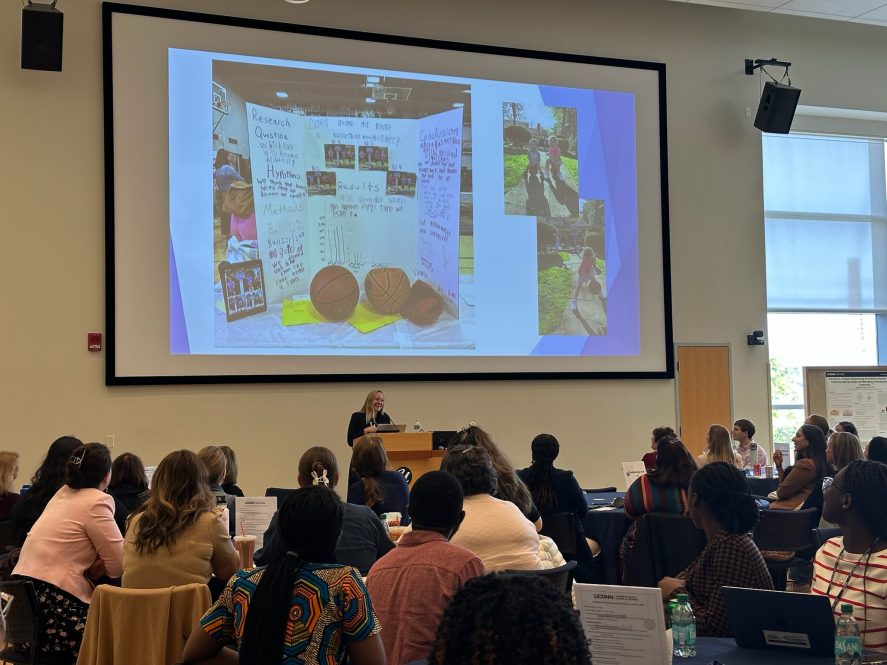
The Elisabeth DeLuca School of Nursing’s third annual Research and Scholarship Day on April 29 highlighted the extraordinary and innovative research and scholarship by UConn faculty, students, and clinical partners that is leading to impactful advances in nursing.
“Here at UConn’s Elisabeth DeLuca School of Nursing, we are united in a commitment to high quality, rigorous nursing research and scholarship that promotes health and optimizes the well-being of individuals, families, and communities,” said Dean Victoria Vaughan Dickson. “UConn’s nurse scholars are investigating the multiple contextual factors that influence health beginning early in life and accumulate over time contributing to health inequities. They are leading efforts to shape policy in ways that will transform healthcare in our state.”
A highlight of the event, which was held in the Student Union Ballroom at UConn Storrs, was the poster award competition for both students and faculty. The student winners were Vernette Townsend ’25 DNP, first prize; Madeleine Willett ’26 (NUR), second prize; and Majeda Basilio ’13 (NUR), ’26 DNP, third prize.
Townsend’s poster was titled, “Self-Monitored Blood Pressure Devices for Hypertension Management in Underserved Communities.”
“You may look at the title and see hypertension, and think ‘People get high blood pressure, they take a pill, they change their diet, they start to move around a little bit more, and then they get better.’ But that’s not true,” said Townsend, who is also the president and CEO of Charter Oak Health Center in Hartford. “It’s even less true for a certain segment of our society. The underserved community, which is particularly Black and brown, have a significant mortality rate related to hypertension, which some parts of our country have under control. They can’t get to a place of control – and it’s not all about lifestyle. A lot of it is the genetics of those two cultures.”
Townsend continued, “My study looked at why, if you have community health centers and we can give them blood pressure monitor equipment, why don’t they get better? I discovered we needed to set up a program around giving patients monitors, teach them how to take care of themselves, and have a nurse and a community health worker support them through the process. What happens is you watch the patient grow up in their healthcare, and they actually have an increased sense of pride. They now understand what that top number is, what that lower number is. They can call someone who’s like them, not a physician, and ask questions that they feel are stupid, but it gets into a better place. They’re more apt to take their medication, and now we have not only the patient who’s impacted, we’ve spread the knowledge in the family. This is community health at its best. This is nursing action at its best.”
Basilio’s poster was titled “Enhancing Resilience in Associate Degree Nursing Students Through Mindfulness-Based Stress Reduction.”
“Associate degree nursing student are often juggling different commitments in life, not just academic,” said Basilio, who is also an assistant professor of nursing at the University of Bridgeport. “Many of them have full-time jobs. There is a need to help them build resilience, succeed in academics, and balance what is going on in their lives.”
She continued, “I wish that I was given these tools years ago as a nursing student. It would have helped me and my nursing career. Just to have a little toolbox where I could have balanced the stress would have been so helpful. I use this with my students now, and it is something they can apply to success in nursing and in their personal life.”
The professional winners were: assistant clinical professor Carrie Eaton ’18 DNP, first prize; assistant clinical professor Amisha Parekh de Campos ’20 DNP, second prize; and assistant professor Katherine Bernier Carney ’19 DNP, third prize.
The keynote speaker for the event was Sarah Rossetti, an assistant professor of biomedical informatics and nursing at Columbia University. Her talked focused on human-centered and nurse-driven artificial intelligence solutions to improve patient outcomes and decrease clinician burdens.
Faculty members who spoke at the event were associate clinical professor Michelle Cole on leveraging multimedia and family engagement to strengthen the understanding of family impact in pediatric nurse education, and associate professor Eileen Condon, on sleep, mental health, and protective factors among Black and Latina women of childbearing age.
UConn nursing students also presented at the event, including Braydon Cretella ’26 (NUR), accessibility of lead exposure education for immigrant families with young children in Connecticut; Darlene Rouleau ’26 DNP, advancing mobility in hospitalized older adults; and doctoral student Ripley Hensley, exploring the emergency department experiences of individuals with Parkinson’s disease.