Like other research institutions across the country, UConn has been hit hard by shifts in federal policy, grant cancellations, and funding stalls from key agencies. On May 14, Connecticut officials pledged to stem the negative tide, approving $35 million directly for UConn’s research enterprise.
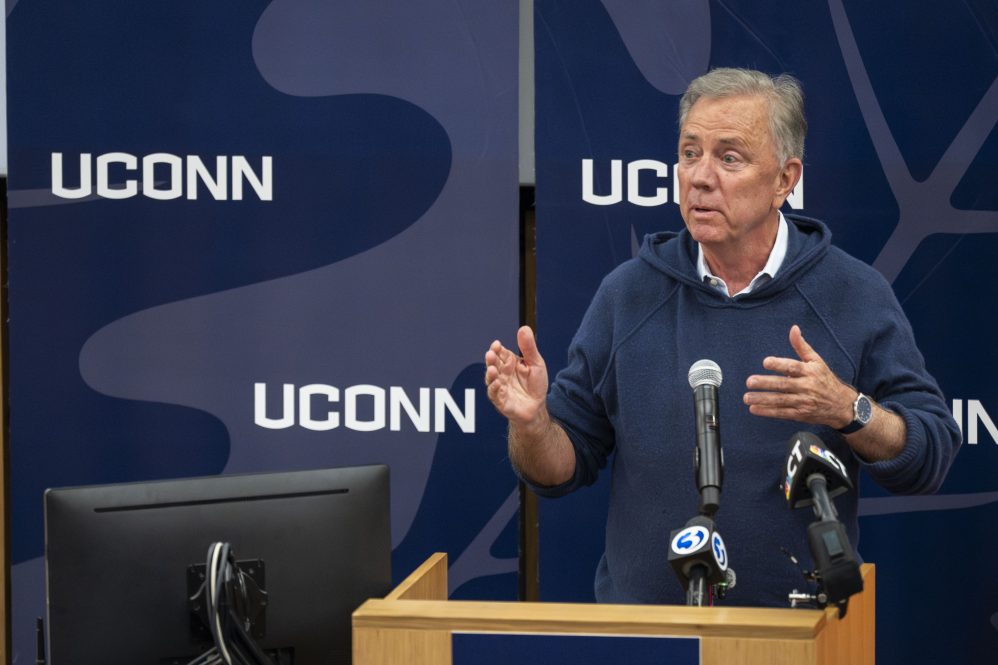
Gov. Ned Lamont, Lt. Gov. Susan Bysiewicz, and legislative leaders held a press conference in the Science 1 building in Storrs. They announced the funding, which is designated for research affected by federal cuts. It will support $21 million at UConn and $14 million at UConn Health.
In making the announcement, Lamont said Connecticut makes advanced technology areas like bioscience, submarines, and helicopters, and now is working to advance the state’s AI and quantum computing.
“These are places where Connecticut has a real competitive advantage and we can’t do that without each and every one of you,” Lamont said, addressing dozens of UConn faculty members in attendance. “When I am talking about UConn, I’m talking about UConn the university and I’m talking about UConn Health as the center of our life sciences and innovations well, and making a difference as the world gets more complicated.”
UConn President Radenka Maric praised the investment the state was making in UConn research, especially at a critical time.
“Today’s announcement shows that the state of Connecticut is committed to enabling discovery, supporting economic resilience, retaining talent, and strengthening our state’s competitiveness in the 21st-century innovation economy,” said Maric. “We are tremendously grateful to Governor Lamont and to the General Assembly for their foresight and leadership on this critical issue. They demonstrate that Connecticut’s commitment to science and learning is not only theoretical, but back up with real investment.”
Since January 2025, federal research funding has become highly volatile. UConn and UConn Health lost approximately $41 million from terminated or non-renewed grants and $54 million in fewer new awards from fiscal year 2024 to 2025. Many fundable proposals remain stalled at the National Science Foundation, National Institutes for Health and other agencies.
Lindsay DiStefano, UConn’s interim vice president for research, innovation, and entrepreneurship, says that the stalled proposals jeopardize dozens of programs, payrolls, and teams that support more than 2,600 faculty, staff, trainees, and students. Meanwhile, many agencies have changed award structures resulting in fewer awards being made and increased the number of requirements that the recipients must support.
These cuts, delays, and changes have forced difficult choices for UConn and other nationwide research universities, with real and immediate impacts. University leaders believe that the state’s investment is essential to bridging federal disruptions and preserve ongoing projects, generating preliminary data to leverage future federal and private support, aligning research with Connecticut’s strategic priorities, and recruitment and retainment of top research talent.
At the press conference, DiStefano said the State has helped “ignite a spark that has brightened some of our darkest days.”
“While the investment goes directly to UConn and UConn Health, it really goes beyond our campuses as an investment to every citizen in Connecticut,” said DiStefano. “As the state’s flagship public research-intensive university, our partnership and collaboration are vital for ensuring that Connecticut continues to grow and be responsive to our communities’ needs.”
Researchers Share Experiences
In her remarks, Maric emphasized UConn’s critical research in areas that directly benefit Connecticut’s economy, both in traditional strengths and fields vital to the future. She highlighted that the research enterprise spans a diverse range of fields, including biomedical and pharmaceutical science, quantum technology, cybersecurity, and healthcare.
Researchers from some of those fields told their experiences and how the funding cuts would impact lifesaving and lifechanging breakthroughs.
Molecular and cell biology Professor Nathan Alder directs a lab that focuses on cures for aging-related diseases, employing graduate trainees who are leveraging their experiences into successful careers. He said that by funding research, the state acknowledges the real-world impacts like his and many more.
“These are not just mission-critical research programs for the University, but in a very real and direct way, represent ways that we can positively impact the lives of the citizens of Connecticut,” Alder said.
Dr. Neena Qasba, an associate professor of OBGYN and the vice president of the UConn Health chapter of the American Associations of University Professors, stated her appreciation for support, especially in fields where there have been widescale cuts. That includes reproductive health, racial disparities, and vaccine safety.
“These areas of research impact the daily lives of our patients, our friends, our neighbors, our families, and even ourselves,” Qasba said.
Dr. Maggie Callahan, UConn School of Medicine professor and chief of the Division of Hematology and Oncology, shared that clinical treatment must continue to improve with the needs of patients. The state’s investment will lead to new opportunities for care and bring the best options for cancer care closer to the Connecticut patients who need them now.
“Speaking about UConn Health, I can say from the bottom of my heart that we are dedicated to providing our patients with care that is second to none reflecting the best care that is available today,” Callahan said. “But, in oncology and so many other areas of medicine, the status quo of today’s medicine isn’t enough.”