Of the 25 older adults who gathered at the West Haven Senior Center for a workshop with UConn Extension educators on a recent Tuesday in May, only one woman said she had a “go bag” on hand in case an emergency arose.
She kept two go bags at the ready, actually: one for herself, and one for her cat.
Equipped with supplies, nonperishable food, medications, important papers, a flashlight and batteries, some cash – a go bag contains those things that someone might need if they had to leave home quickly.
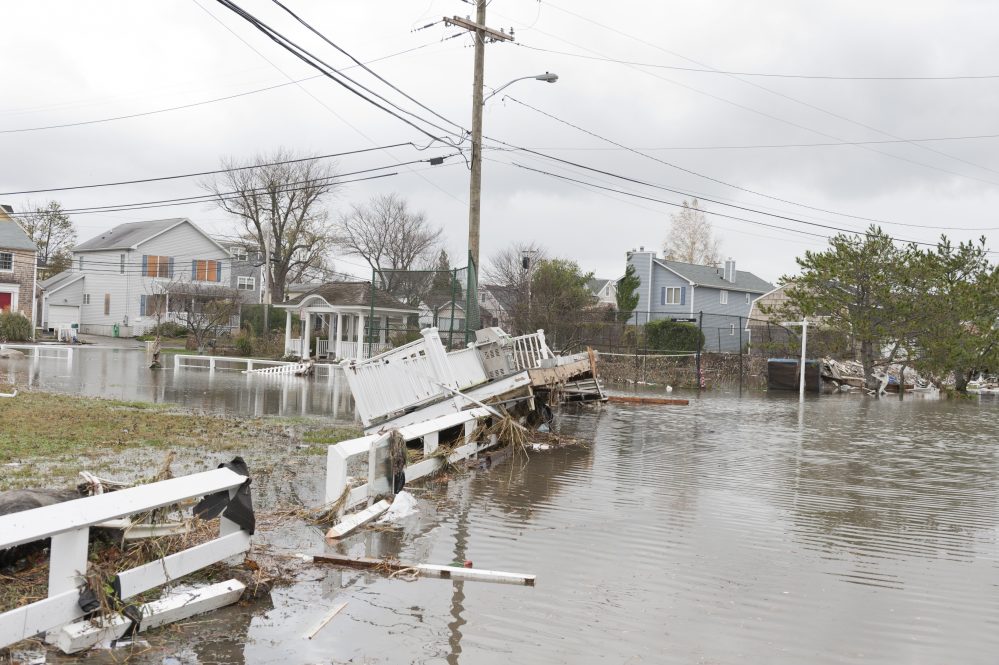
A storm. A flood. A fire. Emergencies can come with a warning or an evacuation notice – but sometimes they don’t.
And in any emergency situation, preparedness matters – even in a small and seemingly well-resourced state like Connecticut.
“We experience extreme weather events,” says Mary Ellen Welch, a family and consumer sciences educator with UConn Extension. “And I think that older people are recognizing this from their connections on social media, or watching TV, the things they read, talking with others. We are seeing and hearing more and more about the risks, and the realities, and there is an urgency to really be prepared.”
Being prepared if something were to happen was the topic at hand at that senior center in West Haven – the first session of a two-part program designed to help educate participants, older adults in particular, on the risks they face based on where they live.
On how insurance and emergency funds work. On how to sign up for emergency alerts, how to build a go bag and its counterpart – the “stay bin.” On when, and where, and why to evacuate.
But the program itself – and two very similar programs planned for this summer in Stamford and New London – are the product of nearly two years of research, collaboration, and action undertaken by a federally funded multidisciplinary team of researchers, students, educators, and advocates at UConn, all working toward the same goal: Greater emergency preparedness for older residents living in shoreline communities in Connecticut.
Understanding Needs
Nearly two years ago, the National Oceanic and Atmospheric Administration, or NOAA, offered a funding opportunity to Sea Grant programs throughout the country to help with emergency and disaster preparedness programs in coastal communities.
Connecticut Sea Grant, based at UConn and part of a national network of 34 university-based and consortium programs that focus on solving coastal problems and developing new marine resources, decided to answer the call.
“Nancy Balcom [Sea Grant’s former associate director] and I had been doing some work on preparedness, and we decided this would be a good one to pursue,” explains Juliana Barrett, a Sea Grant extension educator emerita. “We decided that older residents of Connecticut would be our target audience, and then we picked three coastal communities, trying to span the coast, to be our pilot communities.”
The goal of the grant-funded effort was to first understand the needs of aging residents and their caregivers and to assess the status of their preparedness for extreme weather emergencies.
That needs assessment would then, hopefully, aid in the creation of programming and resources aimed at helping older adults – who are often more vulnerable in emergency situations – be better educated and prepared in the event of a disaster situation.
“The needs assessment would really provide the foundation for what we went on to do,” says Barrett, the principal investigator on the project.
To accomplish those goals, Sea Grant teamed up with additional UConn partners, including the Departments of Anthropology and Communication in the College of Liberal Arts and Sciences and UConn Extension.
“I think that’s one of the biggest strengths of this project, and one that made it the most enjoyable as well – understanding different perspectives,” says Barrett. “We brought a really unique group together.”
Listening and Learning
For more than eight years, Eleanor Shoreman-Ouimet, an associate professor of environment and human interactions with UConn’s Department of Anthropology and associate director of UConn’s Institute of Environment and Energy (IoEE), has been examining extreme weather preparedness in Connecticut through her work with the multidisciplinary Designing Interdisciplinary Science And Strategies To Enhance Resilience, or DISASTER, research team.
“Juliana and I were well-acquainted,” Shoreman-Ouimet explains, “and early on, we started thinking about how we could take some of the questions we were looking at statewide and focus it specifically on the needs and challenges facing aging populations in distinct communities along the coast.”
Shoreman-Ouimet says that, through other ongoing projects related to disaster preparedness, she and graduate student Abigail Beckham knew a significant cross section of state residents were underprepared when it came to resource allocation, communication efficacy, and connections between residents and policymakers.
With that in mind, they first approached this project by setting up focus groups with local stakeholders.
“Folks who are already leaders in community care in that area,” Shoreman-Ouimet explains. “Maybe it’s those who run senior centers or work in libraries, people who work in emergency management, or in health and human services, nutrition assistance. Talking to the people who are already doing the work on the ground and seeing firsthand what the biggest challenges were when it comes to engaging community members.”
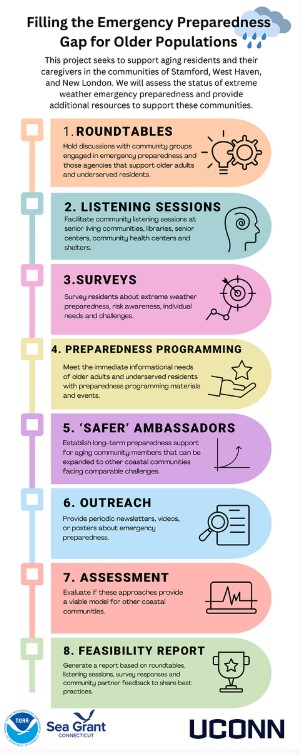
They held virtual focus groups with officials from each of the three communities before then engaging with older residents in a series of listening sessions held in-person in West Haven, Stamford, and New London.
“We had sets of broad, open-ended questions about what their memories were of events throughout their lifetime that have kind of stuck with them in terms of experiences with severe weather, their resources, their awareness of municipal assistance programs, how they receive their communication, how they prefer to receive it,” Shoreman-Ouimet says.
What they found was that, among the older adults in the listening sessions, many were frustrated with the towns and felt as though they weren’t getting the information from local officials that they wanted. They expressed uncertainty at what to do in specific circumstances – a flood versus a snowstorm versus a heat wave, for example.
They had a lack of trust in and use of technology, concerns about the reliability of news sources, and felt isolated from friends and family. They worried about their safety, their vulnerability to violence and theft during emergencies, and they worried about their pets and how they’d get their medications.
They also largely lacked basic preparedness supplies, and issues were often exacerbated by accessibility issues, with many having health or physical mobility limitations and many also living alone.
“I think one of the really interesting things was the number of people who expected to be called if there was a situation,” says Beckham. “If there’s any kind of problem, they expect that someone is going to know to show up or will come check on them, and that is directly opposite of what many of the emergency management directors said – they think people know that they’re supposed to call them if they need help. I think that was a really important insight and glaring issue that needs to be addressed.”
Same Story, Different Ways
In addition to the local sessions, the research team on the project also used survey techniques to learn even more about how older populations in Connecticut view their disaster preparedness.
Kenneth Lachlan – the head of the Department of Communication in the College of Liberal Arts and Sciences and an expert in crisis communications – led the survey effort.
“A lot of what came out of these initial listening sessions that we conducted with these older audiences went into the survey to see if we could make more general statements about what’s happening with older adults in Connecticut, based on some of that feedback and based on some things that we know from prior research in the area,” says Lachlan.
Lachlan’s survey reached 500 older adults across the state and looked to explore some of the same themes of resilience, risk perception, trust in first responders, and informational needs.
The dominant concerns that came out of the survey, Lachlan noted, were about flooding, power outages, evacuation logistics, event timing, and access to supplies and shelter.
“One thing that did stand out that really matched the listening sessions was the specific vulnerabilities that people fear,” Lachlan says. “Floods, natural disasters, fires, and infrastructure failures seem pretty consistent both in the survey data and in listening sessions and the focus groups.”
The survey found that while older audiences felt as though they would need more information in the event of a disaster, they had less of an idea of where to go, what to do, or who to contact, and expressed a greater perceived need for instructions or information.
“The specificity of what came out in the qualitative analysis in the survey tightly aligned with what we saw in the focus groups and listing sessions,” Lachlan says. “That was one thing that really struck me, the consistency across the methods that we used and what the specific vulnerabilities were that people were identifying. You don’t normally get that close of a match when you’re doing things that are so methodologically disparate, but we were getting the same story told two different ways.”
And that consistent and detailed information expressing fears, confusion, communication challenges, needs, and vulnerabilities was exactly what the entire team needed to take the next step in the project.
“The stakeholders helped inform us in terms of sort of where to go, who to look for, what to start thinking about big picture, because they were really the experts,” says Shoreman-Ouimet. “And by taking the listening session information with the survey session, it then allowed us to build out these tools to assist the stakeholders.”
Accessible Resources
Perhaps unsurprisingly, the multidisciplinary team took a multimodal approach to the resources that they’ve been assembling since completing the project’s needs assessment phase.
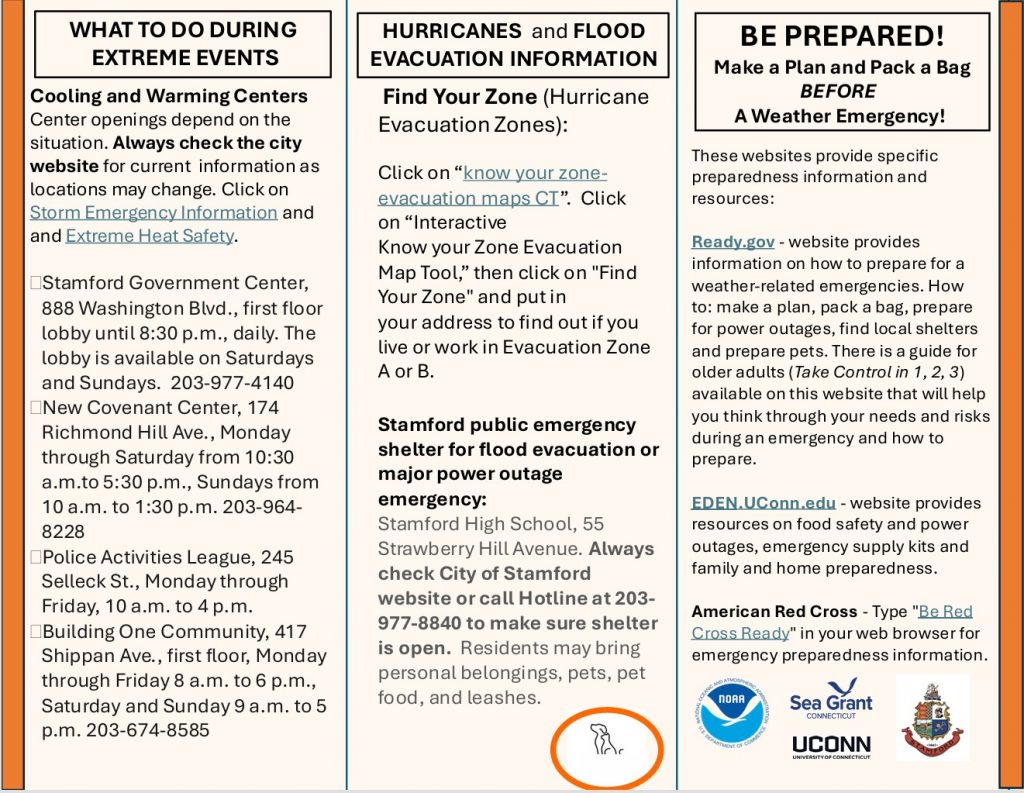
“The first step was putting together brochures, printed brochures and online brochures that were also made available in Spanish, which was another need that we heard, having things in multiple languages,” says Barrett.
Those brochures were produced with town-specific information for each of the three communities – numbers to call, important locations for heating and cooling locations, and how to sign up for emergency alerts.
“We tried to put all that together in a format where somebody could put it in a drawer and pull it out when they needed it,” Barrett says.
For the next resource, the team engaged undergraduate students in Climate Corps, an academic program at UConn focused on service learning and workforce development related to climate change adaptation at the community level.
Three Climate Corps students joined the project to develop a series of scripts for informational videos that can be used in online outreach efforts and could also be shared with stakeholders to help teach older adults about various emergency preparedness topics.
“We wanted to help build resilience in the event of a weather-related disaster, especially because climate change has increased these phenomena greatly,” says Kris Watson ’27 (CLAS), an environmental science major. “And we do find that elderly populations may not have quite as much access to this sort of knowledge, which is very important.”
“Our main goal was to help close that emergency preparedness gap that does exist,” says Willa Glass ’27 (CLAS), a marine science and environmental science major. “We really tried to make the content accessible and easy to understand and friendly so that they can be effective and make a positive impact on these target communities.”
The trio worked on topics like, how do you sign up for an emergency alert? When should you call 9-1-1 versus 2-1-1? What to do in the first 24 hours of a power outage. How to deal with a snow emergency. What’s a stay bin and a go bag? When do you stay, and when is it time to leave? What do you need for your pets?
“We all know that coastal Connecticut faces many climate hazards each year,” says Ella DiNardi ’27 (CAHNR), an environmental science major, “some things being increased precipitation, sea level rise. I’m sure we’re all aware of flooding, heat stress, and power outages. So, we wanted to make sure that all of our topics covered a wide range.”
They relied on research and trusted sources, like the American Red Cross and the Federal Emergency Management Agency, as they wrote their scripts, and kept the needs of the communities in mind with their planning.
“We really wanted to respect the needs of our audience, which are the elderly residents of coastal communities,” Watson says. “So, in order to make them more accessible, we chose to incorporate some accommodations for auditory needs. We spoke slowly, and we used very common language. We included Spanish subtitles, which were very kindly translated by a student here.”
They then worked with a student in the Department of Communication to record their scripts and begin to actually produce the videos, a process Barrett said will continue through the summer until the videos are ready for distribution.
Solutions and Interventions
The final resources that the team has launched are the two-part in-person workshops in the three shoreline communities, which will continue through June.
For those sessions, the team has relied on the expertise of UConn Extension and its educators, who live and work in communities statewide and offer research-based information to improve lives and strengthen the state, to engage and present a comprehensive overview of emergency preparedness tips and resources for area seniors.
“We know through research that older populations are vulnerable,” says Faye Griffiths-Smith, an extension educator involved with the project. “We had a strong interest in working with older populations to try to share information with them about the many important reasons they might want to evacuate, or things that they could do to be better prepared should they end up staying home.”
Each of the three Extension educators on the project brought a different area of expertise to the team. Griffiths-Smith focuses on financial preparedness – things like insurance and emergency funds – and Welch on disaster preparedness education.
Heather Peracchio is a nutrition educator, an area that becomes critically important when considering hydration, food safety, kitchen hygiene, and spoilage and contamination issues that can arise during extended power outages at home.
The first session in West Haven was led by Griffiths-Smith, who went over everything from understanding risks based on the town where they live to signing up for alerts to building those go bags and stay bins.
“From the listening sessions and roundtables, we know that people were not as prepared as we thought they might be,” says Peracchio, “so they really needed some of those practical tips. They also shared that they wanted contact lists, they wanted to know who to call and when to call, and they didn’t have basic necessities like flashlights. And so, that’s what we based a lot of the education around – the importance of having those things readily available.”
At the first session in West Haven, they also gave out new flashlights to each of the participants in attendance, and the reception to that seemingly simple item took Barrett, who was in the audience for the workshop, by surprise.
“We gave them flashlights with batteries, whistles, mylar blankets, and at the next workshop, they’re going to be getting a zippered waterproof document file where they can put critical papers in the event that they have to evacuate,” Barrett says. “And the reaction to being given a flashlight with batteries was incredible, because they were so grateful to get these supplies.”
While the grant for the project ends in September, Barrett said she’s heard from other municipalities interested in working with them to produce resources for their community’s older populations.
The team is seeking funding sources to help them continue their work – and as climate change continues to impact Connecticut in new and different ways, it’s work that will stay relevant to all of them in each of their respective areas of research and outreach for some time.
Across the board, team members said that working together across disciplines – something UConn as an institution encourages, some noted – not only helped in accomplishing their mission, but also helped them learn from each other in the process.
“One thing that I really appreciate about UConn, having worked at two other institutions before I came here, is that I think as an institution, UConn takes that very seriously and provides these mechanisms for connecting with other researchers in other disciplines and coming up with solutions and interventions that really help the people of the state of Connecticut,” Lachlan says.
“And I don’t feel very siloed in my department as a researcher who feels as though he needs to compete with other social science units. I feel free to collaborate with them and to address different questions from different angles. And I wouldn’t say that it’s rare, but not every institution has that philosophy or approaches things that way.”
UConn Extension provides easy access to significant research-based emergency preparedness information and resources for Connecticut municipalities, residents, and farms through its Extension Disaster Education Network, or EDEN. For more information, visit eden.uconn.edu.