Earlier this year, there was a flurry of reports about CDC data showing increased ER visits for tick bites.
In April, the Connecticut Agricultural Experiment Station reported that they were seeing more ticks submitted by the community for testing than they usually do at that time of year, likely due to warmer, wetter weather creating ideal conditions for ticks to breed.
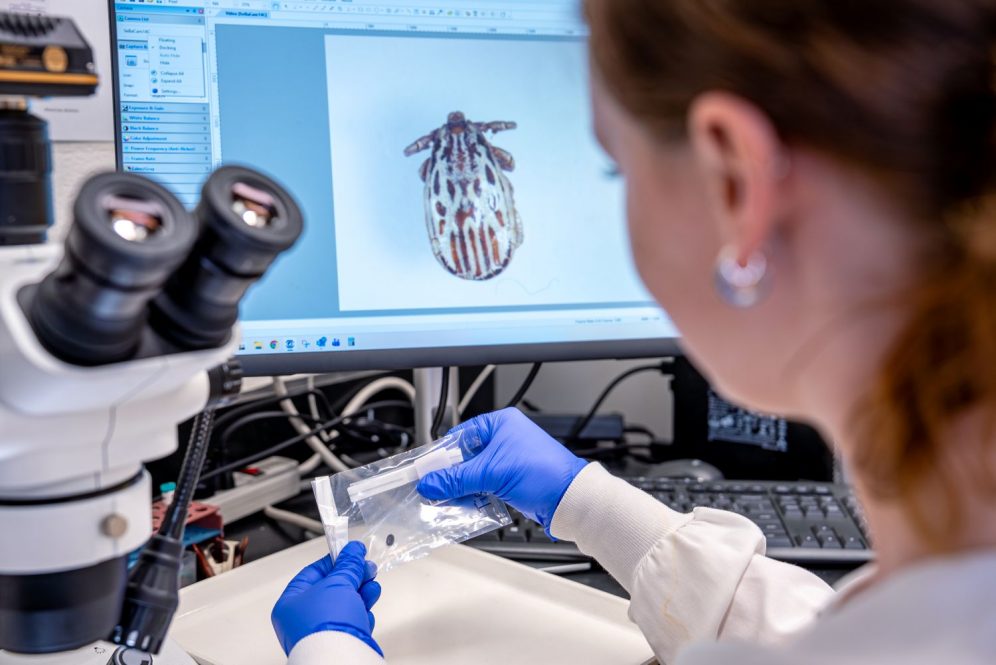
The Connecticut Veterinary Medical Diagnostic Laboratory (CVMDL) in the College of Agriculture, Health and Natural Resources (CAHNR), which offers testing services for ticks sent into the lab, has not seen a similar spike.
Last year, the lab identified 391 ticks total. Approximately 25% of deer ticks tested positive for Borrelia burgdorferi, the pathogen that causes Lyme disease. Maureen Sims, CVMDL laboratory technician, says these numbers are currently expected to be about the same this year.
“One thing we like to point out is that our data is somewhat biased,” Sims says. “We’re not going out and actively collecting ticks ourselves. It depends on what people submit to us.”
This matches what Tom Worthley, UConn Extension professor of forest sustainability, says he has been seeing in the field (and woods).
“I haven’t seen a tremendous amount more,” Worthley says. “What I have observed is that when I’m in the field with students or I’m in the field with groups or I’m in the field by myself, somebody, not everybody, but somebody always finds a tick on them.”
Most of the samples the CVMDL receives come from Connecticut and elsewhere in New England. Sims says most ticks are ones people find on themselves, with a smaller portion having been attached to dogs, and very rarely, other animals.
The most common tick the CVMDL identifies is the deer tick, followed by dog ticks. They have also received lone star tick submissions for over 15 years. Lone star ticks are the most common carrier of a sugar molecule called alpha-gal. In some hosts, this can lead to an immune response that causes an allergic reaction to red meat. New evidence has shown that alpha-gal transmission can be associated with other species of ticks too.
“Each year, the lone star ticks have increased,” says Zeinab Helal, CVMDL research associate. “There’s been a gradual increase every year for the submission of lone star ticks.”
The CVMDL has also seen an increasing number of Asian longhorned ticks from areas near the New York border.
CVMDL has identified ticks testing positive for carrying Borrelia burgdorferi, Anaplasma, Ehrlichia and Borrelia lonestari infections. Borrelia burgdorferi is the most common pathogen by far.
“We’re testing for the bacteria that causes Lyme disease, we’re not actually testing for Lyme disease,” Sims says. “Lyme disease is a condition that’s caused by infection and is only diagnosed by a healthcare professional.”
Ticks prefer warm, wet conditions. During periods of drought, ticks are less active, Worthley says.
“They will hide out in the ground, or near the ground, and wait for more moderate and more humid conditions to take place when they come out. They’ll forage or exhibit what is called ‘questing behavior,’” Worthley says. “They climb up on a tall stalk of grass or a branch of some shrub and hang out at the very tip of it waiting for some warm-blooded creature to walk by that they can grab onto.”
While ticks are attracted to warm blood, bug spray can disrupt their ability to actually latch onto you.
“They’re attracted to you by those means, but their final decision about whether to take the bite comes from sensers in their feet that let them know they’re on a surface where there’s blood right below,” Worthley says. “Repellents keep them from biting you because they’ll be attracted to the blood smell, and when they touch your skin and that material is there, their feet will say ‘uh uh, you don’t want to touch this,’ so it will keep them from choosing to bite.”
If you are spending time outdoors, UConn’s experts say to be sure to do a tick check afterwards. While outside, using bug spray and wearing long, light-colored clothes, including tucking wide pant legs into your socks, can help keep ticks away. Those spending extended time outdoors can also treat their clothes with a chemical called permethrin that is toxic to ticks.
“Don’t let the ticks keep you from enjoying the outdoors,” Worthley says. “Just be aware and be diligent about doing the tick check at the end of the day.”
This work relates to CAHNR’s Strategic Vision area focused on Enhancing Health and Well-Being Locally, Nationally, and Globally.
Follow UConn CAHNR on social media