Connecticut leaders from government, academia, and industry believe the state is well positioned to capitalize on the artificial intelligence revolution. To fully maximize AI’s capabilities, collaboration is key, with education as a catalyst to preparing the workforce for evolving skills.
Hundreds of people gathered at Rentschler Field in East Hartford on Thursday, Nov. 19, as UConn held its annual Economic Impact forum. Entitled “Powering the AI Economy for Connecticut Towns,” the event explored how Connecticut’s established strengths support continued growth and the respective roles that each sector of the economy must be prepared to play.
It was the third consecutive year for the forum, held in Storrs in 2024 and Stamford and 2025. UConn’s annual economic impact to Connecticut has grown to $13 billion, supporting 60,000 jobs and returning $19 for every dollar the State invests in the University, according to Reka Wrynn, UConn’s associate vice president for budget, planning, and institutional research.
UConn President Radenka Maric said that for AI to be successful in Connecticut, the state must break through the various silos that obstruct collaboration.
“It is not only what technology can do for us, it is how we enhance our collaboration,” said Maric. “Today’s meeting is truly about you having time to hear from each other, thinking what we can do together, thinking what are those competitive research ideas that you have and cannot solve alone.”

The forum marked Maric’s first public remarks since the UConn Board of Trustees announced plans to extend her presidency. Lt. Gov. Susan Bysiewicz led a standing ovation, saying that she joined Gov. Lamont in excitement that Maric will continue her tenure.
In her remarks, Bysiewicz addressed Connecticut’s modern “industrial revolution,” with an economic transformation as business adapts to AI, quantum computing, biotech, and advanced manufacturing. The state is well-positioned to succeed, with a proven legacy of companies, educational network, and governmental infrastructure to meet challenges.
“We want innovation to happen in every sector of out economy, which brings us to artificial intelligence,” Bysiewicz said. “I believe our state has a distinct advantage. We don’t need to build an economy around AI from scratch. We already can apply AI to industries that already have tremendous expertise and global competitiveness. Our strategy should be to help companies of all sizes understand how to use these technologies and to help them grow their businesses.”
Bysiewicz continued that the state needs to make innovation an engine of broad-based economic opportunity, which is where the flagship university comes into the picture.
“UConn is one of our state’s most important economic assets,” Bysiewicz said. “It educates our engineers, our scientists, our entrepreneurs, our healthcare professionals, and our business leaders that will shape our future. It conducts research that advances knowledge and creates new technologies, and increasingly, it’s helping us to translate those discoveries into business opportunities that benefit Connecticut and our country.”
The timing of the forum coincided with a Wall Street IPO that underlines the impact of AI and its growing value on the economy. Anthropic, the company that created AI platform Claude, went public on Thursday, closing at $97.17 a share for an evaluation of about $1.76 trillion, factoring in traded shared and restricted shares and stock options. According to the Wall Street Journal, it was largest IPO in history.
David Bergman, the associate dean for faculty and research for the School of Business and special advisor for AI to the provost, said the forum’s timing was appropriate given Anthropic’s record-setting IPO.
“It’s pretty amazing and an indication of just how important it is to educate our students and workforce on artificial intelligence,” Bergman said. “It’s not going anywhere, and we’re really going to lean in and make sure we’re all skilled and ready for the future.”
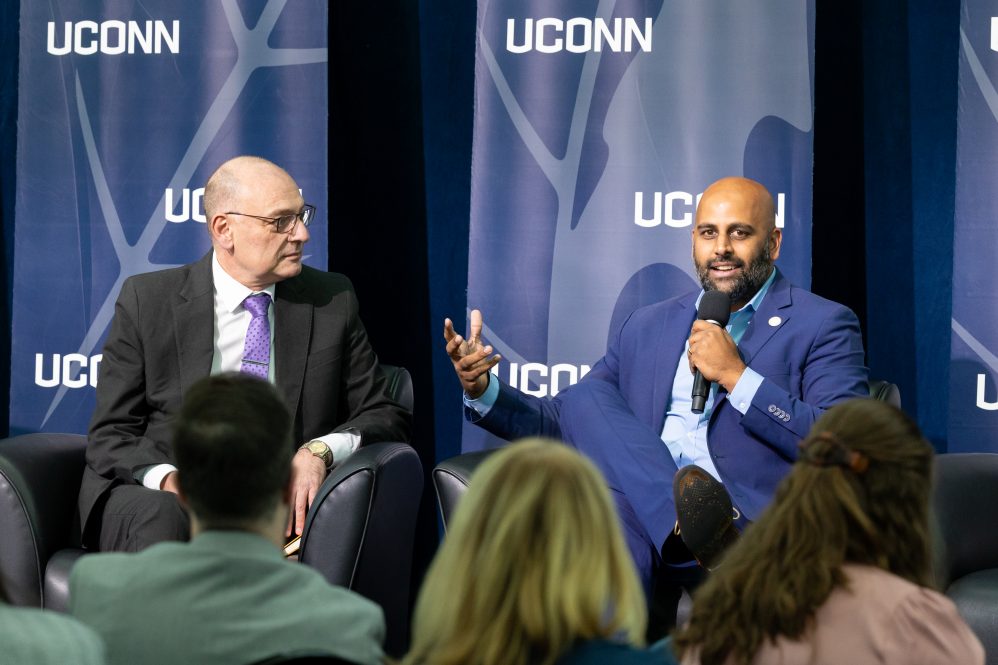
Cities like Hartford are seizing upon AI and the emerging talent and brilliance of its students. In a conversation with UConn Provost Pamir Alpay, Hartford Mayor Arunan Arulampalam explained how the capital has built opportunities out of what already was in place – seeking not to create a new “Silicon Valley or Cambridge,” but to work with a set of hiring institutions that rivals any city in the country.
“But most importantly, how do we make sure these kids coming out of these higher ed institutions are as prepared for the technological changes and world of tomorrow as any kids coming out of any institutions anywhere in America, and how do we get them to stay in Hartford?” said Arulampalam. “If we can solve that problem, then we will be way ahead of this technology wave from every other city in every other region looking at it.”
The mayor continued that the city is seeking to foster opportunities to work with employers and colleges to create hands-on opportunities to help students hone skills and gain a technological edge. “This might sound audacious, but our goal is to have a workforce that is among the most prepared for the technology of tomorrow of any workforce in America,” Arulampalam said.

Lindsay DiStefano, UConn’s vice president for research, innovation, and entrepreneurship, highlighted how the University’s research efforts benefitted individual communities. Illustrated through the Grant Trails heat map, which demonstrates research impact town-by-town through Connecticut, UConn’s research investment bears significant return for state municipalities.
Specific to AI, DiStefano lauded UConn’s first-ever Genesis Award. The program is federally funded by the Department of Energy to double the country’s scientific productivity by funding AI-related research projects to accelerate breakthroughs in energy, discovery, and national security.
Assistant Professor Wei Ren of the College of Agriculture, Health, and Natural Resources, led the UConn proposal that earned a highly competitive Genesis Award. The DOE granted $525,000 for a project that uses AI to allow study how water and other fluids move underground.
“Our winner is coming from one of the areas so vital to the mission a land grant university and the state, looking at using AI to create a digital twin help us better understand exactly what’s in out our water,” DiStefano said. “These are things that are impossible to do with normal technology and are really making a true impact.”
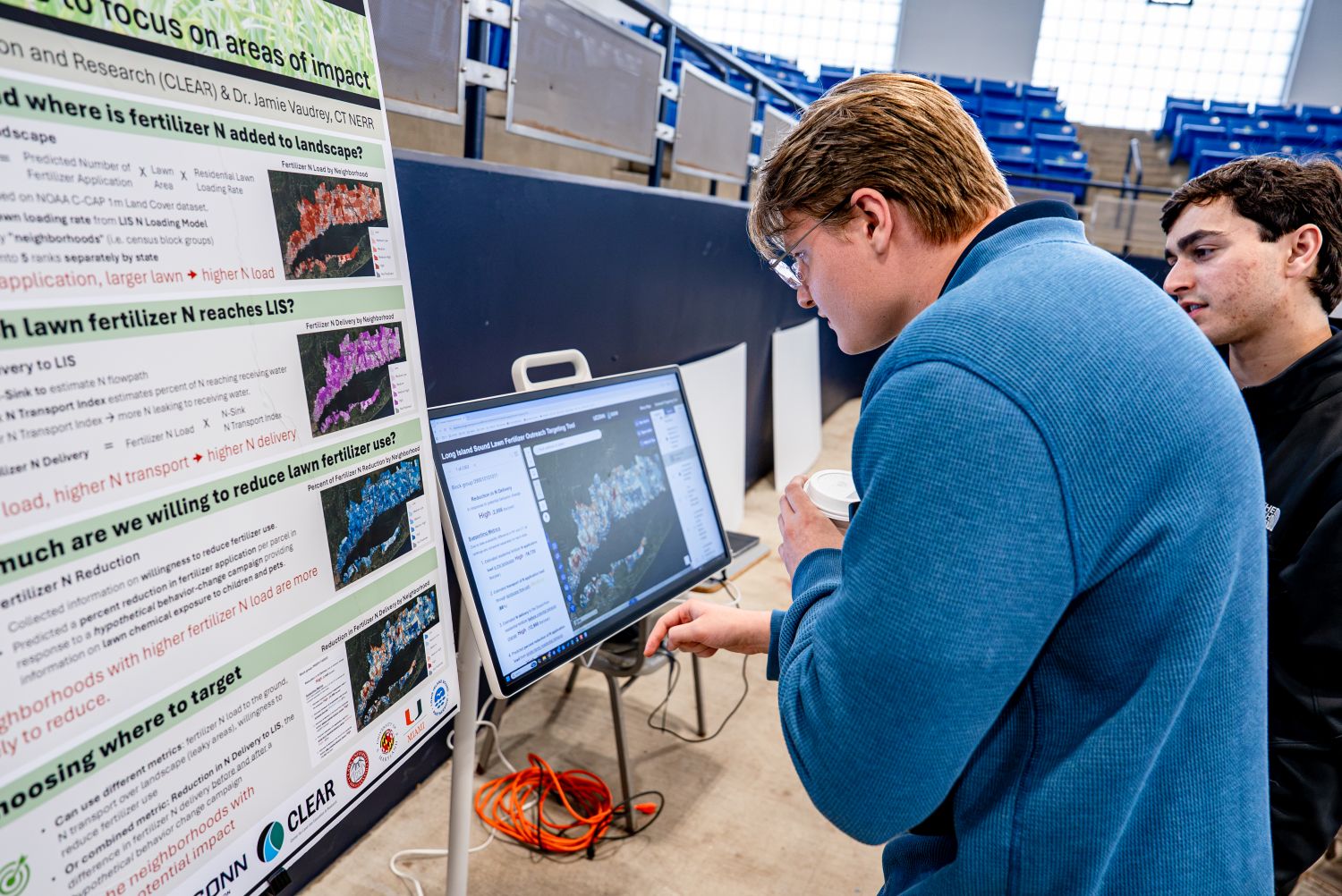
The forum also included expert panels on how UConn is teaching responsible use of AI to students and building successful partnerships with organizations throughout the region. Several students presented individual research topics, highlighting their expertise in topics like crumbling foundations in Connecticut, weight stigma in social media, and inventions.