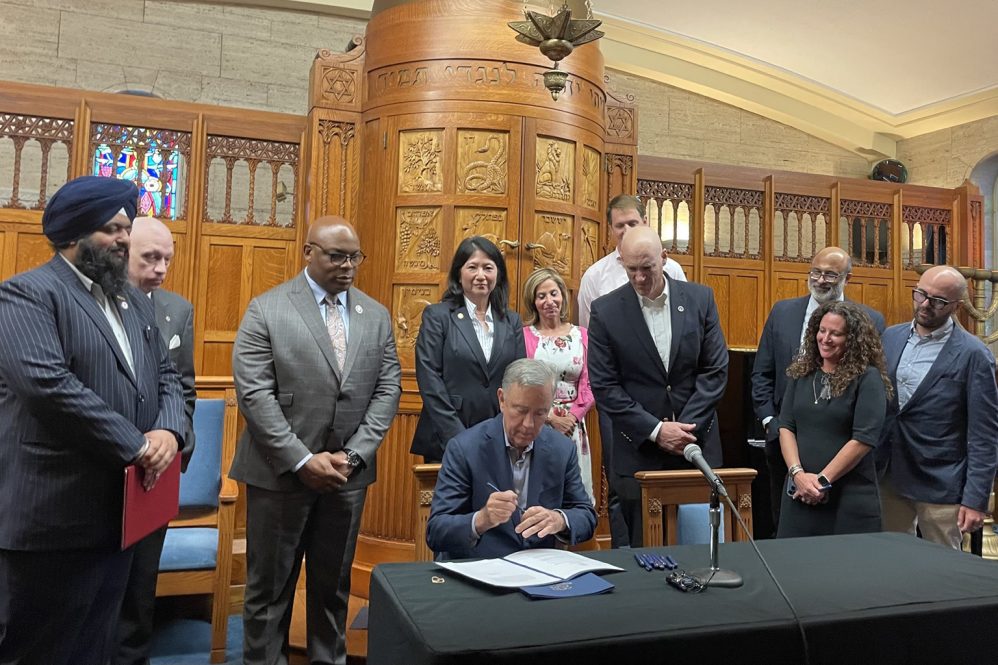
UConn Law Professor Sachin S. Pandya helped shape Connecticut’s new hate crime law, signed by Governor Ned Lamont on June 8.
Pandya helped draft the model bill that formed the basis of the legislation, which consolidates and revises the state’s hate crime laws. Over time, those laws had become difficult to find, inconsistent in their requirements and who they protected, and harder to enforce.
Working with Connecticut’s Hate Crimes Advisory Council, Pandya and then-UConn Law Professor Richard Wilson gathered input from prosecutors, defense attorneys, civil rights lawyers, and others to refine the proposal, which the Council then recommended to lawmakers. Pandya then advised the Governor’s office and testified before the Judiciary Committee on two bills based on that proposal.
In announcing the legislation’s passage, the Council highlighted UConn Law’s role.
“We are grateful for the support of the University of Connecticut School of Law, Professors Sachin Pandya and Richard Wilson … who helped foster this collaborative achievement that exemplifies the finest traditions of legal academy in service to the public good, directly contributing to a safer, more inclusive, and more just Connecticut,” said Amy Lin Meyerson ’94, co-chairperson of the Council.
Pandya spoke at the signing ceremony.
“This law is just a first step,” he said. “The law on the books is still far from perfect. And if it takes a village to make a good law, it takes even a bigger village—a whole state even—to make that law work for real. It takes . . . everyone working together to make clear that threats and violence, big or small, motivated by someone’s race, religion, sexual orientation, gender identity, or [an]other socially protected category — they’re not just wrong. They’re crimes. They’re hate crimes. And we will not tolerate that here.”
The legislation is part of a broader effort to detect, deter, and address hate crimes and bias incidents in Connecticut. Alongside the new law, the Council has launched a statewide reporting campaign supported by UConn’s Institute for Municipal and Regional Policy, including an online tool (reporthate.ct.gov) designed to make it easier for individuals to report bias incidents.