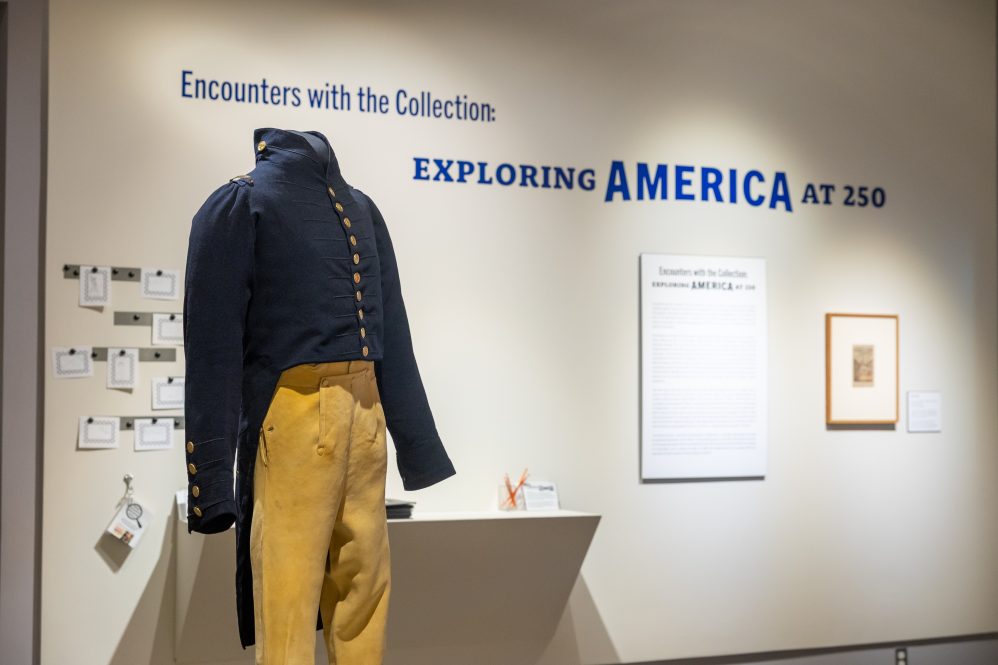
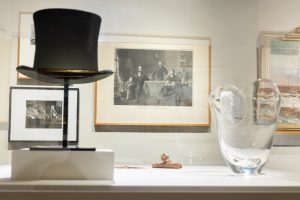
Amanda Douberley answers in the affirmative when asked whether she ever thought she’d curate an art exhibition that includes a military uniform from the War of 1812, a couple rolls of shiny pennies, and a pop art suite of prints from Robert Indiana.
“That’s what the exhibitions in this gallery are really about, trying to find ways to bring together pieces that would seem to be as different as possible,” says Douberley, curator and academic liaison at the William Benton Museum of Art.
So then, what could possibly bind together a picture of Abraham Lincoln and his family, the photograph “La Conquistadora (Our Lady of Peace) at the Trinity Nuclear Test Site Near Socorro, New Mexico,” and a portrait of Marilyn Monroe?
Simple, Douberley says: “The America 250 celebration seemed like a perfect opportunity for the Benton to show off our collection of American art, which is one of the strengths of the collection.”
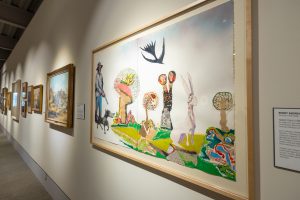
Chock-a-block with photographs, paintings, sculpture, and other media, “Encounters with the Collection: Exploring America at 250” ponders such quintessential themes of the American dream, East meets West, civil rights, and urban renewal.
“We went through lots of ways to organize the exhibition and realized we needed different points of access for people, so we went broad and decided to think about what the word ‘America’ can mean,” Douberley says. “America is a place, an identity, and an idea.”
Places, People, and Dreams
Douberley has put on display such iconic locations as Yosemite National Park in an Ansel Adams photograph and the Blue Ridge Mountains in a William Louis Sonntag painting, alongside Martin Johnson Heade’s “Rye Beach, New Hampshire,” painted just before the Civil War.
Many New England vacationers might recognize the horseshoe-shaped beach, but the sketch’s focus is the burst of red sky off in the distance: “What you think of this painting has a lot to do with what you think is going on in the sky. Is it a sunrise? Is it a sunset? Is there a fire? Any of those things could be true, and there’s no indication in the title,” Douberley says.
The neighboring piece, “Louisiana,” blends the themes of place and identity, as artist Sarah Sense quite literally weaves pictures of Sitting Bull, Buffalo Bill Cody, and Marilyn Monroe together into a paper tapestry.
Douberley says “Louisiana,” the newest addition to the Benton’s collection, represents two sides of Sense’s identity, the Native American Chitimacha and Choctaw side and the nonindigenous side. Kind of a “cowboy and Indians” mash up, the wall tag reads.
“When I’ve talked to groups about this image, we talk about how weaving the images together actually makes it harder to see them, and it’s harder to tell what’s here. Maybe that says something to you about history, identity, and our place within this story – that it’s complicated,” Douberley says.
As visitors have come through the exhibition, which has been open since last summer and closes Aug. 2, she adds that she’s seen people gravitate to the other side of the room toward Jack Levine’s painting “The Political Arena.”
The canvas depicts two men in a fight, presumably a boxing or wrestling match, with a throng of onlookers ringside. On the walls above their heads, signs read: “Kansas,” “Nevada,” and “Idaho.”
It’s meant to bring on lots of questions, Douberley says. What are the signs? Is this a sporting event? Could this be a political convention? There are no answers in the exhibition, although one might deduce their own if they know Levine’s art is famous for his political and social commentaries.
A hand-colored lithograph of Pocahontas also has drawn attention, Douberley says, if only for the replica 1616 engraving that’s printed on the wall label. It’s the only surviving image of her, and the lithograph and engraving look nothing alike.
“And then there’s ‘Path of the Axe,’” Douberley says of the winter landscape from Albertus Eugene Jones that depicts a clearcut forest. “I’ve had really great conversations with students about this one. There was one student who told me they liked it because you don’t see the axe, and how something not even in the painting could change the landscape and make such a big impact.”
Douberley says she used as her inspiration for the exhibition a set of five prints from artist Indiana, who’s best known for his pop art “Love” image with the famously slated O. The Benton owns “Demuth American Dream No. 5” but has never displayed together all five silkscreens.
In the lead up to the exhibition over the last few years, Douberley says she took notice of various news stories about the American dream, whether it still exists and whether it’s achievable.
“Being on a university campus, centering this idea of the American dream made a lot of sense for the exhibition. The American dream, of course, has its own history and is something that gets reformulated and rethought by different generations,” she says.
What’s American?
Though this exhibition closes in about a month, the Benton will continue to mark the semiquincentennial in its next show, “Encounters with the Collection: Reframing America at 250.”
Its theme comes from a conversation Douberley says she had with a visitor to “Exploring America at 250” who asked her about photographer Tseng Kwong Chi, with his “Niagara Falls, NY” on display, and what made him an American artist if he was born in Hong Kong.
Douberley says she couldn’t answer whether he was a naturalized citizen or had a green card. Turns out, he was Canadian.
“It made me reflect on how American artists are claimed as much as they are born,” she says. “He is characterized in our collection as ‘American’ and some of that has to do with the fact he’s best known for taking America as his subject – and that characterization is common in the art world. But it made me think about other instances, other stories in our collection that might question and expand what we consider American art.”
She says a person’s nationality is a basic way that museums categorize artists. When someone is added to a database, their nationality automatically gets added. But for many artists, especially contemporary ones, a single – or even two – nationalities might not be fully descriptive.
“This is the launch point for the next America 250 exhibition,” she says.
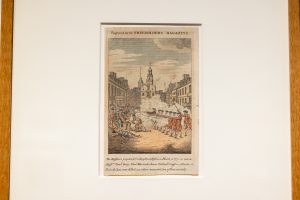
It’ll include a painting from Benjamin West, an 18th century artist who spent most of his career in England painting for King George: “He’s always considered an American artist, but you could just as easily say he’s a British artist,” she says.
Work from Dutch American abstract expressionist Willem de Kooning also will be on display, along with Native American artists such as Natalie Ball, whose work comes courtesy of the Art Bridges Foundation, which through museum partnerships and other efforts seeks to put American art on display.
“Our focus with these exhibitions has been on giving people opportunities to find their own way into American art and decide what celebrating the 250th means to them,” Douberley says. “The heart of our democracy is asking questions and doing that relative to art is a way to celebrate.”
“Encounters with the Collection: Exploring America at 250” will be on display at the William Benton Museum of Art until Aug. 2. “Encounters with the Collection: Reframing America at 250” will open Sept. 1 and run until Aug. 1, 2027. They are part of America 250 CT, administered by CT Humanities.