One fish.
Two fish.
Three fish.
The concept of counting a small number of objects is so simple, so fundamental, that we often take for granted what one, two, and three really mean when applied to the world.
Not just reading the words, or recognizing the numeric characters – 1, 2, and 3 – but understanding how those numbers apply to sets of things around us. How they answer the question, “How many?”
Understanding that the final number word said when counting a group of objects represents the total quantity of items in that set is a mathematical concept known as the cardinal principle, and it’s something that typically developing children usually grasp between the ages of 3½ and 5½.
“Kids learn to count, then they start understanding what the words mean, and then they understand this cardinal principle – that the last number word that you say, if you’ve followed all of the counting principles, is a property of the set,” says Marie Coppola, a professor of psychological sciences and linguistics in UConn’s College of Liberal Arts and Sciences who studies language acquisition and language creation as well as the relationship between language and cognition.
“It’s not like there’s something special about that last one that makes it seven,” Coppola says. “No, it’s the whole set that’s seven. It’s an abstraction, and it marks a real milestone in children’s number development.”
Achieving that milestone is a critical component in later mathematics proficiency.
But what if a child doesn’t know the word “one” to begin with, or doesn’t understand what “two” means when applied to a set?
That can be the case for children who are deaf and hard-of-hearing, where language acquisition that otherwise would begin in infancy oftentimes doesn’t begin until later in development.
Cascading Impact
Fewer than 10% of deaf and hard-of-hearing children are born in the United States to deaf parents who use American Sign Language, or ASL, meaning that very few acquire language at home starting at birth like most hearing children do.
Many parents are instead encouraged to pursue spoken language, assistive technologies, and speech therapies for their children, and Coppola notes that while some deaf children do acquire those spoken-language skills, a large number do not.
“Even though we know ASL is a natural language, there is this very, very strong idea – it’s millennia old – that speech is associated with intelligence and ability to learn,” says Coppola. “And that really persists even in the face of so much counterevidence.”
Researchers have reported that significant gaps exist between hearing and deaf and hard-of-hearing children in language development in early childhood. Even in high-income nations with strong infrastructure in special education, deaf and hard-of-hearing children lag about one year behind their hearing peers in mathematics.
The impact cascades through later educational experiences as well. Deaf and hard-of-hearing students score lower on standardized mathematics assessments conducted between ages 8 and 16, researchers have found. In 2017, 15.2% fewer deaf and hard-of hearing individuals earned bachelor’s degrees compared with hearing individuals.
But there isn’t any fundamental reason why deaf children can’t achieve proficiency at the same rate as hearing children, Coppola maintains, and researchers have been working to increase our understanding of why these differences exist and about the approaches that make greater proficiency possible.
“I’ve been very passionate about building an evidence base for the benefits of early access to language for deaf and hard-of-hearing children for a very long time,” Coppola says. “There has been more than 30 years of research showing that later access to language leads to less proficient language development. But that didn’t seem to be getting anyone’s attention.”
Hoping to capitalize on the growing popularity of STEM education and careers, Coppola wants that attention now, with novel research that focuses on the early access to language’s impact not on literacy – but on math.
How High Can They Count?
In 2016, Coppola received a National Science Foundation CAREER Program award to explore the hypothesis that access to language from birth, be it spoken English or ASL, would impact a child’s development of numeracy skills.
The findings from her team’s study were recently published in the Sept.1 issue of the journal Child Development.
To begin investigating the links between language and math proficiency, Coppola worked with specialized schools around the United States to recruit deaf and hard-of-hearing students between the ages of 3 and 7 years old, including those identified as having been exposed to ASL by at least one signing parent since birth, those exposed to spoken English since birth, and those who began acquiring either spoken English or ASL later in childhood.
“Honestly, that was the most difficult part of the study, because only one to two kids per thousand has a significant hearing loss around the time of birth,” Coppola says. “Of this small population, only 5% of them have deaf parents, so we focused on the schools that had a lot of native signing kids.”
She notes that the study would not have been possible without the collaboration of the participating programs.
Once participants were identified and agreed to participate, Coppola’s team began flying around the country to conduct assessments, focused mostly on how well the children had grasped the cardinal principle.
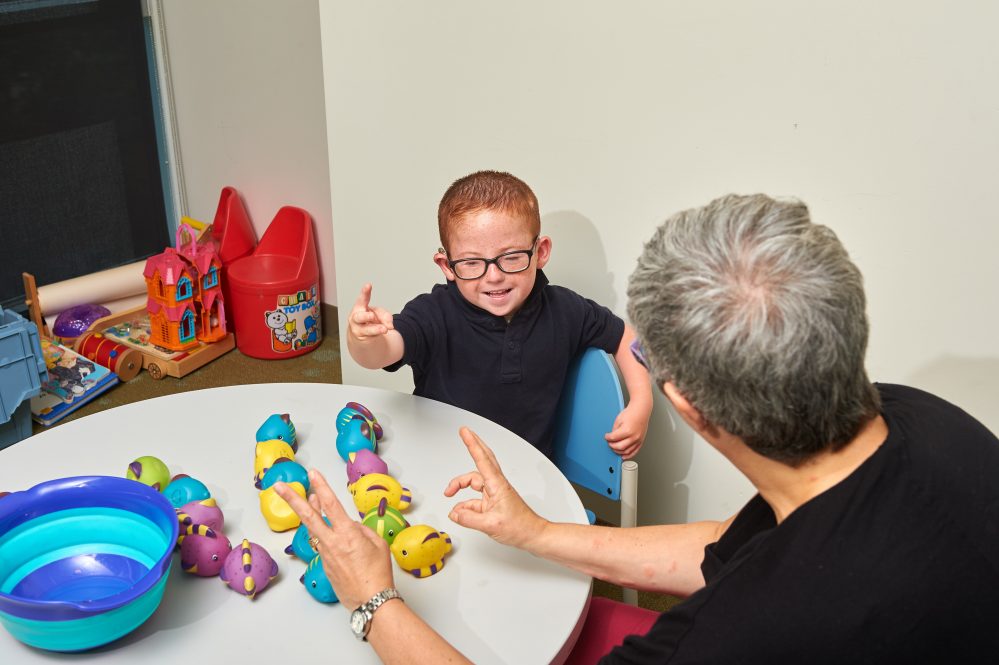
“The easiest thing is the counting – how high can they count?” Coppola explains. “We had two ways of getting them to count. One was just counting, without any objects. For the second condition, we gave them a board that had these very colorful fish and had them count the fish. If they could count up to 10, then we gave them another 10, and they’d count up to 20.”
The data collection process took years and was led by a team comprised of deaf and hearing research assistants who interacted with each of the 178 children included in the study.
“If you’re going to say that deaf kids are struggling with something, you want to give that kid the best opportunity to communicate what they know,” Coppola says. “And that means having a deaf person who’s a proficient signer and who is really good at interacting with deaf kids who may not have had all the language access that they should have had.”
Each child participant was evaluated on their grasp of number concepts, with researchers noting the highest number each child correctly counted without any mistakes, like skipping a number, saying number words out of order, or repeating numbers.
The children were also asked to create sets of specific quantities to assess how well they understood the meanings of the number words they knew, and whether they understood the cardinal principle.
Indistinguishable
What they found, Coppola says, was clear.
“If you compare hearing kids learning spoken English from their parents at home – the way that all hearing kids are – to deaf kids learning ASL from their parents at home, those kids are indistinguishable,” Coppola says. “They have totally comparable performance.”
The study also found that the children who had early access to spoken English or ASL at home performed better at the numbers tasks than children who were exposed at later points in their development, even when controlling for external factors, including socioeconomic status, or SES.
“If you pick any math development paper out of the literature, SES is a significant factor,” says Coppola, but it had no impact in this study.
The findings, Coppola notes, dovetail with research from Boston University that found deaf children of hearing parents demonstrated age-level vocabulary development when exposed to ASL by the time they were 6 months old.
“It turns out that, regardless of how old kids were when they started having good access to language, knowing how to count is really important for understanding the cardinal principle,” Coppola says. “This is not surprising, but it is the first really hard evidence that this is the case for both hearing kids and deaf kids.”
It turns out that regardless of how old kids were when they started having good access to language, knowing how to count is really important for understanding the cardinal principle. This is not surprising, but it is the first really hard evidence that this is the case for both hearing kids and deaf kids. — Marie Coppola, a professor of psychological sciences and linguistics in UConn’s College of Liberal Arts and Sciences
A Language of Academics
This study represents the first to systematically assess how the timing of access to language, the modality of language learned, and hearing status affect children’s acquisition of the cardinal principle and the ability to create sets larger than six.
The study demonstrated, the researchers note, that deafness itself does not impede numeracy development – underscoring the equivalence of early sign and spoken language in supporting number cognition.
The implications, according to Coppola, are broad, though her primary focus is on the people who would impact deaf and hard-of-hearing early learners the most: their parents.
“I designed this whole study and the whole proposal, the whole grant project, to be aimed at parents,” Coppola says. “If hearing parents have a deaf child, and they don’t know what to do, and they want their kid to succeed like a typically hearing child, well, here you go. Now you can see that kids who are exposed to ASL from early in life look like typically hearing children.”
Hearing parents can even be learning to sign right alongside their deaf children, Coppola notes, and research has shown that hearing parents can support age-appropriate development.
More broadly, Coppola hopes that the study will contribute to broader conversations and efforts to impact best-practice recommendations and early intervention methodologies for deaf and hard-of-hearing children – something she acknowledges will take time.
But as evidence-based literature like her study gain attention, and as Deaf culture becomes increasingly more visible through social media and popular culture, Coppola is hopeful that the work of members of the Deaf Community to shift the ways service providers and clinicians approach the needs of deaf and hard-of-hearing children will ultimately change.
And she’s energized to tackle the task herself.
“I want people to see that ASL is a language of academics,” Coppola says. “This is why I sign my talks if there’s some percentage of deaf people in the audience. It’s why I try to amplify the perspectives of deaf people whenever I can.
“Kids experience so many conditions and circumstances where the best intervention or approach is not obvious. It’s so clear in this case, and yet it’s still not happening after decades. So, I’m really very motivated to try and change this.”
This study was coauthored by Kristin Walker, department of psychology at Stony Brook University; Emily Carrigan, an independent researcher based in North Carolina; and Anna Shusterman, department of psychology at Barnard College of Columbia University.
It was supported U.S. National Science Foundation Grants 1553589, 0845966, 1420966, and 2010547; and by NSF National Research Fellowship Program Grant 2234683.