Land grant universities, like UConn, were established with the goal of broadening the scope of education to respond to societal needs and serve the public good. One of many stellar examples of this in practice at UConn is the Environment Corps (E-Corps), which demonstrates the powerful role land grant universities play in their home states.
E-Corps had its start about 10 years ago when an interdisciplinary group of UConn researchers and educators identified a need; with the growing list of issues Connecticut’s towns and municipalities are responsible for, many were falling behind on implementing projects to enhance sustainability or climate adaptation.
“Our research showed that there was a ‘capacity gap’ in Connecticut towns – they wanted to address environmental issues but lacked the technical knowledge and staff time to do it,” says Emeritus Extension Educator Chet Arnold. “We realized that our undergraduates could provide much-needed assistance to these towns if we developed a course structure that focused on the local aspects of these issues.”
So, in 2016 faculty from Extension and the Environmental Sciences, Environmental Studies, and Environmental Engineering programs got together to design a course, supported by a seed grant from the Office of the Provost.
Originally nicknamed Climate Corps, the new course served the dual purpose of partnering with towns to assist in bridging capacity gaps, while providing an innovative approach to educating and inspiring students. In 2019, the team collaborated with the Neag School of Education, Center for Excellence in Teaching and Learning (CETL), and the Provost’s Office on a $2.25 million-dollar National Science Foundation (NSF) grant to build on the success of the effort by developing two more courses based on the same model, Stormwater Corps and Brownfield Corps. The UConn E-Corps was born.
Over the next seven years, students and educators and communities collaborated on projects across the state that respond to community identified needs and make real world impacts. To date, E-Corps students have completed 237 projects with 134 unique partner organizations in Connecticut and neighboring states, including 70 of Connecticut’s 169 towns.
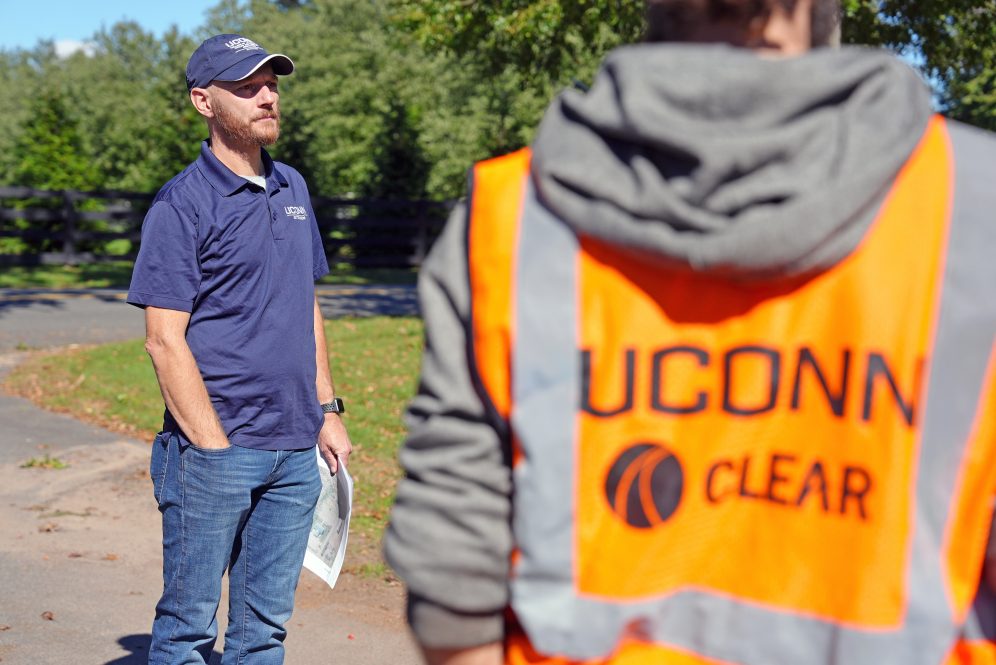
Students enrolled in the program spend one semester of team-taught active learning in the classroom, followed by an optional semester of hands-on service learning and fieldwork. Extension and other outreach-focused faculty bring their extensive experience in navigating the often-tricky municipal policymaking landscape to foster effective collaboration between students and local officials.
The topics of E-Corps projects typically focus on compiling information, examining scenarios, or employing tools that are unfamiliar to, beyond the capacity of, or too time-consuming for town staff.
Climate Corps projects include climate vulnerability assessments, public engagement campaigns, educational websites, and data collection for use in community applications to Federal Emergency Management Agency (FEMA) programs. Stormwater Corps projects identify opportunities for retrofitting existing development with “green stormwater infrastructure” such as rain gardens and pervious pavements, a task related to town compliance with state permitting requirements that can also provide information for inclusion in grant applications. Brownfields Corps projects include developing site reuse assessments, performing data gap analyses, creating brownfields inventories, developing community engagement materials, and compiling information to be used in grant applications to the state and to the Environmental Protection Agency (EPA); to date, these grant proposals that have resulted in over $16 million awarded to 20 towns.
Feedback from students participating in E-Corps is extremely positive, as the course has been instrumental in helping many of the participants decide on fields of further study or employment. Many students who participated in E-Corps have gone on to pursue environmentally focused graduate programs, as E-Corps has helped them realize the part of this field that is a good fit for them. The students also report gaining deeper insights into the numerous and nuanced elements surrounding environmental issues, the stakeholders, and skills needed to work successfully with stakeholders.
Their feedback says it all. When asked what they learned in the course one student responded: “This course was extremely educational, far more than a normal course. Having to go out for the site visits, analyze real locations, make a real, proper plan, those things really are very beneficial. Those are a way better way to learn about this sort of thing. This course honestly really shaped what I want to do for a proper career. It also showed me how, despite having good intentions, towns really do not know how to handle this sort of thing, so help is very much needed.”
Sharing the Success
The impact of the initiative on students and communities has generated interest in expansion to other disciplines at the University. Todd Campbell, professor in the Neag School of Education, and another principal investigator of E-Corps, explains that from the outset, the team wanted to share the success of the model to inspire others both at UConn and beyond to adapt this method of teaching. The program’s website catalogs useful information and resources for those interested in adapting and applying it.
“We see this pedagogical model as a win-win-win,” says Campbell. “The students get real workforce preparation and projects that they can put on their resumés, the towns get much-needed assistance that they can really use, and the University builds its reputation as a committed and valued partner at the local level. Studies done by our NSF-funded external evaluator confirm this.”
During this past semester, the model served as a springboard for the development of a new E-Corps course led by Eleanor Shoreman-Ouimet, assistant professor in the Department of Anthropology and associate director of the Institute of the Environment and Energy (IoEE). The new course, nicknamed the “Disaster Corps,” focuses on assisting communities in preparing and responding to weather related hazards and disasters.
As the impacts of a changing climate appear or intensify in unexpected ways throughout the state, from coastal flooding to wildland fires and more, it is increasingly clear that communities need assistance in preparing for the next big event.
Shoreman-Ouimet teaches Culture and Conservation, a service-learning course that takes a deep dive into theory and literature to explore how applied environmental anthropology can aid communities. After realizing the capacity gaps in Connecticut’s disaster management system, Shoreman-Ouimet joined the E-Corps team to further develop her conservation course using the E-Corps model, demonstrating its applicability to many different types of courses. Her interest provided an opportunity for the team to explore an adaptation to the E-Corps model that could unlock additional opportunities for expansion.
“Disaster Corps was an opportunity to see how the project-based approach could be adapted to a one-semester model, in this case, focused on how student learning and community engagement could support local emergency services personnel and offer solutions to community members,” says Shoreman-Ouimet.
Students involved in the Disaster Corps course provided valuable ideas and materials to their community partner while also expanding their professional skills and competencies.
Expanding the Initiative
The team is hoping the E-Corps success stories and adaptations like Shoreman-Ouimet’s one semester model might entice additional faculty to consider their own adaptation of the model and contribute to addressing pressing local issues like environmental resilience, climate adaptation, and community wellbeing.
“They’re a really wonderful group to work with, I am not surprised E-Corps has been so successful,” says Shoreman-Ouimet.
In the meantime, the core team is developing proposal ideas, both for NSF and other agencies, that focus on exploring additional adaptations to the model and increased support infrastructure at UConn.
“Now that we know the approach works, we are seeking ways to overcome resource and institutional barriers with an overall goal of expanding the program to reach more students and communities,” says Dave Dickson, Extension educator and director of the Center for Land Use Education and Research (CLEAR), who has taken over leadership of E-Corps.
“We need to work together to combine all the necessary information and expertise to make effective policy change,” says Shoreman-Ouimet. “We are a land grant university, we need to be working for the communities, that is our charge.”